# Gold Price Outlook Sharpens Ahead of Key U.S. Data This Week
Precious metals markets enter the new week with gold holding near elevated levels, but the direction of the gold price now hinges on a light yet important run of U.S. macro data. Investors are watching whether fresh signals on consumer spending, housing, jobs, business activity, and sentiment will push the Federal Reserve closer to easing or keep interest rates higher for longer.
Gold posted choppy but broadly positive price action over the past week as markets balanced weakening sentiment indicators against still-resilient hard economic data. Silver followed broader risk appetite and industrial-growth expectations, at times underperforming gold as recession concerns lingered.
Friday morning also brought a major geopolitical development: news that the Strait of Hormuz had fully reopened, provided the Israel-Lebanon and Iran-United States ceasefires continue to hold. That reopening improved market risk appetite, and both gold and silver rose strongly alongside a sharp rally in equities.
For Indian investors, the setup matters because U.S. data can quickly move XAUUSD, the U.S. dollar, Treasury yields, and in turn domestic bullion prices in rupees. Even if global gold holds firm in dollar terms, moves in USD/INR can amplify or reduce the impact on Indian gold rates.
What Is Driving Gold Prices Heading Into the New Week?
Gold prices are being driven by a mix of slowing-growth fears, sticky inflation concerns, recession hedging, and shifting expectations for Federal Reserve policy. That combination has kept bullion near high levels even as markets swing between risk-on and risk-off moods.
Recent trading has been volatile rather than one-directional. Investors have had to process weaker sentiment readings on one side and still-solid hard economic indicators on the other.
The reopening of the Strait of Hormuz added another layer to the outlook. With Middle East tensions easing for now, markets may shift attention back to economic fundamentals and the likely path of U.S. interest rates.
That matters for gold because lower growth and rising recession fears usually support safe-haven demand, while stronger data can lift bond yields and weigh on non-yielding assets such as bullion. In the coming week, the data calendar is relatively sparse, but each release could carry outsized importance.
How Could U.S. Retail Sales Affect Gold Price?
U.S. retail sales could move gold sharply because they offer an early read on the strength of the U.S. consumer. If the March report comes in stronger than expected on Tuesday morning, gold could face pressure as traders price in a higher-for-longer Federal Reserve.
Recent U.S. consumer data has been mixed but generally resilient. Even so, many analysts now expect some softening after surprisingly strong readings in prior releases.
For precious metals, the logic is straightforward. A stronger retail sales print would reinforce the view that the economy can tolerate elevated rates, which is typically negative for gold and silver. A weaker-than-expected number would likely support gold price and silver price by increasing expectations for policy easing.
For Indian bullion buyers, this is especially important because stronger U.S. retail data can also support the dollar. If both XAUUSD and USD/INR move at the same time, local gold prices per 10 grams may show sharper swings than international traders expect.
Why Are Pending Home Sales Important for Bullion Markets?
Pending home sales matter because they reveal stress in the interest-rate-sensitive U.S. housing sector. Weak March housing data would underline the drag from tight financial conditions, which is usually supportive for gold.
Analysts have pointed to ongoing strain in housing. Builders have reported difficulty pricing homes because of uncertainty around material costs, while the broader market continues to deal with rising costs and high interest rates.
If pending home sales disappoint, markets may interpret that as further evidence that restrictive policy is slowing the economy. That would tend to strengthen safe-haven demand for bullion and increase bets on eventual Federal Reserve easing.
For Indian investors, softer U.S. housing data can become a signal that global growth momentum is cooling. In that environment, gold often regains appeal as a portfolio hedge, especially when equity-market optimism begins to fade.
What Will Jobless Claims and PMI Tell Investors About Gold?
Weekly jobless claims and the Flash S&P Global Composite PMI will show whether the U.S. economy is losing momentum fast enough to support gold. A meaningful rise in claims or a downside PMI surprise would likely boost bullion.
How do weekly jobless claims matter for XAUUSD?
Thursday morning’s weekly jobless claims report is the only labor-market update on next week’s calendar. Analysts have described the current jobs backdrop as a "low-hire, low-fire" phase, with claims staying remarkably low by historical standards despite growing macro uncertainty.
That makes the release especially important. If claims rise meaningfully, traders may quickly shift toward a recession-hedging mindset, which would likely be positive for gold.
Why is the Flash S&P Global Composite PMI so important?
The Flash S&P Global Composite PMI for April is one of the market’s most closely watched real-time gauges of economic activity. Traders use it to assess whether weakness is spreading across manufacturing and services.
Economists have grown more cautious on the growth outlook. According to Gregory Daco, National Association for Business Economics, or NABE, survey participants warned that the outlook had "shifted quickly and meaningfully."
The same NABE survey also said that "the risks are skewed to the downside." That language matters because it suggests concern that economic momentum may be fading across the economy, not just in isolated sectors.
For gold, a weak PMI reading would likely reinforce safe-haven demand. It would also strengthen the case that the Federal Reserve may eventually need to support growth, a view that tends to underpin bullion prices.
Why Does Consumer Sentiment Matter for Gold and Silver?
Consumer sentiment matters because weak confidence can support gold even when hard economic data still looks solid. The final April reading of the University of Michigan consumer sentiment survey on Friday will therefore be a key signal for precious metals markets.
Sentiment has deteriorated sharply since the start of the Iran conflict. At the same time, inflation expectations have risen well above already pessimistic expectations, creating a difficult backdrop for policymakers.
White House economic adviser Jared Bernstein acknowledged this disconnect, saying policymakers face "an uphill battle trying to persuade the public they are doing better." That gap between official data and public confidence often matters for markets because it can foreshadow weaker spending and slower growth ahead.
For gold and silver, poor sentiment tends to highlight fragility in the economic outlook. Gold usually benefits more directly from that dynamic than silver because gold is the more established safe-haven asset, while silver is also tied closely to industrial demand.
What Should Indian Gold Investors Watch Next Week?
Indian gold investors should watch whether U.S. data points to slower growth, lower rate pressure, or renewed economic resilience. Those signals will shape XAUUSD, the dollar, bond yields, and ultimately domestic bullion prices.
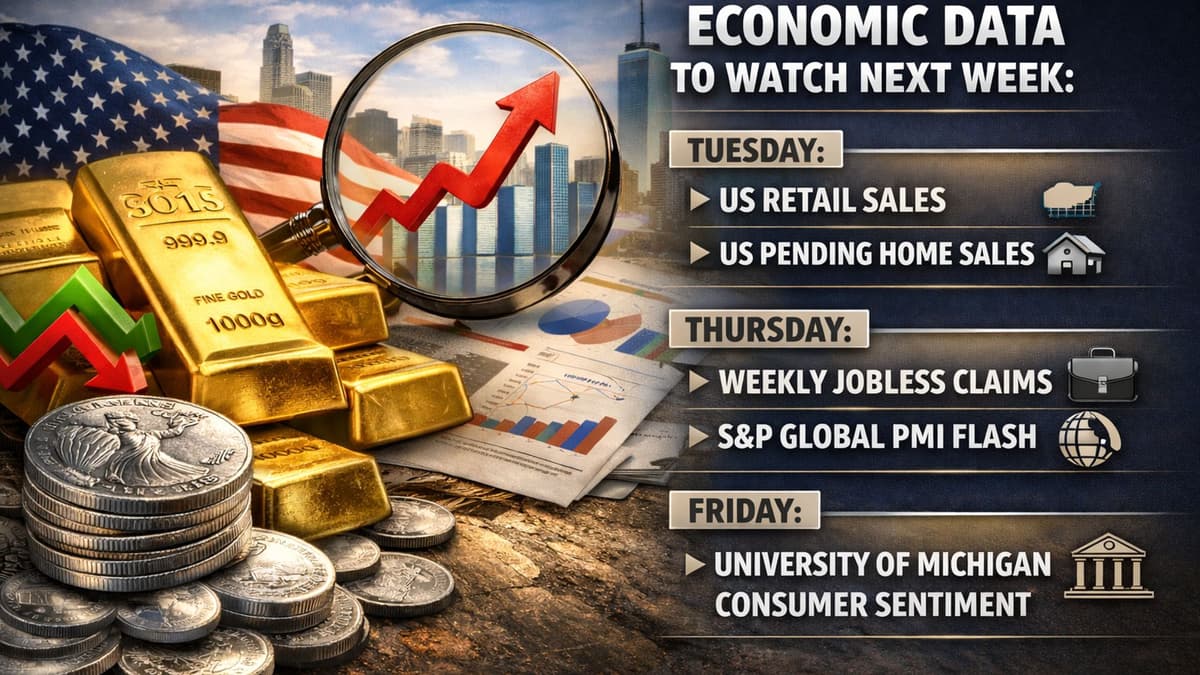
The key releases on the calendar are:
Tuesday
- U.S. Retail Sales
- U.S. Pending Home Sales
Thursday
- U.S. weekly jobless claims
- U.S. S&P Global Composite PMI Flash
Friday
- U.S. University of Michigan Consumer Sentiment Final