# Gold Price Outlook: MKS PAMP Sees $5,800 Record by December
Gold could still hit a fresh all-time high of $5,800 per troy ounce by December 2026, according to Nicky Shiels, head of research and metals strategy at MKS PAMP. Her view is that the Iran war has changed the market narrative but has not broken the long-term bull case for bullion.
For Indian investors, that matters because a sustained rise in global XAUUSD prices can keep domestic gold rates elevated even if rupee moves partly offset the rally. The same outlook also points to stronger medium-term upside in silver, while platinum is emerging as a breakout candidate among precious metals.
What is MKS PAMP forecasting for gold prices in 2026?
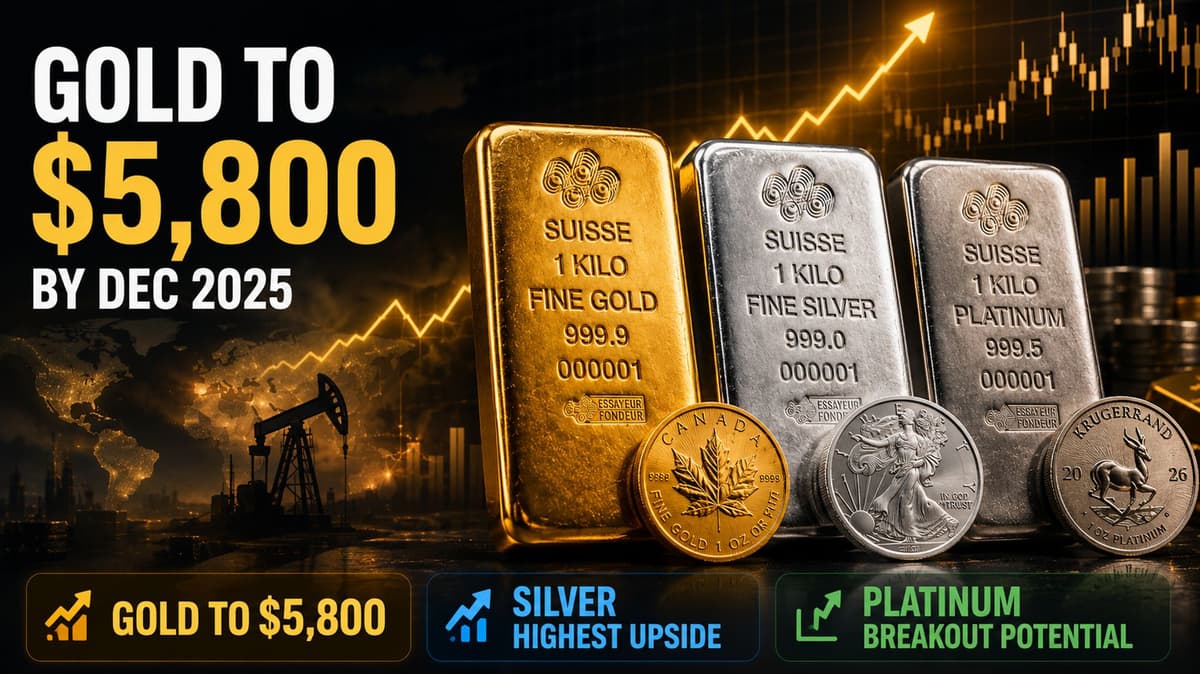
MKS PAMP expects gold to average $4,500/oz in 2026 and to reach a new higher all-time high of $5,800/oz in the second half of 2026. Shiels also said she expects gold to gain 30% in 2026.
Shiels said, “Gold is still expected to average $4,500/oz in 2026, with a new higher all-time high of $5,800/oz a fair target for the second half of the year.” That places the firm among the more bullish houses on the global gold price outlook.
She added that the current market is in a near-term consolidation phase, but the longer-term bullish structure remains intact. In her view, the key supports are fiscal dominance fears, longer-term U.S. dollar weakness, and persistent geopolitical risk.
For Indian bullion buyers, a move toward $5,800 per ounce globally would likely keep MCX gold and physical gold prices firm, especially if the Indian rupee weakens against the U.S. dollar. Even if INR stays stable, such a large XAUUSD rise would still be supportive for domestic rates.
How has the Iran war changed the gold price story?
The Iran war has reshaped gold’s short-term behavior, but it has not derailed the bullish case. Shiels said gold has shifted from a classic debasement trade to an inverse oil proxy during the conflict.
She said, “Gold has morphed from a debasement trade into an inverse oil proxy during the current conflict, and while that correlation has weakened recently, the stagflationary backdrop comes back into play.” In other words, oil-driven inflation risks and slower growth are now central to the gold narrative.
Shiels said gold prices below $5,000/oz are fair given current oil levels and softening physical demand into the summer, but she expects $5,000+ to be the range in 2H'26. That suggests a softer near-term band before a stronger move later in the year.
For India, the oil link is especially important. Higher crude prices can pressure India’s import bill, affect inflation expectations, and influence the rupee, all of which can feed into local gold prices.
Could gold really hit $10,000 by 2030?
Yes, Shiels said $10,000 per ounce by 2030 is unlikely, but possible. She described it as a tail scenario rather than a base case.
She said, “It’s theoretically possible, as real assets continue to debase higher.” But she also stressed that “a lot would have to happen for gold prices to reach five figures, including a substantial rotation from US institutional investors out of equities.”
What market-cap model supports $10,000 gold?
One of Shiels’ arguments uses gold’s value relative to the global stock market. She said gold’s global market cap, or the value of above-ground stocks, is around 20 per cent of the global stock market, while historically it can be 40 per cent.
Using that comparison, she said a return to that historical relationship would imply gold at $10,000/oz, assuming no drawdown in stock market value. This is one of the big-picture debasement and asset-allocation arguments now circulating in the bullion market.
What debt-based models imply even higher gold prices?
Shiels also compared U.S. gold holdings with U.S. government debt and foreign-held debt. These ratios produce even more dramatic theoretical price targets.
She said, “Today’s US Gold holdings backs only 3 per cent of US government debt; back in the previous wartime era, WWII, in which ~50 per cent of federal debt was Gold-backed; a mere 10 per cent of the US’ debt pile today equates to $15,000/oz.”
She added, “The value of the US’ Gold (81100 tonnes) is 14 per cent of all foreign-held US debt; the long-term average has been 50 per cent, which implies ~$18,000/oz.” She emphasized that this scenario “remains a tail, not the base case, but it’s not an unreasonable tail.”
For Indian investors, these long-range scenarios are not price targets to trade blindly. They are frameworks showing why many global strategists still see bullion as a core safe-haven and anti-debasement asset over a multi-year horizon.
Why does MKS PAMP see silver as having the highest upside?
Shiels said silver has the higher long-term upside than gold because of structural supply deficits and its leverage to a hard-asset bull market. However, she still sees gold as having the better outlook for 2026.
She said, “The January high above $120/oz can absolutely be revisited, but it’s contingent on gold making new all-time highs.” That means silver’s next major breakout likely depends on gold first extending its own rally.
Shiels also noted that silver is “nowhere near its inflation-adjusted highs of around $200/oz.” She referenced the period when gold took out its 1980 inflation-adjusted high of $3,600/oz in September 2025, saying silver would need several drivers to align at once.
Those drivers include retail investment, institutional investment, and industrial and physical flows all re-engaging simultaneously. If that happens, silver could outperform other precious metals on a percentage basis.
For Indian investors, silver often attracts traders looking for higher beta than gold. If the global silver price tightens on supply deficits while industrial demand stays resilient, domestic silver prices could become even more volatile than gold in rupee terms.
What is the bear case for silver right now?
The bear case is that recession or prolonged stagflation could damage industrial demand and keep silver stuck in a lower trading range. Shiels said the Iran war and oil shock have already created serious headwinds.
She called silver the “high-beta” precious metal because it sits between monetary/investment demand and industrial demand. According to Shiels, “Investment demand has softened while industrial demand faces macro pressure and fears over a growth slowdown.”
She warned that silver consumption is highly exposed to the economy. “The core bear case [revolves around] a recession or prolonged stagflationary environment that would hit industrial demand (which accounts for over half of silver consumption) hard, particularly if the green energy buildout slows,” she said.
In that scenario, the risk is that investment inflows will not be enough to offset weak industrial use. Shiels said that could leave silver trapped in the lower half of its range, $50–$70/oz.
Why does silver still appeal over the long run?
Despite those risks, Shiels still prefers silver for long-term upside. She said gold has stronger institutional support, more resilient central bank demand, clearer macro catalysts, and less exposure to industrial demand shocks.
But she added that silver remains well below its inflation-adjusted peak near $200/oz, while facing persistent structural supply deficits where supply is slow to respond. In her words, “once both retail and institutional investment flows re-engage simultaneously, the squeeze potential is significant.”
She summed up the thesis clearly: “Long-term, silver’s leverage to the hard-asset bull market is its biggest asset.” That makes silver particularly relevant for Indian investors with a higher risk appetite and a longer holding period.
Why does platinum have breakout potential while palladium lags?
Shiels said platinum is better positioned than palladium to break out of its range because it has stronger structural support. She pointed to multi-year supply deficits, rising hybrid vehicle demand, resilient industrial demand, steady jewellery demand, and a new investor base in China.
She said January’s move in both platinum and palladium reflected a real mix of catalysts rather than pure speculation. Those included physical tightness, tariff-driven trade re-ratings, supply disruption, especially Russian palladium redirected away from the US, and strategic stockpiling.
However, she said the market backdrop has since deteriorated. The oil shock, demand destruction fears, and auto sector uncertainty have all weighed on both platinum group metals.
Why is platinum stronger than palladium?
According to Shiels, platinum has “persistent multi-year deficits, growing hybrid autocatalyst demand, resilient industrial demand, steady jewellery demand, and a new investor base with the launch of futures contracts in China.” That combination gives platinum a broader support base.
By contrast, she said palladium is more policy-driven and heavily dependent on auto demand. That makes palladium more vulnerable if vehicle demand weakens or emissions policy support changes.
For India, platinum is also relevant because jewellery trends and auto-sector developments can influence investor interest. If Chinese futures deepen liquidity and global deficits persist, Indian investors may increasingly track platinum alongside gold and silver.
What should Indian investors watch next in gold, silver and platinum?
Indian investors should watch whether gold sustains the move toward $5,000+ in 2H'26, because that would strengthen the case for $5,800/oz and could trigger renewed momentum in silver. They should also track oil prices, U.S. dollar direction, geopolitical risks, physical demand trends, and signs of recession or stagflation.
For silver, the key question is whether industrial demand holds up while retail and institutional investment flows return. For platinum, the focus is on whether supply deficits, hybrid vehicle demand, and China-linked investor participation can overpower macro headwinds.
If Shiels’ outlook plays out, gold remains the anchor safe-haven trade, silver offers the strongest long-term upside, and platinum could become the next breakout story in the precious metals complex. For Indian bullion investors, the biggest watchpoint is whether global price strength coincides with rupee weakness, a mix that could amplify domestic gains sharply.