# Gold Price Outlook: Lombard Odier Sees $5,400 Return by H1 2027
Gold prices can still rally back to $5,400 per troy ounce within 12 months and by H1 2027, according to Kiran Kowshik, Global FX Strategist at Lombard Odier. The Swiss private bank argues that gold’s recent consolidation after the Iran war has not damaged the medium-term bullish case, provided central banks do not raise rates and passive fund flows do not collapse.
For Indian investors, that matters because a recovery in global XAUUSD prices could keep domestic bullion rates elevated even if the rupee remains stable. If the Indian rupee weakens against the U.S. dollar at the same time, local gold prices could rise even faster.
Why does Lombard Odier still expect gold prices to hit $5,400?
Lombard Odier still expects gold to reach $5,400/oz because it sees the recent drop as a temporary correction, not a structural reversal. Kowshik said the broader mix of central bank buying, private investor demand, fiscal uncertainty, and geopolitical fragmentation remains supportive for bullion.
Kowshik wrote that gold prices more than doubled in the year to January 2026, when bullion reached a record $5,595 per ounce. After that peak, gold fell in the wake of the Middle East conflict to a trough of $4,099/oz in mid-March, before most recently recovering to around $4,560/oz.
He noted that gold has fallen more than 10% since the conflict began. He also said this drawdown came with unusually high volatility compared with other major geopolitical episodes such as the Iranian Revolution in 1979, the first Gulf War, the second Gulf War, and Russia’s invasion of Ukraine.
What is Lombard Odier’s base case after the Iran war?
Lombard Odier’s base case is that the Middle East conflict de-escalates and energy prices fall. If that happens, Kowshik said gold could recover as earlier overcrowded investor positioning normalises.
He added that the Iran war is not the only driver of bullion prices. In his view, the broader macro backdrop remains as supportive now as it was before the conflict.
“The medium-term outlook is also determined by whether demand and the broader geopolitical and fundamental macroeconomic environment have changed,” Kowshik said. “Here, we do not see a shift and therefore remain constructive on gold, maintaining our 12-month price target of USD 5,400/oz, and our overweight allocation in portfolios.”
What drove gold prices lower after the Middle East conflict?
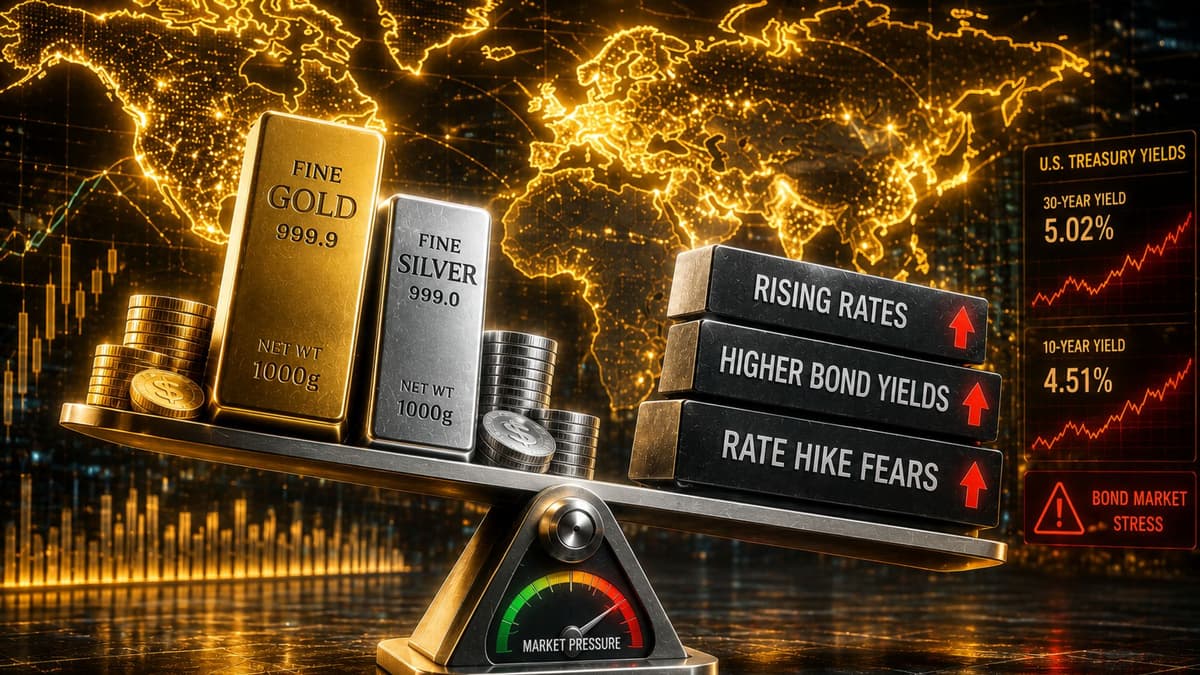
Gold prices fell because the market began pricing in inflation risk, higher real yields, and a stronger U.S. dollar after the energy shock. As a non-yielding asset, gold usually performs best when real yields fall and the dollar weakens, but an oil-driven inflation scare can reverse that setup.
Kowshik said crowded investor positioning at the start of the year also worsened the decline. When too many investors hold the same bullish trade, even a supportive long-term outlook can still lead to a sharp short-term correction.
How do energy prices, bond yields, and the U.S. dollar affect gold?
Gold has shown a strong negative relationship with rising energy prices in this episode, according to Kowshik. Higher energy prices can push markets to expect tighter monetary policy, which lifts bond yields and supports the U.S. dollar.
That combination usually hurts bullion because gold does not pay interest. When Treasury yields rise and the dollar strengthens, investors often reduce exposure to non-yielding safe-haven assets in the short term.
For Indian investors, this global relationship matters because domestic gold prices reflect both international bullion prices and the USD/INR exchange rate. Even if global gold pauses, rupee weakness can cushion declines in Indian markets.
Why does Lombard Odier say gold’s structural bull case is intact?
Lombard Odier says gold’s structural bull case remains intact because central banks and private investors continue to buy real assets in a world marked by sanctions risk, inflation concerns, and lower confidence in fiat currencies. Kowshik argued that investors must separate short-term headwinds from long-term demand drivers.
“At the structural level, demand from both central banks and private investors remains resilient,” he said. “This explains how short-term headwinds – including a stronger dollar and higher bond yields – can create temporary weakness without undermining longer-run demand. In other words, slowing momentum should not be mistaken for a structural reversal.”
Why is gold different from currencies and other financial assets?
Kowshik said the strongest structural case for gold lies in its role as a real asset with limited supply. Unlike currencies, whose supply can expand through monetary easing and fiscal support, gold supply has remained relatively stable through history.
Industry estimates suggest about 220,000 tonnes of gold have been mined throughout history. New mine output adds only just over 1% to above-ground stocks each year.
He also highlighted gold’s role as a reserve asset that is not subject to financial sanctions. According to Kowshik, U.S. sanctions on Russia accelerated central banks’ desire to hold reserve assets such as gold that preserve value while remaining insulated from such threats.
As more countries gradually diversify away from the U.S. dollar and settle trade in other currencies, demand for neutral reserve assets such as gold rises. That trend is especially relevant for emerging markets, including India, where reserve diversification and global trade realignment remain key investor themes.
How strong is central bank and private investor demand for gold?
Gold demand remains strong enough to support higher real prices, according to Lombard Odier. Kowshik said total demand from central banks and private investors has stayed well above the level associated with price stability.
Over the past decade, he wrote, there has been a strong link between combined gold volumes bought by private investors and central banks and real gold prices. He said roughly 400 metric tonnes of quarterly demand is consistent with price stability, while every additional 100 tonnes is associated with about a three-percentage-point rise in quarterly prices.
Since 2023, demand has averaged about 620 tonnes per quarter, well above the 450-tonne average between 2010 and 2022. Despite concerns about weaker demand this year, World Gold Council data shows total demand of 790 tonnes in the first quarter of 2026.
How much gold did central banks buy in Q1 2026?
Central banks bought a net 244 tonnes of gold in the first quarter of 2026, according to World Gold Council data cited by Kowshik. That was a 3% year-on-year increase.
Private demand was roughly in line with 2025’s average. Kowshik said lower ETF flows were offset by stronger demand for physical gold, with China accounting for 40% of the total.
This demand mix matters because not all buyers influence prices equally. Central banks, in particular, can create a stronger floor under bullion because they are long-term reserve managers rather than fast-moving speculative traders.
Why do central bank purchases matter more for the gold price floor?
Central bank buying matters more because these institutions are among the least likely sellers in the market. Their steady accumulation can lift the floor for gold prices even during periods of volatility.
Kowshik said that from 1980 to 2005, central banks reduced gold reserves. That trend accelerated after the Cold War as globalisation deepened and U.S. security guarantees supported allies.
However, he said recent years have reset international relations. Central banks have rapidly increased gold purchases due to concerns about U.S. financial sanctions, broader geopolitical uncertainty, and unpredictable trade policies.
What does this mean for Indian investors?
For Indian investors, sustained central bank demand supports the longer-term case for holding gold as a portfolio hedge. India’s gold market is highly sensitive to global bullion moves, but official-sector buying can help limit downside during macro shocks.
That is especially important in a market where Indian households already use gold as a store of value, inflation hedge, and diversification tool. If global central banks keep buying while private demand remains resilient, domestic gold prices could stay firm even through periods of international volatility.
How should Indian investors read this gold price outlook now?
Indian investors should read this outlook as medium-term bullish but short-term sensitive to yields, energy prices, and Federal Reserve expectations. Lombard Odier’s call does not dismiss volatility; it argues that volatility has not broken the underlying uptrend.
Kowshik also said private investor demand is being supported by persistent fiscal uncertainty, still-high inflation, and falling confidence in some currencies. He added that when investors question public debt trajectories, deficit financing capacity, or policy credibility, demand for diversified assets rises.
In that environment, gold can hedge risks that are difficult to manage, including inflation surprises, poor government finance management that constrains monetary policy, and declining confidence in institutions. Kowshik noted that the gold price has recently correlated with fears around the Federal Reserve’s independence.
The key watchpoint now is whether the Middle East conflict de-escalates and energy prices ease without triggering a fresh rise in policy rates. If that happens while central bank buying stays strong, Lombard Odier’s $5,400 per ounce target could come back into focus for global bullion and, by extension, for India’s gold market.