# Gold Price Outlook: Jeff Sarti Says Bullion Is Built to Survive
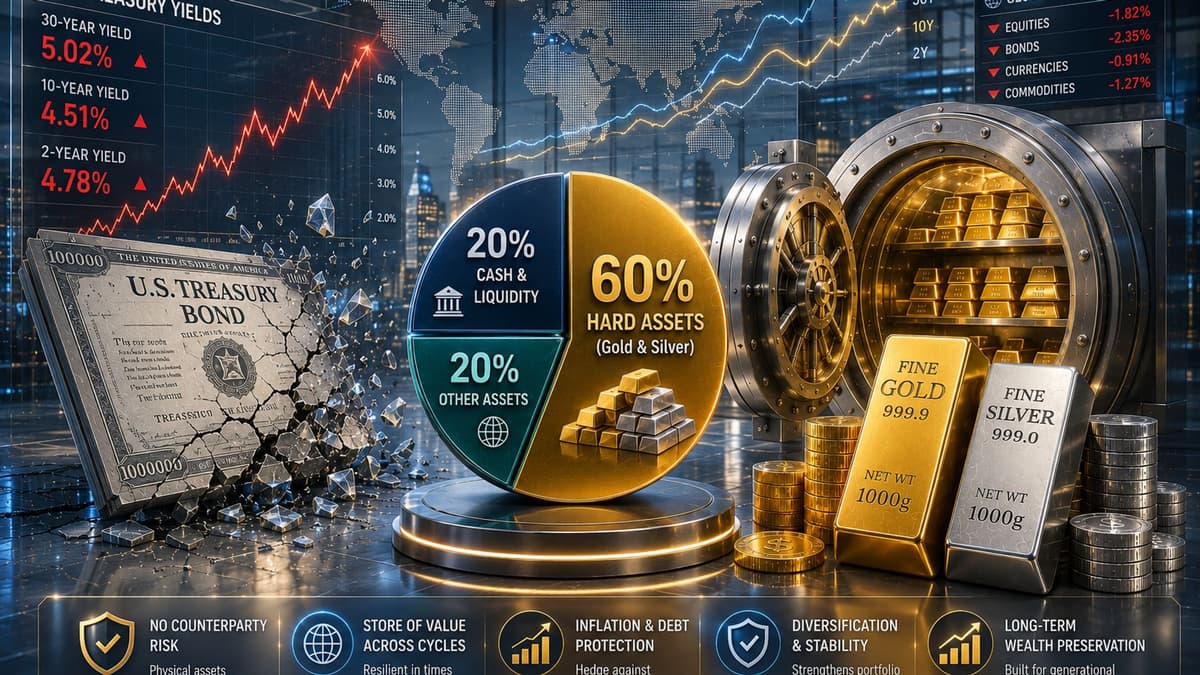
Gold is not meant to make investors rich overnight, according to Jeff Sarti, CEO of Morton Wealth. He argues that gold’s real role is to preserve purchasing power through debt build-ups, currency debasement, and financial repression.
In an interview with Kitco News, Sarti said investors often misunderstand gold because they treat it like a growth asset. His view is different: gold is savings, a store of value, and a core form of portfolio resilience when fiat currency systems come under strain.
Why does Jeff Sarti say gold is savings, not an investment?
Gold is savings because it is designed to hold value over long periods, not generate cash flow. Sarti said that is exactly why bullion matters in uncertain macro cycles.
“Gold is not an investment — it’s savings,” Sarti told Kitco News. “Over the long run, the purpose of gold is as a store of value.”
That framing challenges the common criticism that gold pays no dividend, produces no cash flow, and resists standard valuation models. Sarti dismissed those objections as too complicated for what gold is supposed to do.
He said reserve currencies eventually change, but gold has retained its monetary role across generations. In his view, that history makes gold one of the few assets that can act as a durable hedge against rising debt and currency debasement.
For Indian investors, that argument has added relevance because domestic gold prices depend not only on global XAUUSD moves, but also on the Indian rupee. If global monetary debasement continues and INR weakens against the U.S. dollar, local bullion prices can stay supported even when international gold price gains are moderate.
What worries Jeff Sarti about the recent gold price rally?
The speed of the rally worries him more than the long-term trend. Sarti said gold’s parabolic move at the start of the year made him nervous, even though he remains structurally bullish.
Morton Wealth has managed a gold position since 2015. Sarti said the strong move to record highs in January created excitement in the market, but it also fed speculative narratives that can distort gold’s true role.
He made clear that he does not want a disorderly surge in bullion. “By definition, a store of value should be boring,” he said. “I want gold at $2,500, not $10,000 — because $10,000 means something is very wrong.”
That comment is important for investors tracking gold price forecasts. Sarti is not cheering for a crisis-driven spike in XAUUSD. Instead, he sees steady price stability as healthier than a panic-driven run in the precious metals market.
He also said “speculative fervor” over the past year is normal in any asset cycle. In his view, that does not weaken the long-term case for gold, but it can create noise around bullion’s primary function as a safe-haven store of value.
How much gold does Morton Wealth hold in portfolios?
Morton Wealth keeps a meaningful but controlled allocation to precious metals. Sarti said the firm has held “high single-digit” exposure for roughly the past decade.
That allocation includes about 5–6% in gold and another 2–3% in mining equities. The split matters because Sarti treats physical gold and gold-linked exposure differently from mining stocks.
He said the firm does not try to aggressively time the market. Instead, it uses disciplined rebalancing and took some profits when gold surged to record highs in January.
That approach offers a practical lesson for Indian investors. Rather than chasing every rally in bullion or gold ETFs, investors can use target allocations and rebalance when prices move sharply. This is especially relevant in India, where festive demand, rupee volatility, import costs, and global troy ounce prices can all affect local gold price trends.
Why does Morton Wealth separate gold from mining stocks?
Mining stocks are more tactical because they are more volatile. Sarti said miners are more sensitive to operational factors such as energy costs, which can make them behave differently from spot gold.
That means mining equities may offer leverage to the gold price, but they also introduce business risk. For portfolio construction, Sarti appears to view bullion as the core holding and miners as a higher-risk extension of precious metals exposure.
What is the long-term bullish case for gold price, according to Sarti?
The long-term bullish case rests on debt, monetary policy, and likely currency debasement. Sarti said those structural pressures, rather than short-term trading excitement, support gold.
“We are, by any economic equation, bankrupt. The only reason we’re not is because we have the printing press,” he said.
Sarti argued that policymakers are most likely to respond to unsustainable debt with continued currency debasement. He said that process could also include financial repression and even yield curve control.
He stressed that this is not only a U.S. problem. Other nations also face debt burdens that will be difficult to solve through stronger economic growth alone.
In his framework, inflationary policy choices would mark a “crossing of the Rubicon.” If that happens, he said, investors could have a stronger case to increase gold allocations further.
For Indian investors, this global backdrop matters because gold often performs well when real interest rates are pressured, fiat currencies lose purchasing power, or macro uncertainty rises. If major economies continue to rely on monetary expansion, Indian demand for bullion, gold ETFs, sovereign gold bonds alternatives, and related safe-haven assets could stay firm.
Why does Sarti believe gold is still under-owned?
Gold is under-owned because institutional and household allocations remain extremely low. Sarti said that lack of participation suggests the current rally may still be early rather than overextended.
“Virtually no one owns gold,” he said, citing estimates that global portfolios hold less than 0.2% exposure.
That is a striking figure for investors assessing whether the gold market is crowded. If portfolio exposure is still below 0.2% globally, the argument is that bullion has not yet reached broad mainstream ownership.
Sarti said the general public is not even widely discussing these themes yet. In his view, the move in gold price is being driven more by macro fundamentals than by a full speculative mania.
For India, that point is especially relevant because physical gold ownership is culturally common, but institutional portfolio exposure to gold can still be limited relative to total financial assets. If global institutions raise allocations even modestly, the impact on XAUUSD and local bullion prices could be significant.
How will investors know when gold is near a true peak?
Sarti said the signal will be cultural, not technical. He is not focused on a chart pattern alone to identify a major top in gold.
“When gold becomes part of the mainstream — when you see it in Super Bowl ads — that’s when I’ll start to worry,” he said.
That view implies that a true peak would likely come when gold becomes a mass-market obsession. In other words, when speculative participation broadens far beyond disciplined portfolio hedging, the risk of a major top increases.
This is a useful framework for investors watching sentiment indicators. If gold dominates mainstream advertising, retail chatter, and momentum-driven trading, that could matter more than any single short-term resistance level in the bullion market.
What does this mean for Indian gold investors now?
The key message is that gold should be treated as portfolio insurance, not only as a return-chasing trade. Sarti said gold is one part of a broader strategy built around real assets and non-correlated investments.
He expects investors to increasingly favor tangible assets over purely financial ones in a world shaped by rising debt, persistent inflation risks, and possible stagflation. That shift, he said, could define the next phase of the gold market.
For Indian investors, the takeaway is clear: gold price moves should be viewed through both a global and rupee lens. International bullion prices per troy ounce, U.S. monetary policy, debt dynamics, inflation trends, and INR direction all influence the domestic market.
If Sarti’s thesis plays out, gold may continue to gain importance not as a speculative bet, but as a foundational asset for wealth preservation. The key watchpoint now is whether governments deepen debt-financed policies and financial repression, because that could strengthen the case for higher strategic gold allocations over time.