# Gold Price Outlook: Iran, Fed Risks Keep Bullion Nervy
Gold and silver still have room to rise, but geopolitical stress around Iran and fresh uncertainty over Federal Reserve leadership are keeping bullion markets cautious. According to Rhona O'Connell, Head of Market Analysis at StoneX, reduced speculative positioning has eased the overhang in both metals, yet large professional traders remain reluctant to build big positions.
For Indian investors, that means global gold price volatility in XAUUSD could remain elevated in the near term. Any move in the U.S. dollar, Treasury yields, and geopolitical headlines can quickly filter into domestic bullion rates in rupees.
What is keeping gold and silver markets nervous right now?
The main reason is uncertainty on two fronts: the Iran-linked Strait of Hormuz conflict and political tensions over the next Federal Reserve chair. StoneX said these risks are discouraging large market participants from taking aggressive positions in gold and silver.
Rhona O'Connell said precious metals markets have been heavily focused on developments in the Strait of Hormuz in recent weeks. She noted that silver has largely followed gold, but with much sharper volatility.
How did the Strait of Hormuz headlines move silver prices?
Silver spiked 5% at the end of last week after an announcement said the Strait of Hormuz was fully open and would remain open for the rest of the ceasefire period. That announcement was later revoked.
O'Connell said the strait is now closed again, in what is believed to be a response to the continued blockade imposed by the United States. Because negotiations are still underway and "the two sides are still pretty far apart," she expects both gold and silver to remain cautious and volatile for now.
Why are big traders staying on the sidelines?
Professional trading houses are hesitant because geopolitical conditions remain highly unstable. O'Connell said firms remain reluctant to commit large positions in such a febrile environment.
She added that exchange-traded funds have been shedding metal in recent days, while shorter-term speculators are positioned on both sides of the market. That combination has reduced conviction and increased the chances of choppy price action.
For Indian bullion buyers, this matters because volatile global moves often translate into sharp swings in local gold price quotes, especially when the rupee also moves against the U.S. dollar.
Does lower speculative positioning create upside for gold and silver?
Yes, StoneX believes reduced long positioning leaves some upside scope for both metals. The speculative excess that had built up earlier has now eased.
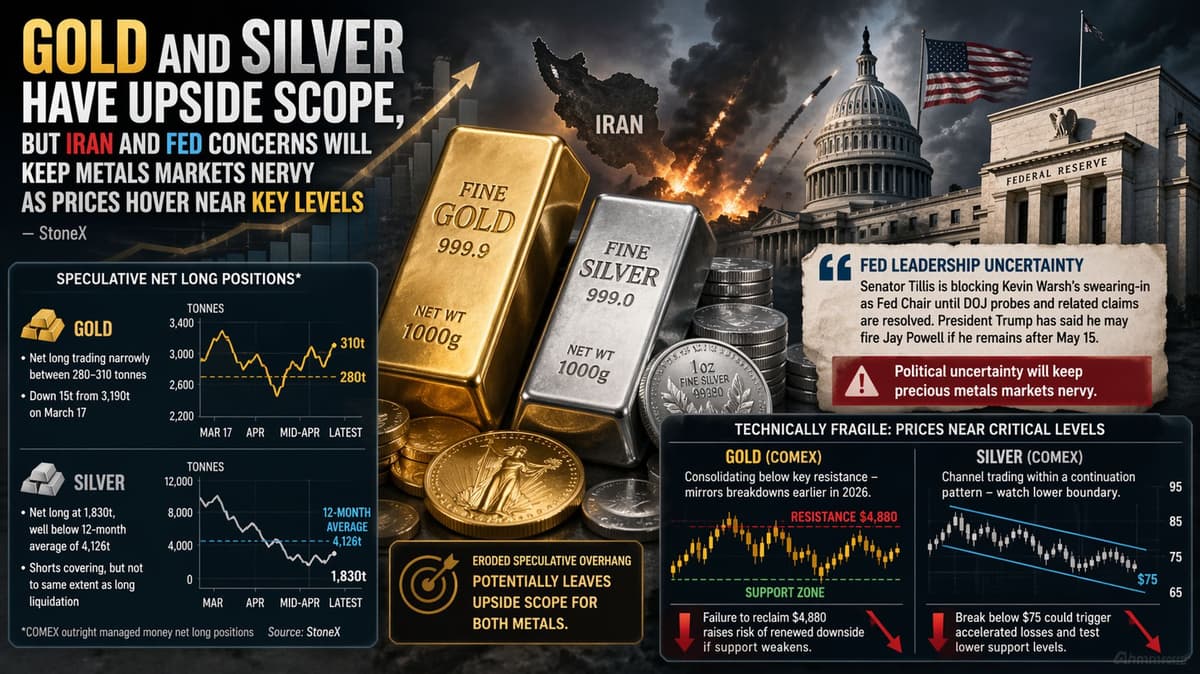
O'Connell said COMEX outright managed money long positions in gold fell in the last week of March, although they have been recovering since then. Even after that rebound, they remain 15 tonnes below the 3,190 tonnes recorded on March 17.
What do the gold positioning numbers show?
Gold's net long position has stayed in a relatively tight band. O'Connell said shorts have also increased, but less than longs had previously fallen, leaving the net long position trading narrowly between 280 tonnes and 310 tonnes.
That suggests speculative enthusiasm has cooled, but not collapsed. In market terms, a lighter speculative overhang can give gold more room to rise if fresh bullish triggers emerge.
What do the silver positioning numbers show?
Silver positions peaked in the final week of March and then drifted lower until mid-April. O'Connell said silver has since regained some traction due to bargain hunting.
Shorts have been covering, but not as aggressively as longs had previously liquidated. As a result, silver's net long position has continued to decline gradually and most recently stood at 1,830 tonnes.
That figure is substantially below the 12-month average of 4,126 tonnes. O'Connell said that in both gold and silver, the speculative overhang has been eroded, which potentially leaves some upside scope for both precious metals.
For Indian investors, this is important because gold prices do not always need a major safe-haven shock to rise. If positioning is cleaner and U.S. yields or the dollar soften, bullion can rebound even without a full-blown crisis.
How is the Federal Reserve succession issue affecting gold prices?
The Federal Reserve leadership dispute is adding another layer of uncertainty to precious metals markets. StoneX said the situation is making traders more nervous ahead of a key date in May.
O'Connell highlighted comments around Republican Senator Thomas Tillis, who sits on the Senate Banking Committee. She said Tillis is continuing to block the swearing-in of Kevin Warsh as Federal Reserve chairman when Jay Powell's term finishes on May 15.
Why is Kevin Warsh's confirmation being blocked?
According to O'Connell, Tillis is refusing to lift the block until the Department of Justice probes into cost overruns in the renovation of Federal Reserve buildings are either concluded or dropped. She also pointed to President Donald Trump's related claim that Jay Powell has been deceiving Congress.
O'Connell said President Trump has stated that if Jay Powell remains in office after May 15, he will fire him. She added that there is apparently a justification for Powell continuing under the Federal Reserve Act.
Can Jay Powell be removed after May 15?
O'Connell said informed opinion believes that is not possible, but markets will need to wait and see what happens over the next three weeks. Her conclusion was direct: this will keep precious metals markets nervy.
For Indian market participants, Federal Reserve instability matters because it can move the U.S. dollar, Treasury yields, and broader risk sentiment. Those drivers directly influence imported gold costs in India, especially when domestic prices are already sensitive to rupee depreciation.
What is actually driving gold price moves now?
StoneX says gold is being driven more by the U.S. dollar and Treasury yields than by a simple geopolitical fear trade. O'Connell said that can make price action look counterintuitive.
She noted that gold has at times risen when geopolitical tensions seemed to ease, and fallen when tensions intensified. In her view, the key explanation is that the dollar and Treasury yields have been falling when the news flow has been positive, and that has fed bullish activity in the gold market, largely through speculative buying.
Why can gold rise even when tensions cool?
Gold can rise if lower yields and a weaker dollar improve the relative appeal of non-yielding assets such as bullion. That relationship often matters more in the short term than headline-driven safe-haven demand alone.
This is a critical point for Indian investors tracking gold price trends. A softer dollar can support international XAUUSD prices, but rupee movement can either amplify or offset that effect in the domestic market.
What technical levels should gold and silver traders watch?
StoneX analyst Razan Hilal said gold and silver are entering a technically fragile phase. Recent rebounds have not restored strong bullish momentum, leaving both metals vulnerable to directional shifts.
Hilal said current price action reflects tension between attempted recovery and underlying structural weakness. In her view, technical confirmation will likely determine the next major move.
Why is gold technically vulnerable below $4,880?
Gold is consolidating below important resistance levels, according to Hilal. She said the pattern resembles breakdown structures seen earlier in 2026.
Hilal warned that gold's failure to reclaim $4,880 increases the probability of renewed downside pressure if support starts to weaken. In practical terms, gold remains vulnerable to further declines unless a clear breakout confirms a change in momentum.
What is the key silver level to watch?
Silver is trading in a channel-like continuation pattern, which raises the risk of a sharp move. Hilal said a break below the lower boundary near $75 could trigger accelerated losses and send silver down to test lower support levels.
For Indian investors in physical bullion, gold ETFs, silver ETFs, or MCX contracts, these technical thresholds matter because they can shape near-term volatility. If global prices break sharply lower or higher, domestic rates may react quickly, especially during periods of rupee weakness or strength.
The near-term watchpoint is clear: investors should track headlines from the Strait of Hormuz, developments around Jay Powell and Kevin Warsh before May 15, and moves in the U.S. dollar and Treasury yields. If gold clears $4,880 decisively, momentum could improve; if silver breaks below $75, downside pressure could intensify.