# Gold Price Outlook: Bond Yield Spike Raises Fresh Market Risks
U.S. bond yields have jumped sharply, and that matters for gold, equities, and Indian investors. While the Reuters source article focused on the risk to richly valued U.S. stocks, the same macro forces—higher inflation expectations, elevated oil prices, and geopolitical stress around Iran—also shape the near-term outlook for gold price, bullion flows, and XAUUSD.
For Indian investors, the message is clear: if inflation fears deepen and Treasury yields stay elevated, global risk assets could face pressure, while gold may continue to attract safe-haven demand even as higher real yields create headwinds.
Why are rising U.S. bond yields important for gold price and global markets?
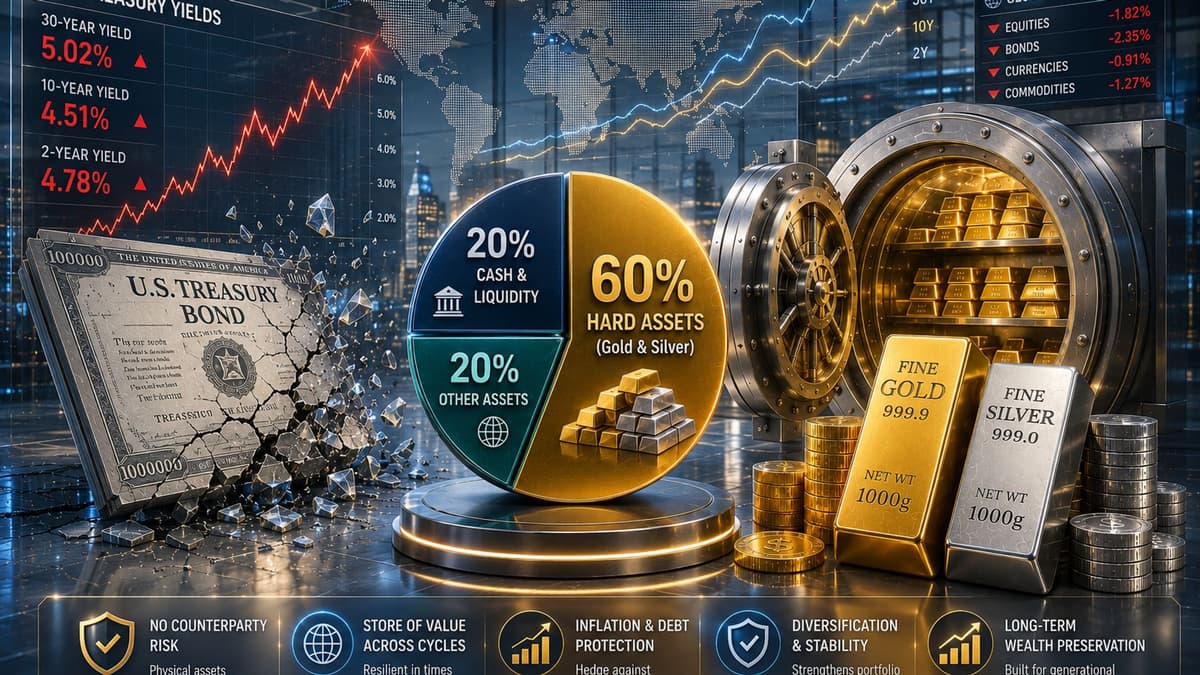
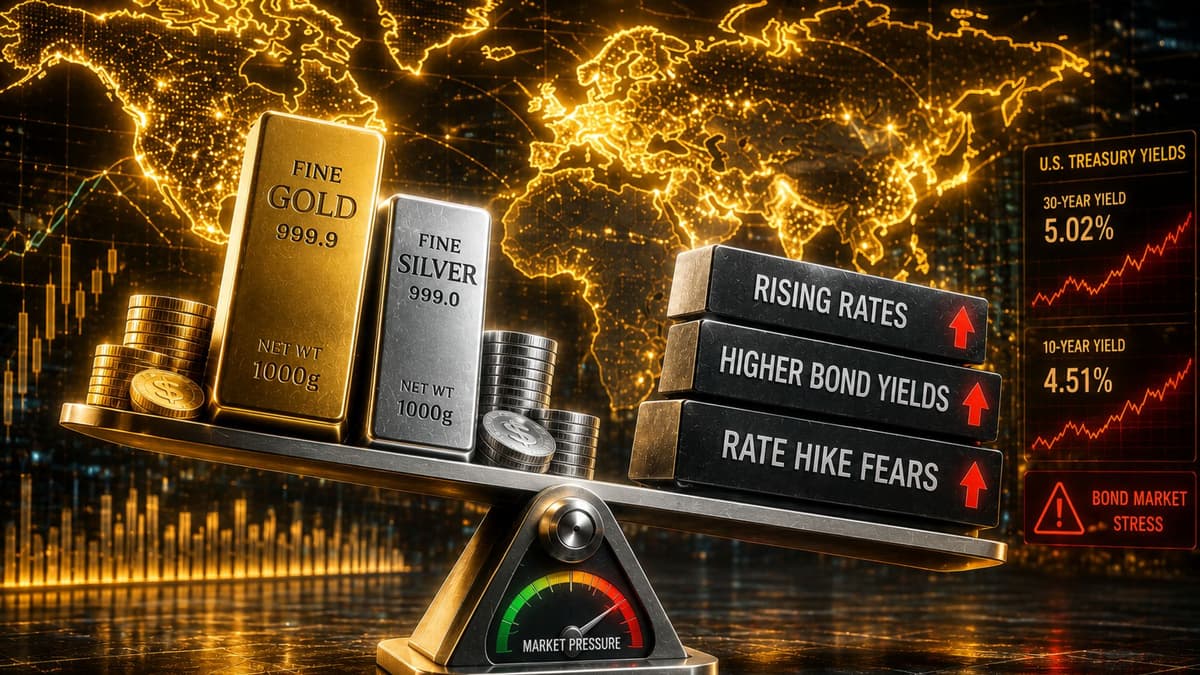
Rising U.S. bond yields matter because they tighten financial conditions, pressure equity valuations, and can change the opportunity cost of holding non-yielding assets such as gold. In the past week, the 30-year U.S. Treasury bond yield rose above 5%, while the benchmark 10-year Treasury yield moved above 4.5%.
That move triggered fresh caution in markets on Friday. Higher benchmark yields typically raise borrowing costs for companies and consumers, which can slow economic growth and hurt corporate profits.
For gold, the impact is more complex. Higher yields can weigh on XAUUSD because bullion does not pay interest. But when yields rise alongside inflation fears, geopolitical tension, and recession risk, safe-haven demand for gold can strengthen.
For Indian investors, this matters through multiple channels: global bullion pricing in U.S. dollars, the rupee-dollar exchange rate, and domestic inflation expectations. If U.S. yields stay high and crude oil remains elevated, imported inflation risks could support local gold demand even if international prices turn volatile.
What is driving investor concern right now?
Investors are worried that U.S. stock markets have not fully priced in the risk of rocketing inflation. According to Reuters, strong first-quarter earnings and optimism around artificial intelligence have overshadowed the risks from high energy prices and the lack of a conclusion to the war with Iran.
The concern intensified after the recent spike in bond market yields. Investors increasingly fear that inflation is becoming embedded in the economy rather than easing.
Peter Tuz, president of Chase Investment Counsel in Charlottesville, Virginia, said: "I do think there is a real fear that inflation is kind of embedded in the economy going forward. You don't see any signs of it going down right now, and that is a real fear, and it will drive the market down if it continues."
Jack Ablin, chief market strategist at Cresset Capital, warned that even a delay of a few months in reopening the Strait of Hormuz to oil, liquefied natural gas (LNG), and commercial shipping could create "a brand new inflation regime for which investors just aren't prepared."
That warning is highly relevant for gold price because energy-led inflation shocks often increase demand for precious metals as portfolio hedges. In India, persistently high crude oil prices can also pressure the rupee and increase domestic inflation, both of which tend to support local bullion prices.
How does the Iran crisis affect gold, oil, and inflation expectations?
The Iran crisis affects gold by lifting geopolitical risk, raising safe-haven demand, and keeping oil prices elevated. Reuters reported that crude oil remained above $100 as uncertainty persisted around the temporary ceasefire between Iran and the United States.
A prolonged disruption in the Strait of Hormuz would have broad market consequences. The waterway is critical for global oil and LNG shipping, so any delay in reopening it can amplify supply fears and inflation pressure.
John Higgins, chief economic adviser for financial markets at Capital Economics, warned in a report published on Thursday that markets are not braced for an "extreme" scenario in the Iran war involving a prolonged Hormuz shutdown. He argued that Treasury markets are pricing in inflation risk, but equity markets are not fully doing so.
Matthew Gertken, chief geopolitical strategist at BCA, said the Iran crisis has the potential to reshape the trajectory of markets for the rest of the year. That view matters for gold investors because prolonged geopolitical instability often supports bullion, silver, and other precious metals as defensive assets.
For Indian households and traders, a sustained oil shock could feed into inflation, import costs, and rupee weakness. That combination can push domestic gold prices higher even if international troy ounce prices move sideways.
Why are U.S. stocks still holding up despite these risks?
U.S. equities remain resilient mainly because earnings have been strong. Reuters reported that first-quarter profits for U.S. publicly traded corporations are running significantly above expectations and are on track to be about 28% higher than a year ago, the biggest increase since late 2021.
Jeremiah Buckley, a portfolio manager at Janus Henderson, said markets are seeing the impact of the AI spending boom and a related increase in productivity. He added that this trend could extend into 2027.
Massive capital spending on data centers and AI infrastructure has boosted demand for chips and supported enthusiasm around large-cap growth stocks. That has helped offset concerns about inflation, oil, and geopolitics.
There is also a positioning factor. Tim Murray, capital markets strategist at T. Rowe Price, said traders do not want to turn bearish if the Strait of Hormuz situation is resolved within a few weeks.
Still, high valuations leave little room for error. As of Thursday, the benchmark S&P 500 was trading at 21.3 times earnings estimates for the next 12 months, according to LSEG Datastream. That is well above its long-term average forward price-to-earnings ratio of 16, although below the 23.5 level reached in October.
What are investors doing with portfolios as risks rise?
Some investors are adding defensive exposure, including gold and cash. Paul Karger, co-founder and managing partner of TwinFocus, which manages money for ultra-high-net-worth families, said clients are constantly asking how to reconcile strong earnings with worsening inflation and oil risks.
Karger said he uses a "barbell" approach. He is accumulating large overweight positions in cash, gold, and other commodities while still maintaining exposure to market-leading mega-cap growth stocks.
That portfolio mix is notable for gold investors because it reflects how sophisticated allocators are responding to uncertainty. Instead of making an all-or-nothing call, they are pairing risk assets with safe-haven and inflation-sensitive assets such as bullion.
For Indian investors, a similar logic may apply. Gold can act as a hedge within a diversified portfolio when global stocks look expensive, oil prices are above $100, and geopolitical risks remain unresolved.
How vulnerable is the U.S. stock market after its rebound?
The U.S. stock market looks vulnerable because valuations remain elevated after a sharp rebound. After an initial selloff following the start of the U.S.-Israeli war with Iran in late February, major U.S. stock indexes recovered strongly.
Reuters reported that the S&P 500 was last up more than 17% from its low for the year in late March. That left the index up more than 8% year to date, even after Friday’s pullback of nearly 1%.
Those gains suggest markets have focused more on earnings and AI optimism than on inflation and war-related risks. If bond yields continue to rise, that balance could change quickly.
For gold, any equity-market repricing could be supportive if investors rotate toward defensive assets. However, if real yields rise faster than inflation expectations, gold could face short-term pressure before safe-haven buying returns.
What should Indian gold investors watch next?
Indian gold investors should watch U.S. Treasury yields, crude oil above $100, the Strait of Hormuz, inflation data, and the rupee. These factors will likely determine whether gold price benefits more from safe-haven demand or faces pressure from higher real yields.
The key near-term signal is whether the bond market’s warning spreads fully into equities and broader risk assets. If inflation remains sticky and the Iran-related shipping risk lasts beyond a few weeks, gold and other precious metals may stay well supported despite rate-linked volatility in XAUUSD.
For Indian buyers, any combination of a firmer dollar, elevated crude, and geopolitical instability could keep domestic bullion prices resilient, making global macro headlines especially important in the days ahead.