# Gold Price Outlook: $4,350 Support Now Critical, SocGen Warns
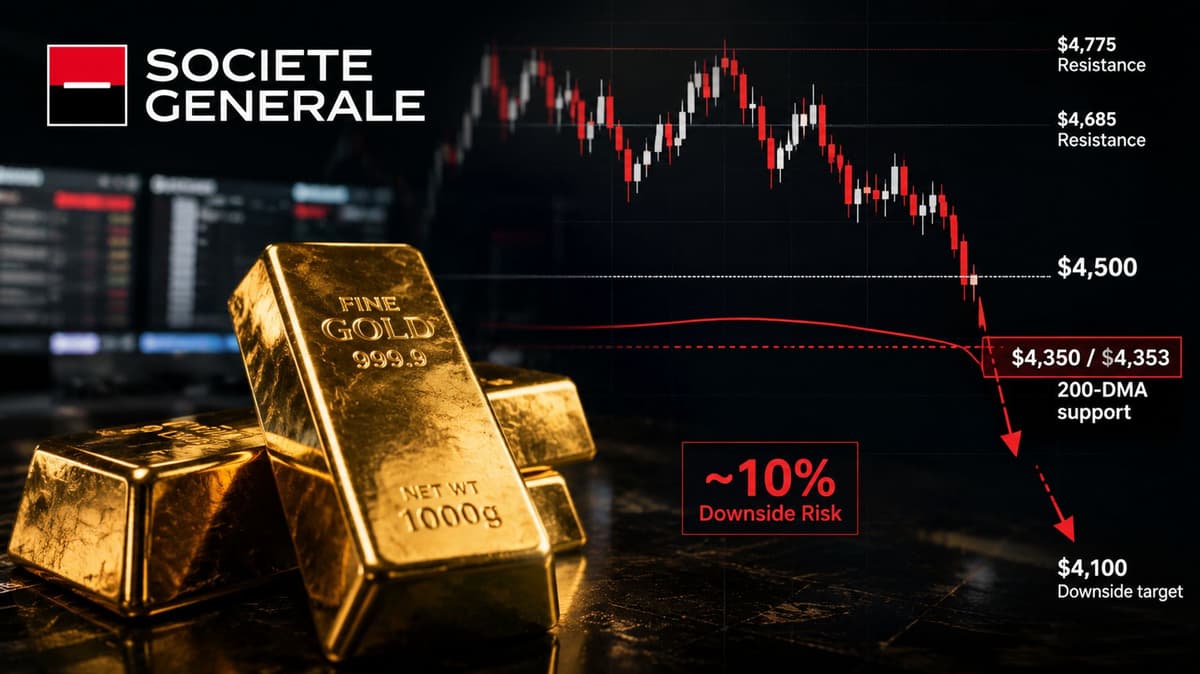
Gold faces fresh downside risk after breaking below $4,500 per troy ounce, and Société Générale says the next crucial support sits near $4,350. For Indian investors tracking global bullion and domestic rates, that level matters because a failure there could open the door to a deeper correction toward $4,100 in XAUUSD.
Why is gold price under pressure below $4,500?
Gold is under pressure because it failed to recover key technical levels after slipping below its 50-day moving average. According to commodity analysts at Société Générale, the bearish momentum has persisted since gold fell below its 50-DMA two months ago.
The French bank said gold “has undergone a pullback after slipping below its 50-DMA in March.” It added that gold’s failure to reclaim that moving average during the latest rebound attempt shows that downward momentum remains intact.
This matters for bullion traders because the break below $4,500 per ounce removes an important psychological and technical floor. Once gold loses such levels, traders often shift focus to the next major support zones on long-term charts.
For Indian investors, weakness in international gold prices can partly cushion domestic prices, but the rupee-dollar exchange rate remains critical. If the Indian rupee weakens against the U.S. dollar, MCX gold and local bullion rates may not fall as much as global XAUUSD prices.
What is the key support level for gold now?
The key support level is the confluence of the 200-day moving average and a multi-year ascending trend line near $4,350. Société Générale identified this cluster as the most important near-term level that gold must hold to avoid a sharper selloff.
The analysts said, “The confluence of the longer-term 200-DMA and a multi-year ascending trend line near $4,350 could be the next potential support.” They added that investors should watch closely to see whether gold can stay above that zone and attempt a bounce.
SocGen was more specific in its warning: “Gold erased the key $4,500/oz level and must hold the 200dma of $4,353/oz to halt a deeper correction towards $4100/oz.” That implies roughly 10% downside risk from recent levels if support fails.
In technical terms, the $4,350-$4,353 area is not just another line on the chart. It combines a long-term moving average with a structural uptrend line, making it a high-conviction support zone for chart-driven funds, momentum traders, and institutional investors.
How low could gold fall if $4,350 breaks?
Gold could slide toward $4,100 per ounce if it fails to hold above the 200-DMA near $4,353. Société Générale says that losing this support would likely trigger a deeper correction in the gold price.
That downside target is significant because it would extend the current weakness well beyond a normal pullback. A move from the recent $4,500 area toward $4,100 would mark a substantial decline in bullion and could reset short-term sentiment across the precious metals complex.
At the same time, SocGen noted that any rebound is likely to face resistance before gold can rebuild upside momentum. The bank said the recent pivot highs around $4,685 and $4,775 could act as resistance if a short-term recovery develops.
That gives traders a clear map: support lies near $4,350, downside risk extends toward $4,100, and upside recovery would likely run into selling pressure near $4,685 and then $4,775. For Indian market participants, these XAUUSD levels often shape sentiment in imported bullion pricing, jeweller inventories, and futures positioning.
Why did Société Générale cut its gold allocation?
Société Générale cut its gold allocation mainly because gold’s volatility has risen sharply and its diversification benefits have weakened in the current market environment. On March 23, the bank published its updated Multi-Asset Portfolio strategy report for the second quarter and said that, for the first time since 2022, it is no longer overweight gold.
The bank reduced its gold exposure to 7% from 10% in the first quarter. Even so, it did not turn bearish on the long-term outlook for gold.
Société Générale maintained its $6,000 year-end gold price target despite trimming exposure. That distinction is important: the bank is cautious on near-term portfolio construction, but it still sees a strong strategic case for gold over a longer horizon.
According to the analysts, volatility is the biggest reason for the shift. The bank said gold is expected to be one of the most volatile assets over the next 12 months.
How has gold behaved as a safe-haven during the Middle East conflict?
Gold has not fully delivered the defensive protection investors typically expect in a risk-off shock, according to Société Générale. The bank said that during the current Middle East conflict, gold failed to fully offset equity market weakness in diversified portfolios.
The analysts wrote, “In the risk-off environment triggered by the current Middle East conflict, gold has not been able to fully offset equity market weakness in portfolios.” They also said gold’s shorter-dated volatility has risen sharply and now exceeds that of other major asset classes.
Société Générale added that gold’s correlation with most major asset classes has been predominantly positive. For portfolio managers, that is a problem because an asset that rises and falls alongside other holdings offers less diversification benefit.
The bank said, “For volatility-controlled portfolios, the recent increase in gold’s volatility, combined with the metal’s positive correlation with other asset classes, presents a headwind.” In other words, gold remains a strategic safe-haven over time, but its short-term behavior has become more complex.
For Indian investors, this is a useful reminder that gold does not always hedge portfolios perfectly in every geopolitical event. Domestic gold demand can still stay resilient because of wedding-season buying, festival demand, and long-term wealth preservation, even when global funds reduce tactical exposure.
What portfolio changes did Société Générale make beyond gold?
Société Générale broadly rebalanced toward commodities and away from concentrated equity risk. The bank said it wants more balance in its portfolio and reduced equity exposure by 5% while taking a broader commodities position.
Its biggest shift was raising exposure to global commodities to 8% from zero in the first quarter. The analysts said they see solid potential in energy markets.
They wrote, “In adjusting our portfolio, we now focus even more on long-term strategic forces. We increase our allocation to commodities and further broaden our exposure to equities beyond US technology.”
The bank added, “Commodities sit at the core of our strategic focus on sovereignty.” It also said that even if the Middle East conflict ends, oil is unlikely to return to the $55 level it had previously expected.
Under Société Générale’s new scenario, Brent crude falls to $77 per barrel in 2Q26 and $68 per barrel in 4Q26, but then starts rising over the medium term as U.S. production peaks and OPEC regains market share. The bank also said copper remains supported by long-term electrification and data-centre demand.
For Indian investors, this broader commodity stance matters because India imports large volumes of crude oil and gold. A sustained rise in energy prices can affect inflation, the rupee, bond yields, and household purchasing power, all of which feed back into domestic precious metals demand.
What did Société Générale change in equities and bonds?
Société Générale reduced exposure to U.S. stocks, global emerging markets, and Chinese onshore equities, while increasing exposure to European equities excluding the U.K. The bank said its equity positioning reflects concerns about concentration risk and a changing growth backdrop.
The analysts said, “Growing doubts about the durability of the AI theme justify our underweight in US equities and our preference for an S&P 500 equal-weight exposure to reduce concentration and capture wider leadership.” They added, “We remain overweight Europe, as the region is benefiting from a firm cyclical recovery.”
Outside equities, the bank kept a 25% exposure to government bonds, a 5% exposure to corporate bonds, and 5% of its portfolio in cash. Those allocations show that SocGen is not abandoning defensive assets, but it is becoming more selective about where it wants risk and diversification.
For Indian readers, the implication is clear: global asset allocators are not exiting gold entirely, but they are becoming more tactical. If gold holds above $4,350 and volatility cools, sentiment could stabilize; if it breaks that level, investors should watch for pressure toward $4,100, resistance at $4,685 and $4,775, and the added effect of INR moves on domestic bullion prices.