# Gold Price Meets Bitcoin in Coinbase’s Bold New Store-of-Value Index
MarketVector and Coinbase Asset Management have launched COINSOV, a new store-of-value index that combines Bitcoin and gold in a rules-based framework designed to balance upside potential with downside protection. For Indian investors tracking gold price trends, bullion demand, and the growing overlap between precious metals and digital assets, the launch is a sign that institutional portfolios are increasingly treating gold and Bitcoin as complementary alternative assets rather than direct rivals.
What is the new Coinbase Store-of-Value Index?
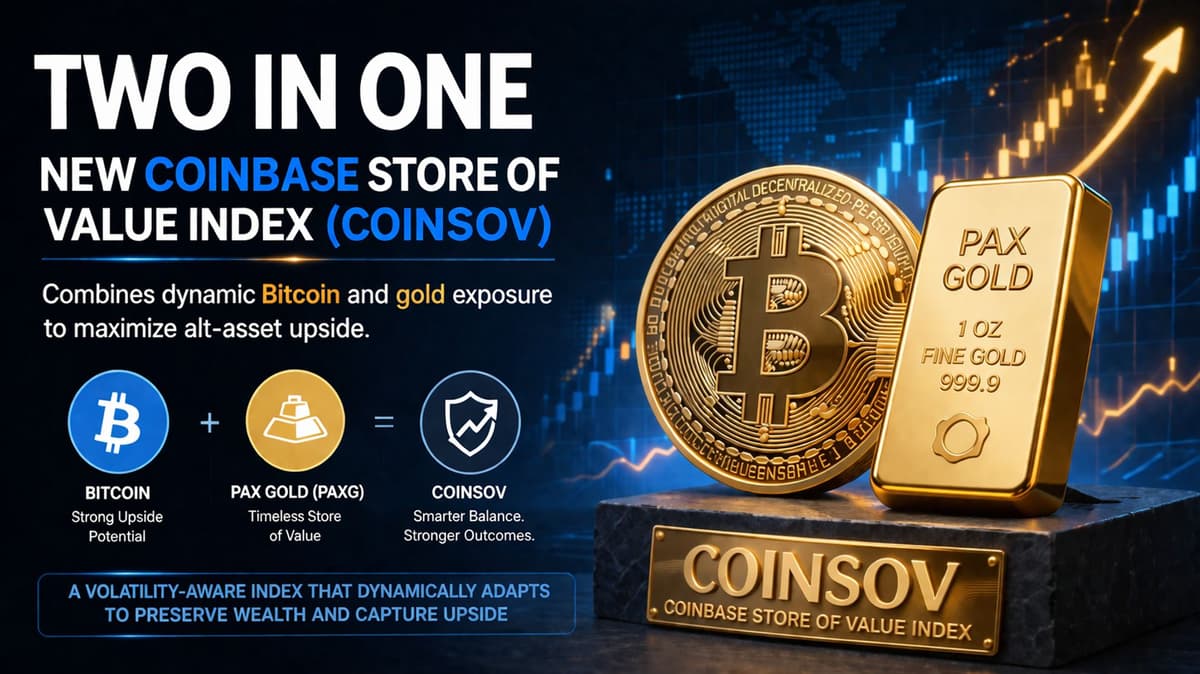
COINSOV is a new index from MarketVector Indexes and Coinbase Asset Management that combines Bitcoin and gold exposure in a single benchmark. The firms announced the launch on Thursday and said the product is designed to help investors preserve purchasing power across market cycles.
According to the companies, the idea reflects a broader shift in how investors define a store of value. In their statement, they said the definition is expanding beyond a “gold-only” approach as investors respond to increasing global debt, rising deficits, and persistent monetary debasement.
The index is a collaboration between global index provider MarketVector Indexes and Coinbase Asset Management. The two firms said it reflects their “shared focus on delivering institutionally governed benchmarks that integrate digital and traditional assets within a single, rules-based framework.”
Anthony Bassili, President at Coinbase Asset Management, said the launch marks “a meaningful evolution in store-of-value investing.” He added, “In a world of fiscal dominance, the future belongs to scarce assets that cannot be printed and are not an obligation of a government or private issuer.”
How does COINSOV combine Bitcoin and gold?
COINSOV combines Bitcoin and gold through a volatility-aware allocation model that adjusts exposure dynamically. Instead of holding a fixed split, the index changes its weightings based on inverse volatility and rebalances quarterly.
That means the index aims to increase exposure to the less volatile asset and reduce exposure to the more volatile one over time. The goal is to capture Bitcoin’s upside when risk appetite improves while keeping the drawdown profile closer to gold than to Bitcoin alone.
The companies said the index is designed to preserve purchasing power through changing macro conditions. In practical terms, that gives gold a central role as the stabilizing asset, while Bitcoin contributes return potential during stronger risk-on periods.
What assets does the index actually track?
The Coinbase Store of Value Index tracks Bitcoin and Pax Gold (PAXG). PAXG is an asset-backed token that represents the price of one fine troy ounce of gold.
For gold investors, that detail matters because the gold component is linked directly to physical-gold pricing through a tokenized structure. This ties the benchmark not only to crypto market performance but also to spot gold price movements in the global bullion market.
Why are Coinbase and MarketVector launching this gold-Bitcoin index now?
The launch comes as institutional investors search for assets that can hold value in an environment of fiscal stress and currency debasement. The firms explicitly linked the index to concerns over global debt, budget deficits, and long-term monetary erosion.
Martin Leinweber, Director of Digital Asset Research and Strategy at MarketVector Indexes, said the index shows how digital and traditional assets can be combined within a transparent, institutional framework. He said COINSOV offers “a disciplined approach to capital preservation in a changing macro environment.”
This timing also reflects a wider market trend. Investment demand continues to drive the gold market, and analysts say gold’s influence in the digital asset landscape is growing faster than in traditional finance.
For Indian investors, this is especially relevant because gold already plays a dual role as both a cultural store of wealth and a macro hedge. If global asset managers increasingly package gold with Bitcoin, that could deepen institutional demand for gold-linked products even as XAUUSD volatility stays elevated.
What does the back-tested performance say about gold and Bitcoin together?
MarketVector said its research suggests the dynamic approach outperformed static allocation models on a risk-adjusted basis between 2017 and 2025. The firms said the index delivered stronger risk-adjusted returns than static Bitcoin-gold allocations and several widely followed benchmarks.
They also said the strategy experienced materially smaller drawdowns than a simple 50/50 Bitcoin-gold blend. That is a key claim because Bitcoin’s volatility has often prevented conservative investors from using it as a store-of-value asset on its own.
Why does inverse-volatility weighting matter?
Inverse-volatility weighting matters because it shifts allocation toward the asset with lower volatility. In this framework, gold can act as the anchor during unstable periods, while Bitcoin can take a larger role when its volatility moderates or risk appetite improves.
That structure may appeal to allocators who want exposure to scarce assets but cannot tolerate Bitcoin’s full price swings. For Indian investors comparing bullion, digital gold, sovereign gold bonds, and crypto exposure, the model highlights how institutional products are trying to make volatile assets more portfolio-friendly.
Why is tokenized gold becoming more important in the digital asset market?
Tokenized gold is becoming more important because it is pulling physical gold demand into the crypto ecosystem. The source article points to Tether’s growing presence in gold as a major example of how investment demand is evolving.
On March 24, Tether announced that it had engaged one of the Big Four accounting firms to conduct its first full independent audit since its founding. That announcement matters because Tether is the world’s largest stablecoin issuer and also one of the largest buyers and holders of physical gold.
Tether’s U.S. dollar stablecoin, USD₮, has a market capitalization of over $184 billion and a global user base of more than 550 million people. Within that broader ecosystem, Tether’s gold stablecoin, XAU₮, has a market capitalization of nearly $2.5 billion and ranks as the 32nd largest cryptocurrency in the world.
How much gold does Tether hold?
Tether holds between 125 and 150 tonnes of gold, according to analysts’ estimates cited in the article. That is a substantial amount of physical bullion for a private digital-asset issuer.
Fahad Tariq, Senior Vice President, Equity Research at Jefferies, said in early February that Tether “remains the largest non-sovereign buyer of physical gold and now ranks within the top 30 global gold holders, surpassing countries like Australia, UAE, Qatar, South Korea, and Greece.”
Tether Gold is the world’s largest gold token, and the company also holds large amounts of gold as a reserve asset backing its U.S. dollar stablecoin. Roughly 7% of Tether’s total holdings are in gold.
How large is XAU₮ compared with gold ETFs and other market players?
XAU₮ is already large enough to rival major gold investment vehicles in tonnage terms. Commodity analysts at Société Générale said XAU₮’s holdings would rank as the eighth-largest ETF globally by tonnage held, even though it is not an ETF but a digital-asset issuer.
That comparison is important for the global gold price because it shows tokenized gold is no longer a niche corner of the market. It is becoming a meaningful source of bullion demand that can influence price action alongside ETFs, hedge funds, and central-bank buying.
Société Générale also said that flows into XAU₮ in December were the second highest among all global ETFs, behind only SPDR Gold Shares (NYSE: GLD), the world’s largest gold-backed ETF.
What did Société Générale say about Tether’s market impact?
Société Générale said Tether’s flows were increasingly important in shaping market behavior, especially around month-end. The bank noted that XAU₮ flows were competing with speculative positioning from hedge funds.
According to the analysts, “In the last week of January, Tether’s flows became dominant and were a clear driver of market behavior into month-end, especially compared to ETFs.” They added that aggregate hedge funds still had the biggest influence on prices into month-end and early February.
After the sharp price decline on Friday the 30th, Tether added a further 11 metric tonnes of gold, effectively buying the dip. SocGen said those flows were larger than ETF flows, though still smaller than the impact of hedge funds.
What does this mean for gold price outlook in India?
The key implication for India is that global gold price formation is being influenced by new channels of demand, including tokenized bullion and hybrid Bitcoin-gold products. That matters because domestic gold rates in India reflect both international spot prices and rupee-dollar movements.
If products such as COINSOV increase institutional interest in gold-linked allocations, they could support bullion demand even when investors also seek exposure to Bitcoin. For Indian buyers, that may reinforce gold’s role as a strategic safe-haven asset rather than weaken it.
How should Indian investors read this trend?
Indian investors should read this as a sign that gold is expanding into new financial formats without losing its core role as a store of value. Physical bullion, gold ETFs, sovereign gold bonds, digital gold, and tokenized gold now sit within a broader ecosystem where gold price exposure can be paired with other scarce assets.
That does not change gold’s fundamentals, but it does change who is buying and how they are buying. As more institutional benchmarks integrate gold with crypto assets, Indian investors should watch whether that creates steadier structural demand for one fine troy ounce exposure through both traditional and digital channels.
The next key watchpoint is whether COINSOV attracts meaningful assets and whether tokenized gold products such as PAXG and XAU₮ continue gaining share in global bullion demand. If they do, Indian investors may need to track not just jewellery demand, central-bank buying, and ETF flows, but also digital-asset allocation trends that increasingly feed into the global gold price.