Why did gold price rise today despite better risk appetite?
Gold price rose because a weaker U.S. dollar index and lower U.S. Treasury yields made non-yielding bullion more attractive. Even with better broader market risk appetite, traders kept buying gold and silver as inflation expectations appeared to soften if Middle East tensions de-escalate.
According to Kitco News, bullion traders focused more on macro signals than on the usual risk-on versus risk-off pattern. That unusual setup mattered because gold had recently sold off during stronger risk aversion, yet rallied when market sentiment improved.
Kitco News said safe-haven metals were behaving in a way that frustrates the largest number of traders. The market appears to be pricing in the idea that inflation could cool if the war in the Middle East eases, even though veteran gold traders also remember periods when gold rallied on inflation fears.
For Indian investors, this matters because global gold price action in XAUUSD, moves in the U.S. dollar, and shifts in U.S. Treasury yields directly affect imported bullion costs and domestic rupee-denominated gold prices.
What were the latest gold and silver prices?
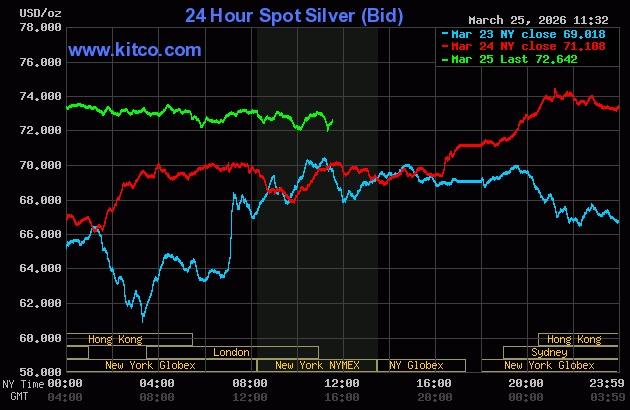
Gold and silver both posted sharp midday gains. April gold futures were last up $155.70 at $4,557.90, while May silver futures rose $3.521 to $73.125.
Those were the key levels cited by Kitco News near midday. The report also noted that the December gold futures contract is currently the most actively traded on the CME because of year-end positioning and market liquidity.
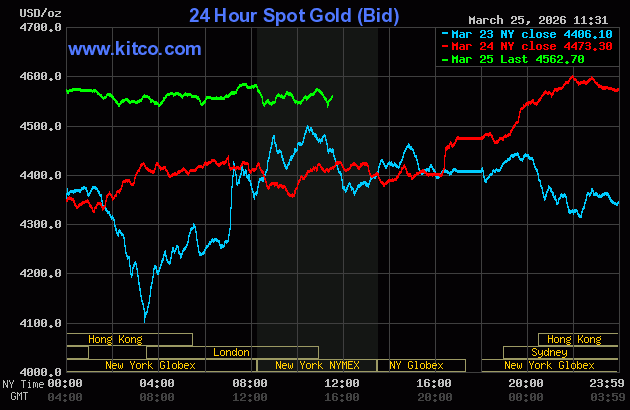
That detail matters because gold trades through two main pricing mechanisms: the spot market for immediate delivery and the futures market for delivery at a later date. Indian investors tracking bullion should watch both, because spot gold, futures pricing, and the USD/INR exchange rate can affect local gold rates differently.
Why does the futures-versus-spot distinction matter for India?
The distinction matters because Indian bullion prices do not move on one global benchmark alone. Imported gold costs can shift based on international spot prices, futures curves, and rupee exchange-rate changes at the same time.
That means MCX gold and physical bullion prices in India may not always mirror a single COMEX or CME move one-for-one. When global futures jump sharply, domestic prices can still be amplified or partly offset by INR moves.
How did the U.S. Treasury auction affect gold and inflation expectations?
A weak U.S. Treasury auction added to concerns that inflation risks remain difficult, especially if Middle East tensions keep oil prices elevated. That backdrop increased volatility across bonds, the U.S. dollar, and precious metals.
Bloomberg reported that U.S. Treasury prices fell on Tuesday and yields rose after investors showed weak demand at an auction of $69 billion in two-year Treasury notes. Losses deepened after the weak sale and after The Wall Street Journal reported that the U.S. was planning to deploy about 3,000 troops to the Middle East.
Two-year U.S. Treasury yields rose by as much as 10 basis points to 3.96%. The two-year notes were awarded at 3.936%, which was higher than their yield in pre-auction trading just before the bidding deadline.
That result signaled softer-than-expected demand and marked the highest two-year auction yield since last May. David Robin, interest-rate strategist at TJM Institutional Services LLC, told Bloomberg that the auction came during a very difficult and unsettled period.
He said, "Why commit? Risk-reward is heavily skewed to risk versus reward." That comment captured the market's hesitation as investors weighed inflation, geopolitical tension, and bond-market risk.
Why can weak bond demand both hurt and help gold?
Weak bond demand can pressure gold because higher yields increase the opportunity cost of holding non-yielding bullion. At the same time, rising inflation anxiety and geopolitical uncertainty can boost safe-haven demand for precious metals.
That tension helps explain why gold held strong gains even as risk appetite improved elsewhere. For Indian investors, higher U.S. yields can also influence foreign-exchange markets and the rupee, which then affects the landed cost of imported gold.
What did Federal Reserve Governor Michael Barr say about interest rates?
Federal Reserve Governor Michael Barr said U.S. interest rates may need to stay steady for "some time" because inflation remains well above the Federal Reserve's 2% annual target. His message reinforced the view that the Federal Reserve is not ready to ease policy quickly.
In remarks prepared for an event in Phoenix on Tuesday and reported by Bloomberg, Barr said he wants evidence that goods and services price inflation is sustainably retreating before considering further policy rate reductions. He added that this view holds as long as labor market conditions remain stable.

Barr said, "While I am hopeful that inflation will fall as the effects of tariffs on prices wane later this year, I would like to see evidence that goods and services price inflation is sustainably retreating before considering reducing the policy rate further, provided labor market conditions remain stable."
Why does Barr's comment matter for gold price outlook?
Barr's comments matter because higher-for-longer U.S. rates usually act as a headwind for gold. Higher policy rates and elevated bond yields can reduce the appeal of bullion, which does not pay interest.
Still, the market reaction on the day showed that dollar weakness and shifting inflation expectations carried more weight than Federal Reserve caution alone. That is an important signal for Indian investors watching whether global bullion can stay firm even without imminent U.S. rate cuts.
What are oil, the U.S. dollar, and Treasury yields signaling now?
Oil, the U.S. dollar, and Treasury yields pointed to a market that still supports precious metals. Nymex WTI crude oil was down around $3.50 a barrel and trading near $89.00, the U.S. dollar index was steady-weaker, and the benchmark 10-year U.S. Treasury yield was around 4.3%.
Lower oil prices suggested some cooling in immediate inflation pressure. A weaker U.S. dollar also made gold cheaper for non-U.S. buyers, which tends to support XAUUSD and other precious metals prices.
These cross-market signals helped gold and silver hold their gains near midday. Even though higher yields would normally challenge bullion, the softer dollar and easing oil pressure gave traders enough reason to keep buying.
What does this mean for Indian gold buyers?
For Indian bullion buyers, a weaker dollar can partly offset imported price pressure, but elevated global gold futures still keep domestic prices sensitive. If the rupee also weakens, Indian gold rates can remain high even when the dollar softens.
That is why Indian investors should track three variables together: global gold price, USD/INR, and U.S. yields. The next watchpoint is whether softer inflation expectations and a weaker dollar continue to outweigh higher-for-longer Federal Reserve signals and ongoing geopolitical uncertainty.