# Gold Price in 2026: Why HSBC Says It Acts Like a Risk Asset
Gold is behaving more like a risk asset in 2026, according to HSBC, even though the long-term case for bullion remains intact because of global de-dollarization and strong central bank demand. For Indian investors, that means gold price swings may stay sharp in the near term even if the broader structural outlook remains supportive.
HSBC Asset Management said moves in the gold price after the Iran conflict broke out have defied the usual safe-haven playbook. Instead of rallying on geopolitical tension, gold sold off sharply, showing that positioning, the U.S. dollar, and leveraged flows are now playing a bigger role in XAUUSD than many investors expected.
Why is gold behaving like a risk asset in 2026?
Gold is behaving like a risk asset in 2026 because ownership has shifted toward retail and leveraged buyers who are more likely to sell during periods of market stress. HSBC said this change helps explain why bullion has failed to react in the traditional safe-haven way during recent geopolitical shocks.
HSBC Asset Management analysts wrote that since the Iran conflict began, gold price action has "defied expectations." The standard market playbook suggested that mounting geopolitical tensions and economic uncertainty would support the yellow metal, much as they did during last year’s "Liberation Day" episode and the powerful two-year rally that followed.
Instead, gold did the opposite. HSBC said the yellow metal was down 15% to date in March.
How has investor positioning changed?
HSBC said market ownership has changed materially since earlier cycles. Retail participation and leveraged buying have increased, and those investors often face forced liquidation when broader markets come under pressure.
That matters because in periods of stress, some holders sell gold not because the long-term thesis has broken, but because they need cash or have to reduce risk. This behavior can make gold trade more like equities or other risk-linked assets in the short term.
Why does this matter for Indian investors?
For Indian investors, this shift means global gold price moves may look less intuitive than before. Even when geopolitics worsen, international bullion prices may still fall if the U.S. dollar strengthens or leveraged traders unwind positions.
In India, domestic gold rates also depend on the rupee-dollar exchange rate. So if global XAUUSD softens but the Indian rupee weakens against the U.S. dollar, the fall in local gold prices may be smaller than the decline seen in dollar terms.
What drove gold prices lower despite geopolitical tensions?
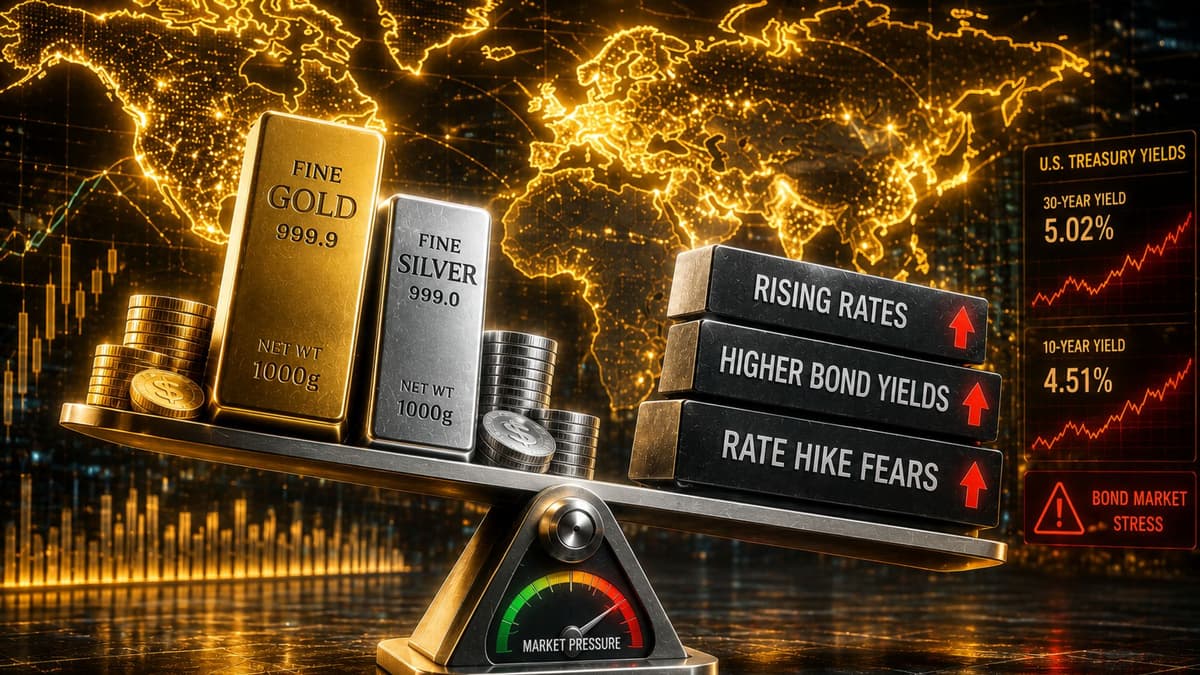
Gold prices fell despite geopolitical tensions because a stronger U.S. dollar and a hawkish repricing of interest rates raised the opportunity cost of holding non-yielding bullion. HSBC said those two forces outweighed the usual safe-haven boost.
The analysts said a stronger U.S. dollar deterred non-U.S. buyers, while higher rate expectations reduced the appeal of holding an asset that does not pay interest. That combination created a meaningful headwind for precious metals.
Why is the stronger U.S. dollar important for gold?
A stronger U.S. dollar usually pressures gold because bullion is priced globally in dollars per troy ounce. When the dollar rises, gold becomes more expensive for buyers using other currencies, which can reduce international demand.
HSBC noted that this has been one key reason for the recent weakness. For Indian buyers, a stronger dollar has mixed effects: it can weigh on international gold demand, but it can also push up imported gold costs in rupee terms if the INR weakens.
Why did higher interest rate expectations hurt bullion?
Higher interest rate expectations hurt bullion because gold is a non-yielding asset. When bond yields or expected returns on cash rise, investors may prefer interest-bearing alternatives over gold.
HSBC said the hawkish repricing of rates increased the opportunity cost of holding gold. Still, the bank also noted that this explanation is no longer complete because gold withstood a similar surge in the U.S. dollar and rates throughout 2022.
Why is gold no longer tracking real yields as closely as before?
Gold is no longer tracking real yields as closely as before because the market structure changed after 2022, with more retail buying, elevated geopolitical risk, and stronger central bank purchases. James Steel of HSBC said the old inverse correlation between gold and real rates has weakened significantly.
On Feb. 15, James Steel, Chief Precious Metals Analyst at HSBC, told CNBC that volatility would define the precious metals market in 2026 as Federal Reserve policy and U.S. dollar exposure continue to shape demand.
He was asked why gold was not responding to a drop in the U.S. 10-year Treasury yield, which had fallen from 4.30% to 4.00% in just a few days. Steel said the market relationship changed in 2022.
What did HSBC say about real rates and gold?
Steel said that before 2022, the real rate on the U.S. 10-year Treasury yield had a strong inverse relationship with gold, stretching back to the end of Bretton Woods. In simple terms, when real yields fell, gold often rose.
But he said that relationship has "broken down completely" in recent years. According to Steel, gold is not as sensitive to real rates, particularly the 10-year yield, as it used to be.
What changed after 2022?
Steel said three forces changed the market after 2022: more retail buying, elevated geopolitical risks, and central bank buying. Together, those factors diluted the old rate-driven model for gold price forecasting.
He added that the relationship between real yields and gold may return, but right now it is not as strong as it used to be. That is an important signal for investors relying on older macro frameworks to predict XAUUSD.
How does de-dollarization support the long-term gold outlook?
De-dollarization supports the long-term gold outlook because central banks can reduce U.S. dollar exposure by increasing their gold reserves. HSBC said this trend remains a solid long-term pillar for bullion, even if short-term volatility stays elevated.
HSBC Asset Management said there remains a "decent long-term investment case for gold," especially amid ongoing global de-dollarization. However, the analysts also warned that recent volatility is a reminder that portfolio diversification should remain broad-based.
What did James Steel say about the dollar’s reserve status?
Steel said HSBC still believes the U.S. dollar will remain the world’s reserve currency for the foreseeable future, and by that he meant for a very long time. But he also said that does not mean every central bank will want to hold as many dollars as it currently does.
One way central banks can reduce dollar exposure is by buying gold. That, according to Steel, has become an important driver of official-sector demand.
How strong has central bank gold buying been?
Steel said central bank buying since 2022 has been two, two and a half, and sometimes three times higher than previous 10-year averages. That scale of buying has helped underpin the long-term bull case for gold even when short-term speculative flows have turned negative.
For Indian investors, this matters because sustained central bank demand can create a structural floor under global bullion prices over time. It also reinforces gold’s role as a strategic asset in portfolios, even if near-term corrections remain sharp.
What did HSBC say about Federal Reserve independence and gold?
HSBC said any threat to Federal Reserve independence would raise the gold price. James Steel argued that as long as the Fed remains independent, that remains the key anchor for markets.
Steel was asked whether the nomination of Kevin Warsh might be linked to the recent pattern of falling rates without rising gold, given Warsh’s stated preference for reducing the Fed’s balance sheet. In response, Steel said the main issue was not the nomination itself, but whether the Federal Reserve’s independence remains intact.
Why does Fed independence matter for safe-haven demand?
Fed independence matters because gold often benefits when investors fear policy credibility is weakening. If markets believe monetary policy could become politically compromised, demand for safe-haven assets such as bullion can rise.
Steel said clearly: "Any threat to that raises the gold price." That makes U.S. monetary governance another important variable for investors tracking gold price direction in 2026.
Has gold’s bull market ended after recent volatility?
No, HSBC does not believe recent volatility means the gold bull market has ended. James Steel said sharp swings are a normal feature of a market that has already logged major gains and attracted substantial new money.
Steel noted that the earlier longstanding high for gold was $850 in January 1980. He said he prefers to assess that level in real, inflation-adjusted terms, which would be about $3,400 in today’s money.
Why is the $3,400 level important?
The $3,400 inflation-adjusted level is important because Steel said gold broke above it in April. That means bullion has exceeded its previous historic peak not just in nominal terms, but also in real terms.
He said gold has made a series of new highs, and the fact that it has not surged again recently does not necessarily undermine the broader bull market. Instead, it suggests the market is digesting earlier gains.
Why does HSBC expect continued volatility in precious metals?
HSBC expects continued volatility because gold saw a parabolic rally in January and attracted a lot of new money over the past couple of years. Steel said when a market rises that quickly, volatility becomes more likely.
He called volatility the benchmark word for 2026 in gold. He also stressed that a safe-haven asset can still be highly volatile.
For Indian investors, that means gold may remain strategically attractive, but entry points and position sizing matter more when price swings are large. Rupee movement, import costs, and domestic festival or wedding demand could further amplify or cushion global moves in local markets.
Investors now need to watch three factors closely: the U.S. dollar, Federal Reserve policy expectations, and signs that central bank buying remains elevated. If de-dollarization flows stay firm while volatility persists, gold prices may remain choppy in the short run but constructive over the longer horizon.