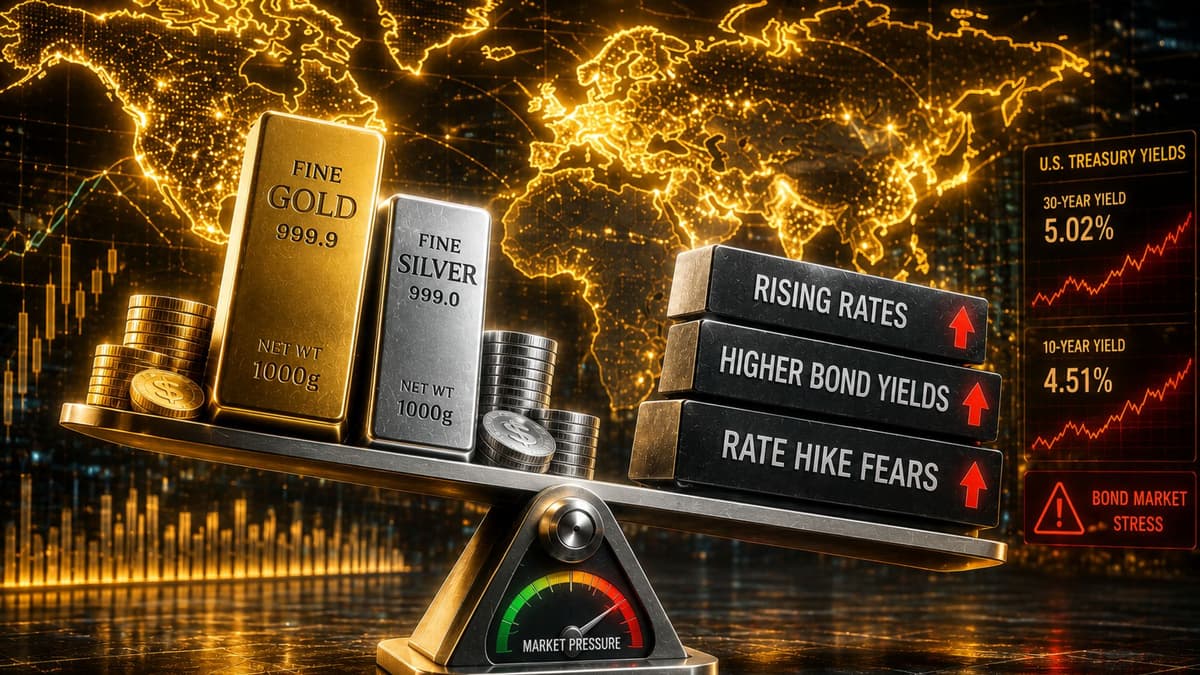
Gold prices held onto a 3% weekly gain and stayed above $4,600 per troy ounce, but bullion lost momentum after failing to break $4,800 resistance on Wednesday and Thursday. For Indian investors, the move matters because stronger crude oil, a firmer U.S. dollar, and rising global rate fears can support domestic gold prices in rupee terms even when XAUUSD struggles to extend gains.
Why did gold prices stall after gaining 3% this week?
Gold stalled because traders ran into strong resistance at $4,800 an ounce even as the market stayed on track for a 3% weekly gain. Prices remained above $4,600, but the upside faded as investors reassessed the fallout from the U.S. and Israel's joint conflict with Iran.Through most of the week, gold and silver regained bullish momentum because investors hoped the war would be resolved soon. That optimism weakened after markets started to price in a more prolonged conflict.
President Donald Trump tried to project confidence in a national address on Wednesday. But analysts said traders focused instead on the risk that the conflict may last longer than initially expected.
What resistance levels are traders watching in XAUUSD?
The immediate technical picture is clear: gold could not break $4,800, which became a near-term ceiling for bullion. That failure signaled that buyers still face headwinds despite the metal's safe-haven appeal.According to Nick Cawley, market analyst at Solomon Global, gold is still in solid recovery mode after briefly falling below $4,100 an ounce during last month's sharp selloff. He said the next major level is $5,000/oz, mainly as a psychological barrier rather than a pure technical resistance point.
Cawley said a confirmed break above $5,000 over the coming weeks would allow gold to reset its sights on the end-of-January all-time high.
How are Iran war risks and oil prices affecting gold price today?
Iran war risks are supporting safe-haven demand, but rising oil prices are also lifting inflation fears and rate expectations, which cap gold's upside. That push-pull dynamic explains why gold remains trapped in a tug-of-war.Oil prices moved back above $100 a barrel ahead of the Easter long weekend. Markets also began to price in the risk of further global supply-chain disruptions, which helped keep the U.S. dollar strong.
A stronger dollar usually makes gold more expensive for non-U.S. buyers and can limit gains in XAUUSD. At the same time, geopolitical stress still supports bullion demand as investors look for protection.
What did Alex Kuptsikevich say about the conflict?
Alex Kuptsikevich, chief market analyst at FxPro, said the market is grappling with conflicting signals on how long the war may last. He noted that Trump's promise to send Iran back to the "Stone Age" clashed with the earlier statement that the conflict could end within 2-3 weeks through successful negotiations.Kuptsikevich added that Polymarket participants estimate a 65% chance that the war between the U.S. and Iran ends by the end of June. He warned that a closure of the Strait of Hormuz before then would be a real disaster for the global economy.
For Indian investors, that risk is especially important because India is a major energy importer. If the Strait of Hormuz is disrupted and crude stays above $100, imported inflation could rise, the rupee could face pressure, and domestic gold prices could remain elevated even if international bullion pauses.
Why are rising rate fears limiting gold upside?
Rising rate fears are limiting gold because traders believe central banks may respond to oil-driven inflation by tightening monetary policy. Higher interest rates raise the opportunity cost of holding non-yielding assets such as gold.Kuptsikevich said the Middle East conflict is weighing on gold prices because markets expect central banks to raise rates to contain inflation caused by higher oil prices. He called that view short-sighted.
He argued that current fuel prices are a shock to consumers and will likely be followed by a broader shock to the economy. In his view, that would eventually require monetary policy to be eased rather than tightened.
What are the downside levels for gold?
Kuptsikevich said one of FxPro's medium-term targets is $4,200. He added that a decline to $4,200 would not break gold's broader upward trend.However, he said a break below $4,200 would signal a reversal of the three-year uptrend. A rebound from that level, by contrast, would keep alive hopes that the bullish trend in gold is not yet over.
Cawley at Solomon Global also said inflation will remain a short- to medium-term concern and cannot be ignored. He expects central banks to start tightening monetary policy over the coming weeks, but he added that if markets believe the situation is temporary and that rates will fall again from the end of this year onward, traditional gold headwinds should remain mild.
What support and resistance levels should gold investors watch next week?
The most important near-term level is $4,600 an ounce. A sustained move below that support could trigger a deeper pullback, while a successful defense could send gold back toward $4,800.According to Lukman Otunuga, senior market analyst at FXTM, a solid daily close below $4,600 could encourage a decline toward $4,450. If $4,600 holds as reliable support, prices may rebound toward $4,800.
When could gold's safe-haven appeal strengthen again?
Otunuga said gold may regain its safe-haven shine if a prolonged closure of the Strait of Hormuz turns into a growth shock that threatens the global economy. In that scenario, safe-haven demand for precious metals could become more important than the drag from higher interest rates.He also said the Federal Reserve remains in a tight spot as it tries to balance conflict-induced inflation against signs of weakness in the labour market. That policy tension is likely to keep volatility high across bullion markets.
For Indian buyers, that means rupee-denominated gold may react to two forces at once: global risk sentiment and the rupee's sensitivity to oil prices and the U.S. dollar. If crude and the dollar both stay firm, local gold prices can remain resilient even without a clean breakout in international markets.
What economic data could move gold prices next week?
The March U.S. nonfarm payrolls report could set the tone for next week because it will shape expectations for Federal Reserve policy and the U.S. dollar. Even though markets are closed for Good Friday, the U.S. government does not recognize Easter as an official holiday, so the employment report will still be released.Otunuga said traders will also watch key service-sector and manufacturing data. These reports could affect inflation expectations, growth forecasts, Treasury yields, and gold price direction.
Which U.S. reports are on the calendar?
Markets will monitor the following data next week:- Monday: ISM Services PMI
- Tuesday: US Durable Goods Orders
- Wednesday: Federal Reserve monetary policy meeting minutes
- Thursday: US final Q4 GDP, US PCE Index
- Friday: US CPI, University of Michigan Preliminary Consumer Sentiment
That mix of payrolls, PCE, CPI, GDP, Fed minutes, and sentiment data could decide whether gold breaks below $4,600, retests $4,800, or builds momentum toward $5,000. For Indian investors, the key watchpoint is whether geopolitical stress keeps supporting safe-haven demand faster than oil-driven inflation and higher-rate expectations can restrain bullion.