# Gold Price Holds Gains as US GDP Hits 2% and Core PCE Stays Hot
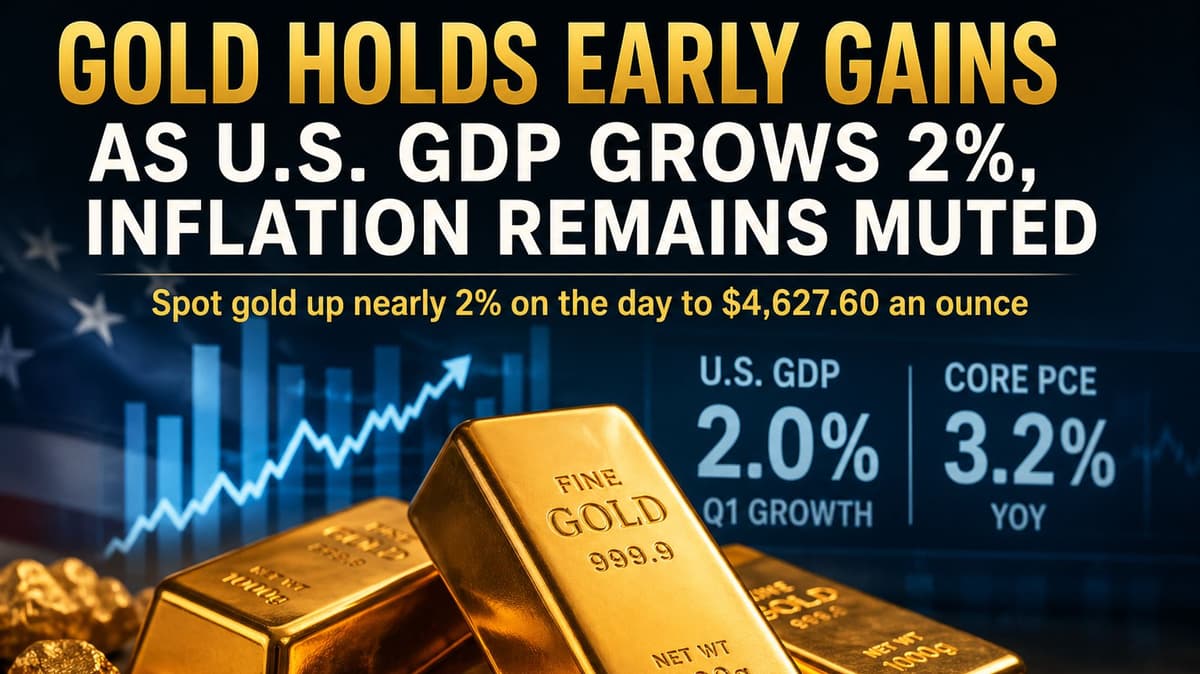
Gold prices held firm after the latest U.S. economic data showed slower-than-expected growth and still-elevated inflation, leaving bullion without a strong directional trigger. Spot gold last traded at $4,627.60 per troy ounce, up nearly 2% on the day, even as U.S. first-quarter GDP rose 2% and annual core PCE inflation stood at 3.2%.
For Indian investors, the takeaway is clear: gold is still drawing support from stagflation concerns in the United States, but sticky inflation may also keep the Federal Reserve cautious on rate cuts. That mix can influence both international XAUUSD prices and domestic gold rates in rupees.
What did the latest US GDP data show for gold prices?
The U.S. economy grew, but it grew more slowly than expected, which helped gold hold its gains rather than break sharply in either direction. The U.S. Bureau of Economic Analysis said on Thursday that first-quarter Gross Domestic Product (GDP) expanded 2% in the first three months of the new year.
That marked a clear improvement from 0.5% growth in the fourth quarter, but it still missed economists’ consensus estimate for 2.2% growth in Q1. For gold, that combination matters because it points to an economy that is still expanding but losing some momentum.
The BEA said the increase in real GDP was driven by investment, exports, consumer spending, and government spending. The report also noted that imports increased, which subtracts from GDP calculations.
For bullion traders, slower growth without a severe downturn tends to support safe-haven demand at the margin, but not enough to create a breakout on its own. That helps explain why gold kept its early gains but did not find a stronger trend after the release.
How did US inflation data affect bullion and the Federal Reserve outlook?
U.S. inflation remained elevated but broadly in line with expectations, which kept pressure on the Federal Reserve and limited gold’s upside response. The BEA said the Personal Consumption Expenditures (PCE) Index rose 0.7% last month, up from 0.4% in February.
On an annual basis, headline inflation rose 3.5%. Economists said the global energy supply crisis linked to the war in Iran continues to push headline prices higher.
However, the more closely watched core PCE reading suggested inflation has not fully spread across the broader economy. Core PCE, which excludes food and energy, rose 0.3% last month, compared with 0.4% in February.
Over the past 12 months, core inflation increased 3.2%. That is not an extreme acceleration, but it remains well above the Federal Reserve’s 2% target.
For gold, this is a mixed signal. Elevated inflation supports bullion’s role as an inflation hedge, but sticky core inflation can also delay Federal Reserve easing, which can act as a headwind for non-yielding assets like gold.
Why are traders focused on core PCE?
Traders focus on core PCE because it is one of the Federal Reserve’s preferred inflation gauges. A 3.2% annual reading suggests inflation is still too high for policymakers to feel comfortable pivoting quickly toward lower interest rates.
When markets expect rates to stay higher for longer, Treasury yields and the U.S. dollar can remain supported. That can cap upside in gold price and XAUUSD, even when growth slows.
Why did gold prices rise nearly 2% despite mixed economic signals?
Gold rose because investors still see a stagflation risk building in the U.S. economy. Slower-than-expected growth alongside inflation above target often creates a supportive backdrop for safe-haven assets such as gold and other precious metals.
Even so, the reaction was measured rather than explosive. Spot gold was last quoted at $4,627.60 an ounce, up nearly 2% on the day, showing that buyers stayed active but did not receive a strong enough macro trigger to push prices decisively higher.
Adam Button, Chief Market Strategist at Forexlive.com, said the inflation data adds important context to the Federal Reserve’s policy decision on Wednesday. The Federal Reserve left interest rates unchanged after its monetary policy meeting.
According to Button, some Federal Open Market Committee (FOMC) members discussed shifting the central bank’s easing bias to a neutral stance because of rising inflation risks. He said, “With Core PCE now well above 3.0%, you can see why some FOMC policymakers wanted to drop the easing bias.”
Button added that inflation, together with Q1 GDP, highlights growing stagflation risks, describing the data as “stagflation-adjacent.” That assessment helps explain why gold buyers remained interested even without a major post-data breakout.
What does the consumer spending and income data reveal about the economy?
The U.S. consumer is still supporting growth, but spending appears stronger than underlying financial capacity, which adds to stagflation concerns. The BEA said personal income increased 0.6%, following a 0.1% drop in February.
That income reading was stronger than expected. Economists had forecast a 0.3% increase.
At the same time, personal consumption increased 0.9%, following 0.5% growth in February. That matched economists’ expectations.
The gap between income growth and continued strong consumption suggests households are still spending aggressively even as inflation remains elevated. For gold investors, this matters because persistent consumer demand can keep inflation sticky, making it harder for the Federal Reserve to turn dovish.
Why does consumer spending matter for gold?
Consumer spending matters because it affects both growth and inflation expectations. If U.S. consumers keep spending at a solid pace, inflation may remain above target, which can reduce the chances of near-term rate cuts.
That environment can create short-term resistance for bullion. At the same time, if spending above means becomes unsustainable, recession worries can later strengthen safe-haven demand for gold.
What does this mean for Indian gold investors and rupee prices?
Indian investors should watch both the U.S. inflation path and the Federal Reserve’s policy bias because they shape global gold prices and often feed directly into domestic bullion rates. When spot gold holds above $4,627.60 per ounce and rises nearly 2% in a day, Indian gold prices can remain firm, especially if the rupee weakens against the U.S. dollar.
The current setup is important for India because gold demand is influenced by both international price action and currency conversion into INR. If U.S. stagflation risks deepen, safe-haven demand may support global bullion. But if sticky core inflation keeps U.S. rates elevated for longer, dollar strength could add volatility for Indian buyers.
For now, the key watchpoint is whether upcoming U.S. data confirms the stagflation-adjacent picture described by Adam Button. If growth slows further while core PCE stays above 3%, gold could remain supported globally, with Indian investors closely tracking the rupee, Federal Reserve signals, and imported inflation pressures.