# Gold Price Hits Session Highs as US Inflation Outlook Jumps
Gold prices climbed to fresh session highs on Friday after the latest University of Michigan data showed U.S. consumer sentiment improved to 49.8 in April, while inflation expectations rose sharply. For Indian investors, the move matters because stronger inflation worries in the United States can reinforce safe-haven demand for bullion and influence domestic gold rates through both global prices and the USD/INR exchange rate.
Why did gold price rise after the US consumer sentiment report?
Gold price rose because the market focused more on elevated inflation expectations than on the modest improvement in consumer sentiment. That combination supported safe-haven demand and pushed spot bullion to new intraday highs.
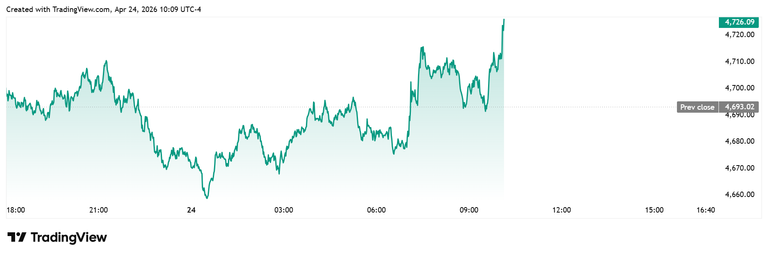
After the 10 am EST data release on Friday, spot gold climbed to $4,725.21 per troy ounce, up 0.69% on the day. The move came even though the final University of Michigan Consumer Sentiment reading for April improved to 49.8 from the preliminary 47.6.
Economists had expected the index to remain unchanged at 47.6, so the 49.8 print was better than forecast. Even so, sentiment remained well below March’s final reading of 53.3, showing that U.S. households still feel significant pressure.
For the gold market, that weaker underlying economic mood combined with hotter inflation expectations created a bullish backdrop for XAUUSD. Investors often buy gold when they expect inflation to stay high and economic confidence to remain fragile.
What did the University of Michigan consumer sentiment data show?
The University of Michigan survey showed consumer sentiment improved from its preliminary April level, but it still declined on the month and stayed near multi-year lows. That suggests U.S. consumers remain cautious despite a modest late-month recovery.
According to Joanne Hsu, Director of the Surveys of Consumers, “Consumer sentiment ticked down 3.5 index points this month, now comparable to the trough seen in June 2022.” She said decreases in sentiment appeared across political party, income, age, and education groups.
Hsu added that expected business conditions weakened over both short-term and long-term horizons. She said those readings nearly matched levels seen a year earlier, when the reciprocal tariff regime was implemented.
The April final reading came in at 49.8. That was above the preliminary reading of 47.6, but still below March’s final 53.3, preserving the broader picture of deteriorating consumer confidence.
What helped sentiment recover slightly later in April?
Sentiment recovered modestly after energy-related pressures eased somewhat. Hsu said the two-week cease-fire announcement and softer gas prices helped consumers regain a small portion of the losses seen earlier in the month.
She noted, “After the two-week cease-fire was announced and gas prices softened a touch, sentiment recovered a modest portion of its early-month losses.” That suggests U.S. households remain highly sensitive to fuel prices and broader inflation shocks.
How did the Iran conflict affect consumer views?
The Iran conflict influenced sentiment mainly through energy prices. Hsu said consumers appear to react more to shocks in gasoline and other prices than to military or diplomatic headlines alone.
She wrote, “The Iran conflict appears to influence consumer views primarily through shocks to gasoline and potentially other prices. In contrast, military and diplomatic developments that do not lift supply constraints or lower energy prices are unlikely to buoy consumers.” For gold, that link is important because geopolitical stress that lifts energy costs can also strengthen inflation hedging demand.
How high did US inflation expectations rise in April?
U.S. inflation expectations rose sharply in April, and that was the most gold-supportive part of the report. Year-ahead inflation expectations jumped to 4.7%, while long-run inflation expectations climbed to 3.5%.
Hsu said year-ahead inflation expectations surged from 3.8% in March to 4.7% in April. She described it as the largest one-month increase since April 2025.
That 4.7% reading also remained above the range seen before the pandemic. Hsu said the figure exceeded all readings seen in 2024 and stood well above the 2.3% to 3.0% range recorded during the two years before the pandemic.
Long-run inflation expectations also moved higher. After holding between 3.2% and 3.3% for the previous four months, they rose to 3.5% in April, the highest level since October 2025.
For historical context, Hsu said long-run inflation expectations ranged between 2.8% and 3.2% in 2024. In 2019 and 2020, they remained consistently below 2.8%.
What does this mean for gold investors in India?
For Indian investors, rising U.S. inflation expectations can support global gold price strength and keep domestic bullion rates elevated. If XAUUSD stays firm and the rupee weakens against the U.S. dollar, Indian gold prices can rise even faster.
A spot gold price of $4,725.21 per ounce directly affects imported bullion costs in India because domestic prices track international benchmarks alongside currency moves. That means jewellers, traders, and retail buyers should watch both COMEX and spot market trends as well as USD/INR.
Higher inflation expectations in the United States can also shape Federal Reserve rate expectations. If investors believe inflation will remain sticky, they may continue using gold as a hedge, especially during periods of geopolitical tension and volatile energy prices.
Indian investors should also note the safe-haven angle. The combination of weak consumer confidence, elevated inflation expectations, softer gas-price sensitivity, and geopolitical risks tied to Iran can keep bullion demand resilient even when headline economic data comes in above forecasts.
What should gold traders watch next?
Gold traders should watch whether inflation expectations remain elevated and whether geopolitical risks continue to feed energy price volatility. Those two drivers could matter more for bullion than a modest rebound in headline consumer sentiment.
The key figures from Friday’s report were clear: April consumer sentiment rose to 49.8 from the preliminary 47.6, but remained below March’s 53.3; year-ahead inflation expectations jumped from 3.8% to 4.7%; and long-run expectations increased to 3.5%, the highest since October 2025. As long as inflation fears stay sticky and uncertainty around energy supply persists, gold price momentum may remain constructive for global and Indian markets alike.