# Gold Price Falls Sharply on Iran Talks Collapse, Inflation Fears
Gold price and silver price fell in early U.S. trading on Monday after failed U.S.-Iran peace talks revived inflation fears and pushed oil prices sharply higher. For Indian investors, the move matters because rising crude, a stronger U.S. dollar, and elevated global uncertainty can keep bullion volatile while also influencing domestic gold rates in rupees.
Why did gold price fall today?
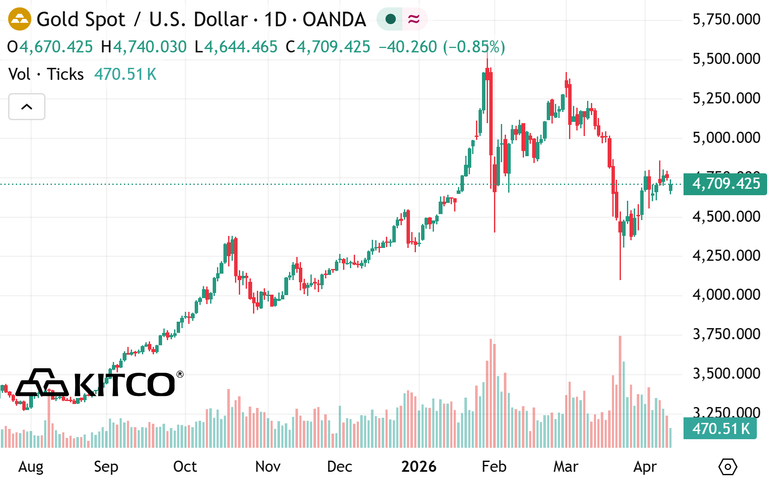
Gold price fell because markets shifted their focus from safe-haven demand to inflation risk and stronger outside markets that pressured bullion. June gold was last down $43.00 at $4,744.10 per troy ounce, while May silver fell $2.13 to $74.35.
The immediate trigger was the collapse of weekend peace talks between the United States and Iran. That breakdown reignited worries that a prolonged Middle East conflict could keep energy prices high and worsen global inflation.
Higher inflation expectations can hurt gold in the short term when they also lift U.S. Treasury yields and support the U.S. dollar. On Monday, the U.S. dollar index was higher, while the yield on the 10-year U.S. Treasury note stood at 4.35%, both of which created headwinds for XAUUSD and silver.
For Indian investors, this matters because international bullion moves are only one part of the equation. If the dollar remains firm and crude stays elevated, the Indian rupee can face pressure, which may cushion any fall in domestic gold prices even when global gold declines.
What happened in the U.S.-Iran conflict and why does it matter for bullion?
The U.S.-Iran conflict matters for bullion because it directly affects oil supply expectations, inflation outlook, and safe-haven positioning. Over the weekend, talks in Islamabad aimed at ending the six-week-old war broke down, leaving last week’s ceasefire looking increasingly fragile.
According to Bloomberg, U.S. President Donald Trump said the United States would blockade the Strait of Hormuz after the collapse of peace talks. Trump said in a social media post: “Effective immediately, the United States Navy, the Finest in the World, will begin the process of BLOCKADING any and all Ships trying to enter, or leave, the Strait of Hormuz.”
Vice President JD Vance and envoys Steve Witkoff and Jared Kushner left the region on Sunday after 21 hours of negotiations with top Iranian officials. Pakistan mediated the talks, but they failed to produce a breakthrough.
Iran said the talks collapsed because of U.S. “shifting goalposts.” Iran’s semi-official media cited “excessive” U.S. demands, while the foreign ministry said it was natural that differences would not be resolved in a single round of talks, leaving room for further discussions.
Several developments kept geopolitical tension elevated on Monday:
- A fragile ceasefire between the U.S. and Iran appeared to be holding, for now.
- The U.S. blockade from 10 a.m. ET Monday targeted all maritime traffic entering and exiting Iranian ports.
- Iran rejected U.S. restrictions on shipping and threatened ports in the Persian Gulf.
- Brent crude and WTI crude rose sharply.
- European gas futures spiked.
- Asian stocks and U.S. futures declined.
- Saudi Arabia said its east-west oil pipeline had been restored to full capacity.
- Bloomberg ran the headline: “A Panicked Race for Barrels Grips the Global Oil Market.”
- CNN reported that U.S. intelligence shows China is set to supply Iran arms.
How are oil prices, inflation worries, and the IMF affecting gold?
Oil and inflation worries are affecting gold by raising concerns that price pressures will stay elevated globally for longer. That can undermine demand expectations and keep financial markets nervous.
The key outside market to watch was Nymex WTI crude, trading around $104.50 a barrel. A sharp rise in crude often feeds directly into inflation expectations because energy costs affect transport, manufacturing, and household expenses worldwide.
International Monetary Fund Managing Director Kristalina Georgieva said prices would remain elevated even if a ceasefire holds. According to Bloomberg, Georgieva said global prices will take time to return to pre-war levels seen before the U.S.-Israeli war with Iran.
Georgieva told CBS’s Face the Nation on Sunday: “It will take some time, yes, and it will take more time for locations that are experiencing higher degree of disruption.” She added: “That’s why we need to remember the asymmetry of this shock.”
She also reiterated that the IMF will cut its global growth forecast because of the war in Iran. Georgieva said: “We are going to have a downgrade, and the size of this downgrade will depend on these two things, duration and speed with which everything can come back to the same level of production that we had before.”
For Indian investors, the inflation angle is especially important. India imports most of its crude oil, so sustained strength in oil prices can worsen imported inflation, pressure the rupee, and influence domestic bullion demand. In such periods, gold often remains strategically important as a hedge, even when international futures face near-term selling pressure.
What technical levels should gold traders watch now?
Gold traders should watch the $5,000 resistance zone on the upside and $4,500 support on the downside. These are the key near-term technical markers for June gold futures.
According to the technical outlook, June gold futures bulls’ next upside price objective is a close above solid resistance at $5,000.00. On the downside, bears’ next near-term price objective is pushing futures below solid technical support at $4,500.00.
Key gold price levels
- Current June gold futures: $4,744.10
- First resistance: $4,800.00
- Next resistance: last week’s high of $4,888.00
- Major upside objective: $5,000.00
- First support: $4,700.00
- Next support: overnight low of $4,626.00
- Major downside objective: $4,500.00
- Wyckoff Market Rating: 6.0
For Indian bullion buyers, these global levels often feed into MCX gold sentiment, especially when combined with rupee movement. If the rupee weakens while COMEX gold tests support, local prices may not decline as much as global charts suggest.
What are the important silver price levels after today’s drop?
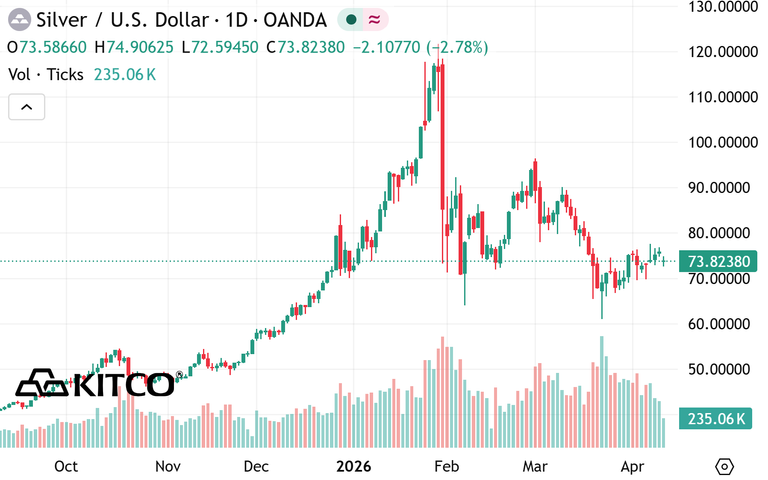
Silver price also weakened sharply, and traders now need to watch the $80 resistance area and the March low of $61.21 as major reference points. May silver futures were last down $2.13 at $74.35 per troy ounce.
Key silver price levels
- Current May silver futures: $74.35
- First resistance: $77.80
- Next resistance: $80.00
- Major upside objective: close above $80.00
- First support: $72.50
- Next support: last week’s low of $69.78
- Major downside objective: close below the March low of $61.21
- Wyckoff Market Rating: 5.5
Indian investors tracking silver should also keep an eye on rupee moves and industrial sentiment. If global growth forecasts weaken further after the IMF downgrade, silver could remain more volatile than gold in the near term.
What should Indian investors watch next in gold and bullion markets?
Indian investors should watch three things next: developments in the Strait of Hormuz, crude oil prices, and U.S. bond yields. These factors are likely to shape the next move in gold price, silver price, and domestic bullion rates.
Any escalation in shipping disruptions around Iran could keep WTI near or above $104.50 a barrel, worsen inflation fears, and increase volatility across precious metals. At the same time, if the 10-year U.S. Treasury yield pushes further above 4.35% and the U.S. dollar index stays firm, gold could remain under pressure despite safe-haven demand.
For India, the rupee response may be just as important as the international gold chart. A weaker rupee can lift local gold prices even if COMEX gold retreats, making global dips less beneficial for Indian retail buyers. The key watchpoint now is whether geopolitical stress pushes gold back toward $4,800-$4,888, or whether stronger yields drag prices toward $4,700 and $4,626 before buyers step back in.