# Gold Price Falls Sharply as Dollar and Bond Yields Climb
Gold prices dropped sharply in U.S. midday trading as the U.S. dollar index and U.S. Treasury yields moved higher, weighing on bullion despite broad market risk aversion. For Indian investors, the move matters because weaker international gold prices can offset some pressure from a firm dollar, while any rise in USD/INR can still keep domestic gold rates elevated.
Why did gold prices fall today?
Gold prices fell because the U.S. dollar index strengthened and U.S. Treasury yields edged higher, reducing the appeal of non-yielding bullion. Those two macro drivers pressured both gold and silver in midday U.S. trading.
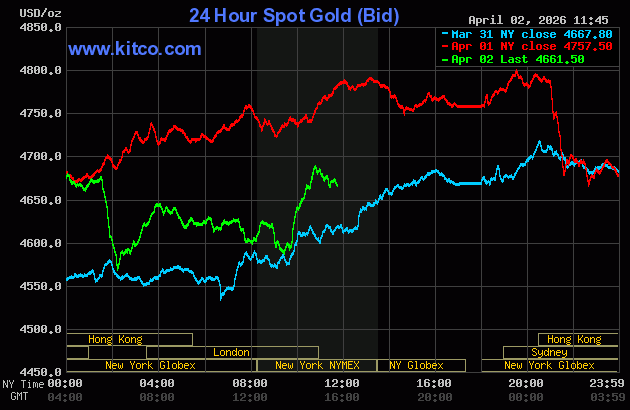
June gold was last down $121.70 at $4,690.90 per troy ounce. May silver fell $3.838 to $72.145.
Even so, both precious metals recovered from their session lows. That suggests selling pressure was strong, but buyers still emerged below the market.
Why is gold not getting safe-haven demand despite risk aversion?
Gold is not attracting strong safe-haven buying even though broader market anxiety remains elevated. That is frustrating gold bulls, especially because crude oil prices are surging, which often signals geopolitical or inflation-related stress.
The source article said market participants were again disappointed that gold and silver could not catch safe-haven bids amid keen risk aversion. In the same session, Nymex WTI crude oil climbed sharply to a three-week high, trading around $110.00 a barrel.
In normal conditions, rising oil, market stress, and risk aversion can support XAUUSD. This time, however, the stronger U.S. dollar and higher bond yields took priority.
For Indian investors, this is a key reminder: global fear does not automatically lift gold price every day. If the dollar rises faster than safe-haven demand, international bullion can still decline.
What are the key market levels investors should watch now?
Gold remains trapped between major technical resistance near $5,000 and support around $4,300. Traders are now watching whether futures can reclaim nearby resistance or break lower toward stronger support.
Gold price technical levels
According to the source article, April gold futures bulls’ next upside price objective is a close above solid resistance at $5,000.00. The bears’ next near-term downside objective is to push futures below solid technical support at $4,300.00.
First resistance stands at $4,700.00 and then $4,750.00. First support is seen at $4,600.00 and then at the overnight low of $4,580.40.
Wyckoff's Market Rating for gold: 5.0. That rating points to a technically neutral near-term setup rather than a clearly dominant bull or bear trend.
Silver price technical levels
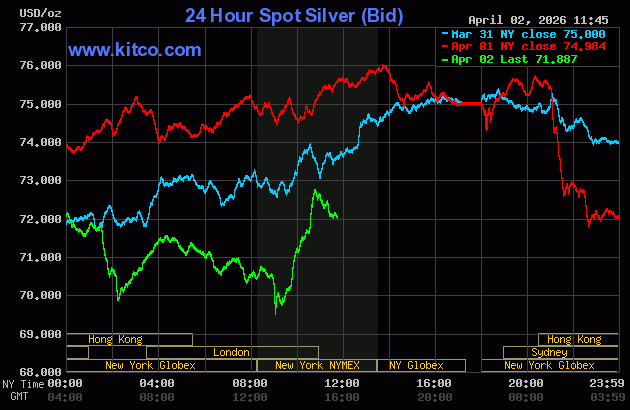
Silver also weakened sharply, but its chart remains defined by a clear trading range. The next move will depend on whether bulls can retake resistance or bears can force a break under key support.
For May silver futures, the bulls’ next upside price objective is a close above solid technical resistance at $80.00. The bears’ next downside objective is a close below solid support at the March low of $61.21.
First resistance is seen at $73.00 and then $75.00. Next support is seen at $70.00 and then at this week’s low of $67.70.
Wyckoff's Market Rating for silver: 5.0. Like gold, that signals a balanced technical picture in the near term.
How are the U.S. dollar and Treasury yields affecting bullion?
A stronger U.S. dollar and higher Treasury yields are hurting bullion by making gold less attractive relative to interest-bearing assets. That is the main reason gold price and silver price came under pressure in this session.
The U.S. dollar index was higher on the day. At the same time, the yield on the benchmark 10-year U.S. Treasury note was around 4.25%.
This matters for Indian investors because gold is globally priced in dollars. When the dollar strengthens, dollar-denominated gold often faces pressure, but the rupee impact can change the domestic outcome.
If USD/INR also rises, Indian bullion prices may not fall as much as international spot or futures prices suggest. That is why domestic buyers should track both XAUUSD and the rupee-dollar exchange rate together.

What should traders watch from the U.S. jobs report and holiday schedule?
The next major watchpoint is the U.S. Employment Situation Report for March, even though many key U.S. markets will be closed on Good Friday. That report could still reshape expectations for interest rates, the dollar, and precious metals.
All 10-year U.S. Treasury, financial and commodity markets will be closed on Friday for the Good Friday Easter holiday. However, the U.S. Labor Department will still release the Employment Situation Report for March.
The key non-farm payrolls number is forecast to show an increase of around 60,000 workers. That compares with a decline of 92,000 workers in the February report.
The overall U.S. unemployment rate is forecast at 4.4% in March, unchanged from February. A stronger-than-expected payrolls number could support the dollar and yields further, while a weaker reading could help gold recover.
For Indian investors, this report is especially important because it can quickly affect global gold price direction before the domestic market fully adjusts.
How do spot and futures prices work in the gold market?
Gold trades through both the spot market and the futures market, and that distinction matters when comparing prices in news reports. Spot prices reflect immediate purchase and delivery, while futures prices reflect delivery at a later date.
The article notes that the gold market operates through two primary pricing mechanisms. The spot market quotes prices for on-the-spot purchase and immediate delivery.
The futures market sets prices for delivery at a future date. Because of year-end positioning market liquidity, the December gold futures contract is currently the most actively traded on the CME.
For Indian readers, this is useful when comparing MCX gold, international spot gold, and COMEX futures. Price gaps between these markets can reflect contract timing, currency conversion, taxes, and local premiums.
The next key watchpoint is whether gold can hold above $4,600 and whether the U.S. jobs report shifts expectations for the dollar and Treasury yields. If yields stay near 4.25% or move higher and the dollar remains firm, bullion could stay under pressure, while any softer U.S. data may reopen the path toward $4,700 and $4,750.