# Gold Price Falls Before U.S. CPI as Traders Eye $5,000 Level
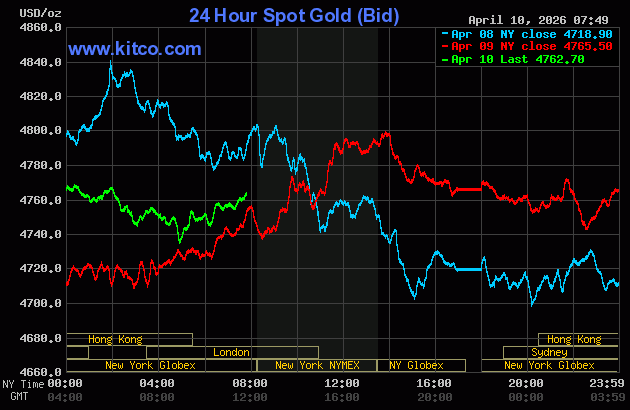
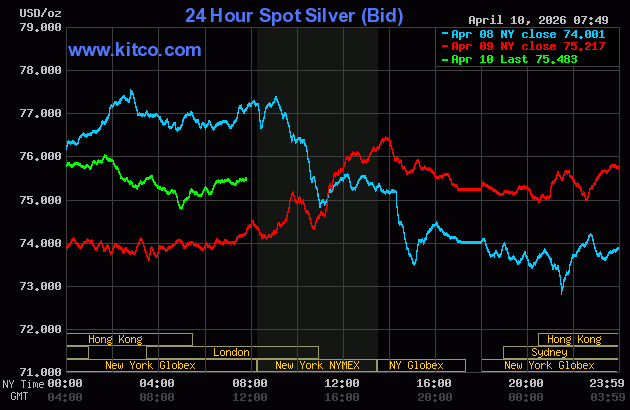
Gold prices slipped in early U.S. trading on Friday as investors turned cautious ahead of the March U.S. consumer price index report. June gold futures were last down $38.50 at $4,779.10 per troy ounce, while May silver futures fell $0.823 to $75.59.
For Indian investors, the move matters because global bullion weakness can influence domestic gold rates, even though rupee moves and import costs can soften or amplify the impact in the Indian market.
Why did gold prices fall before the U.S. CPI report?
Gold prices fell because traders reduced risk ahead of a major U.S. inflation print that could shift Federal Reserve rate expectations. When inflation data surprises on the upside, markets often price in higher-for-longer interest rates, which can pressure non-yielding assets such as gold.
The March U.S. CPI report was due later on Friday. Economists expected headline CPI to rise 0.9% month on month, while core CPI, which excludes food and energy, was forecast to increase 0.3%.
On an annual basis, the market expected headline CPI at 3.3% and core CPI at 2.7%. Those figures are important for XAUUSD and broader precious metals because they shape expectations for Federal Reserve policy, U.S. Treasury yields, and the U.S. dollar.
Thursday’s inflation data had already kept markets alert. The core PCE price index, the Federal Reserve’s preferred gauge of underlying inflation, rose 0.4% month on month in February, matching expectations and sustaining the 10-month high recorded over the prior two months.
Year on year, core PCE rose 3.0%, down from 3.1% in the previous month, but still well above the Federal Reserve’s 2% annual inflation target. That sticky inflation backdrop likely encouraged some short-term profit-taking in bullion ahead of the CPI release.
What do the latest U.S. inflation expectations mean for gold?
The answer is straightforward: if inflation stays hot, gold could face near-term volatility even if its longer-term safe-haven appeal remains intact. Higher inflation can support gold as an inflation hedge, but if it also pushes bond yields up and delays rate cuts, the immediate market reaction can be negative for bullion.
The key outside markets reflected that tension on Friday. Nymex WTI crude oil traded higher at around $98.00 a barrel, the U.S. dollar index was slightly lower, and the yield on the benchmark 10-year U.S. Treasury note stood at 4.3%.
For Indian investors, this mix is especially relevant. Higher crude oil prices can feed inflation concerns globally and also affect India’s macro outlook through imported energy costs. At the same time, a softer U.S. dollar can sometimes cushion global gold declines, although domestic rupee moves ultimately shape the landed gold price in India.
How are Middle East tensions affecting gold and silver prices?
Geopolitical risks are still supporting safe-haven interest in precious metals, but they did not stop Friday’s pullback. Traders were balancing inflation risk against a fragile security backdrop in the Middle East.
According to the source report, the ceasefire agreement between the U.S. and Iran appeared to be largely holding, but tensions remained elevated. U.S. and Iranian delegations were set to meet in Pakistan on Saturday, while Israeli strikes into Lebanon continued and Hezbollah kept firing rockets across the border.
President Donald Trump demanded that Iran reopen the Strait of Hormuz ahead of U.S.-Iran peace talks. A Russian-flagged tanker also transited Hormuz into the Persian Gulf in a rare passage, and Trump warned Iran not to charge fees for ships transiting the waterway.
Bloomberg reported that the truce announced on Tuesday remained shaky. Kuwait reported large-scale drone attacks on “vital” facilities overnight and accused Iran and its proxy groups of violating the ceasefire terms. There were no further reports of strikes on Friday, according to Bloomberg.
Israel also continued to target towns in southern Lebanon, raising fresh doubts over whether parallel regional conflicts could derail diplomacy. Hezbollah said it launched drones and rocket salvos toward Israel, while Israeli medics said they treated several people who were injured while rushing to shelters in central and southern Israel.
The Strait of Hormuz remains central to the market’s risk calculations because it handled about one-fifth of the world’s oil and liquefied natural gas before the war. Vice President JD Vance was expected to lead the U.S. delegation in talks scheduled in Islamabad, Pakistan.
For Indian bullion buyers, this matters because any disruption or renewed tension around Hormuz can affect oil prices, inflation expectations, the rupee, and ultimately domestic gold price trends.
What other global developments are shaping bullion sentiment?
Gold traders are also watching energy supply and war-related headlines beyond the Middle East. Developments in Venezuela and Ukraine could influence crude oil, risk appetite, and safe-haven demand.
How could Venezuela’s oil story affect gold markets?
ConocoPhillips is evaluating a potential return to Venezuela, according to Bloomberg. The company sent a team to assess drilling prospects in the oil-rich country nearly two decades after the socialist regime seized billions of dollars in assets.
ConocoPhillips spokesman Dennis Nuss said the purpose of the trip was to “better understand the potential for in-country oil and gas opportunities.” He added that the company would evaluate Venezuela against other international opportunities as part of its disciplined investment framework.
Bloomberg noted that this makes ConocoPhillips only the second major U.S. oil company to publicly disclose an on-the-ground inspection in Venezuela. Exxon Mobil Corp. had exited the country after asset seizures under Hugo Chavez.
At the CERAWeek by S&P Global conference in Houston last month, Dan Ammann, upstream president at Exxon, said rebuilding Venezuelan oil output to 3 million barrels a day would require “probably hundreds of millions of dollars” over a long time horizon.
If Venezuela eventually increases supply, that could influence oil prices and inflation expectations, which in turn can affect gold price direction.
Is progress in Ukraine-Russia talks reducing safe-haven demand?
There are signs of possible diplomatic progress, and that may be slightly easing some geopolitical risk premium. Bloomberg reported that Kyrylo Budanov, Ukraine’s top negotiator with Russia, said he sees progress toward a potential peace deal with the Kremlin.
Budanov said in an April 4 interview with Bloomberg that a resolution may not take long to achieve. He added, “They all understand the war needs to end. That’s why they are negotiating,” and said, “I don’t think it will be long.”
Any sustained improvement in peace negotiations could reduce demand for safe-haven assets such as gold, though markets are likely to wait for concrete developments before repricing aggressively.

What are the key technical levels for gold and silver now?
The technical picture shows gold still holding a broader bullish structure, but the market has turned cautious below the recent highs. June gold futures bulls now need a close above $5,000.00 to regain stronger upside momentum.
Bears, meanwhile, are targeting a move below solid technical support at $4,500.00. Immediate resistance for June gold futures stands at $4,800.00, followed by this week’s high at $4,888.00.
Initial support comes in at $4,750.00 and then $4,700.00. Wyckoff's Market Rating for June gold futures is 6.0, indicating bulls still retain a modest near-term technical advantage.
What are the important silver price levels?
Silver also weakened, and the technical setup remains slightly less constructive than gold. May silver futures bulls are targeting a close above solid resistance at $80.00.
On the downside, bears want a close below the March low of $61.21. First resistance is seen at this week’s high of $77.80 and then at $80.00.
Next support is located at $72.50 and then at this week’s low of $69.78. Wyckoff's Market Rating for May silver futures is 5.5.
How should Indian investors read today’s gold price move?
Indian investors should treat this dip as a data-driven pause, not necessarily a trend reversal. Gold remains sensitive to U.S. inflation, Federal Reserve policy signals, crude oil prices, and geopolitical stress, all of which can quickly shift bullion sentiment.
In India, the global gold price is only one part of the equation. The USD/INR exchange rate, import duties, local demand, and wedding-season buying can all affect retail prices for physical bullion and jewellery.
The immediate watchpoint is the U.S. CPI release. If inflation prints hotter than expected, gold could see more short-term pressure through higher yields and tighter rate-cut expectations; if the data cools, bullion could quickly retest $4,800 and potentially turn back toward $4,888 and the bigger $5,000 milestone.