# Gold Price Drops Sharply as Iran War Risks Cloud Demand
Gold prices fell sharply in Monday’s U.S. session as traders focused less on safe-haven buying and more on the economic damage from a prolonged U.S.-Iran war. For Indian investors, the move matters because weaker global bullion prices can offset some support from geopolitical risk, while any firmness in the U.S. dollar can still keep domestic gold rates elevated in rupee terms.
Why did gold prices fall today despite war tensions?
Gold fell because the market focused on war-driven demand destruction, slower growth, and tighter monetary conditions rather than on safe-haven flows. That shift pressured both gold and silver even as Middle East tensions remained elevated.
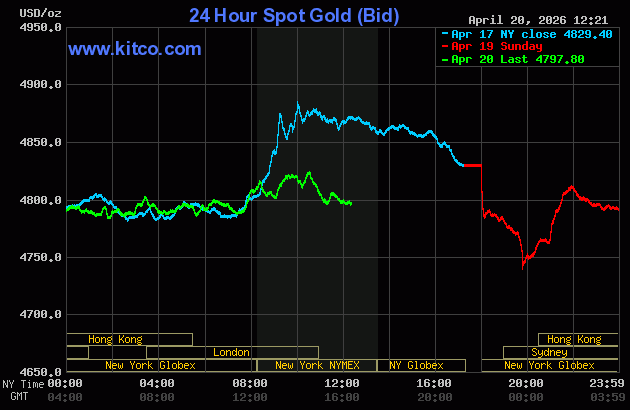
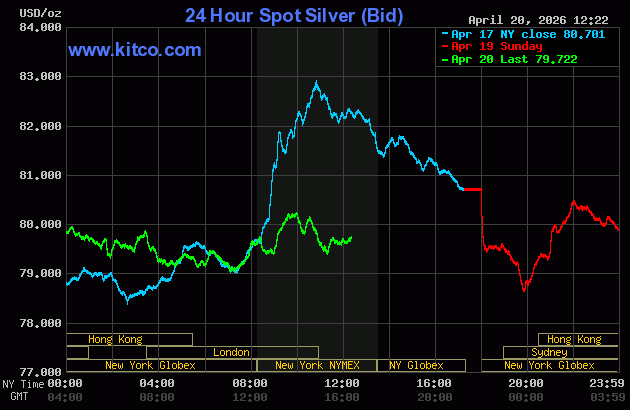
June gold futures were last down $62.00 at $4,817.60 per troy ounce in midday U.S. trading on Monday. May silver futures were down $2.007 at $79.835 per troy ounce.
Prices were also off their session lows, which shows some buyers still stepped in. However, the dominant trade on the day was bearish, with traders judging that a prolonged conflict could dent consumer and commercial demand for precious metals.
The core market view was that war-related economic strain may slow economies and lead to tighter monetary policies. In that setup, bullion loses some support even when geopolitical risks would normally boost safe-haven demand.
What is happening in the U.S.-Iran war and why does it matter for bullion?
The conflict matters because fading hopes of a near-term resolution kept economic uncertainty high while also raising worries about weaker physical demand. That combination weighed on gold price sentiment.
Iran wavered on whether to send diplomats to Pakistan for a second round of peace talks after the United States maintained a blockade of the Strait of Hormuz and seized an Iranian ship. Those developments dimmed hopes of a diplomatic breakthrough to end the war soon.
The article notes that the Middle East war has now lasted seven weeks. As that timeline extends, markets are beginning to assess the cumulative impact on growth, inflation, trade flows, and energy prices.
For Indian investors, this matters directly because disruptions around the Strait of Hormuz can affect crude oil prices, India’s import bill, inflation expectations, and the rupee. Higher oil prices can weaken the INR and raise local gold prices even if XAUUSD softens.
How is the war affecting the global economy?
The economic impact is expected to become clearer this week through a fresh round of business surveys across major economies. Investors are watching for evidence that the war is worsening the mix of slowing growth and rising prices.
According to a Bloomberg report cited in the source article, the key focus is whether the twin blows to growth and inflation seen in purchasing manager indexes after the first month of the Iran conflict intensified during month two. The first read for April in economies from Australia to the U.S. will be published on Thursday.
The same report said indexes in Germany, France, the euro zone, and the UK are expected to show broad deterioration, while U.S. indicators are seen as little changed. Bloomberg said the figures may show the degree to which stagflation is lurking, referring to the damaging combination of surging prices and stalling growth associated with the 1970s.
That backdrop can be mixed for precious metals. Gold often benefits from inflation and risk aversion, but it can also suffer when traders expect weaker industrial demand, tighter policy, and a firmer U.S. dollar.
What did the IMF say about growth, inflation, and recovery?
The International Monetary Fund signaled that the war’s damage will not disappear quickly, even if hostilities end soon. That warning reinforced concern about slower global growth and persistent inflation pressure.
IMF Managing Director Kristalina Georgieva told Bloomberg that even if the war ends tomorrow, recovery would still take quite some time to begin. That suggests the shock to the world economy could outlast the immediate military conflict.
The IMF also trimmed its global growth forecast for 2026 because of the oil-price shock caused by the war in the Middle East. The IMF now sees the world economy expanding 3.1% this year, down from its January forecast of 3.3%.
At the same time, the IMF raised its inflation estimate due to higher energy and food prices. For Indian households and investors, that is especially relevant because imported inflation and fuel costs can influence both jewellery demand and investment demand for gold.
Which economic data are markets watching next?
The main U.S. data release this week is retail sales, and economists expect a strong headline number. Much of that increase, however, is tied to higher gasoline spending rather than broad-based consumption strength.
The source article says economists project a sizable jump in overall March retail sales, largely because of sharply increased spending on gasoline. If energy costs are driving the gain, markets may read the data as more inflationary than growth-positive.
That matters for gold because sticky inflation can keep interest rates higher for longer. Higher rates typically raise the opportunity cost of holding non-yielding bullion.
How did the dollar, Treasury yields, and oil move?
Outside markets were broadly unsupportive for gold. Oil climbed, the U.S. dollar firmed, and Treasury yields remained elevated.
Nymex WTI crude oil was solidly higher and trading around $89.00 a barrel. The U.S. dollar index was a bit firmer, while the yield on the benchmark 10-year U.S. Treasury note was around 4.25%.
A firmer dollar usually pressures XAUUSD because gold becomes more expensive for holders of other currencies. For India, stronger crude and a firmer dollar can create a complicated setup: global gold may struggle, but domestic bullion prices can remain resilient if the rupee weakens.
What are the key technical levels for gold price now?
Gold still holds a moderately positive technical structure, but bulls need a move above $5,000 to regain stronger control. Bears, meanwhile, need to push prices below $4,500 to trigger a deeper breakdown.
The source article notes that the gold market operates through two main pricing mechanisms: the spot market, which quotes prices for immediate purchase and delivery, and the futures market, which sets prices for delivery at a later date. Because of year-end positioning market liquidity, the December gold futures contract is currently the most actively traded on the CME.
Gold futures resistance and support
For June gold futures, bulls’ next upside price objective is a close above solid resistance at $5,000.00 per troy ounce. Bears’ next near-term downside price objective is pushing futures below solid technical support at $4,500.00.
First resistance stands at the overnight high of $4,834.50, followed by $4,900.00. First support is seen at the overnight low of $4,752.00, followed by $4,700.00.

Wyckoff's Market Rating: 6.0.
For Indian traders tracking COMEX and MCX correlations, these levels matter because international futures often set the tone for domestic bullion pricing, adjusted for USD/INR and import-related costs.
What are the technical levels for silver price?
Silver also weakened, but its chart still shows a balanced technical setup similar to gold. Traders are now watching whether silver can reclaim resistance above $80.755 or slip toward the mid-$70s.
For May silver futures, bulls’ next upside price objective is a close above solid technical resistance at $85.00. Bears’ next downside objective is a close below solid support at $70.00.
Silver futures resistance and support
First resistance is seen at the overnight high of $80.755 and then at last week’s high of $83.245. Next support is seen at $77.00 and then at $75.00.
Wyckoff's Market Rating: 6.0.
Silver’s dual role as both a precious metal and an industrial metal makes it especially sensitive to fears of slowing global growth. That is one reason silver underperformed sharply on the day.
What does this mean for Indian gold investors?
Indian investors should watch the interaction between global gold price weakness, crude oil, and the rupee. A falling XAUUSD price does not always translate into a similar drop in domestic gold rates.
If the U.S.-Iran war continues to support oil near $89.00 a barrel or higher, India could face pressure through higher imported inflation and currency volatility. That may keep local bullion prices supported even if COMEX gold remains below recent highs.
In the near term, traders should monitor Thursday’s April PMI releases, the U.S. retail sales data, the U.S. dollar index, and whether June gold can hold above $4,752.00 support. If the war drags on and stagflation fears deepen, Indian investors may see volatile but opportunity-rich moves in both gold and silver.