# Gold Price Dips After Fed Hold as Split Vote Jolts Bullion
Gold prices fell after the U.S. Federal Reserve kept interest rates unchanged, while fresh disagreement inside the Federal Open Market Committee signalled a less unified path on future easing. For Indian investors, the move matters because shifts in U.S. rates, dollar strength, and global risk sentiment often feed directly into domestic gold prices in rupees.
Why did gold prices fall after the Fed decision?
Gold prices fell because the Federal Reserve held rates steady and revealed a split over how quickly policy should turn more dovish. That combination reduced immediate support for bullion, even though markets had widely expected no rate change.
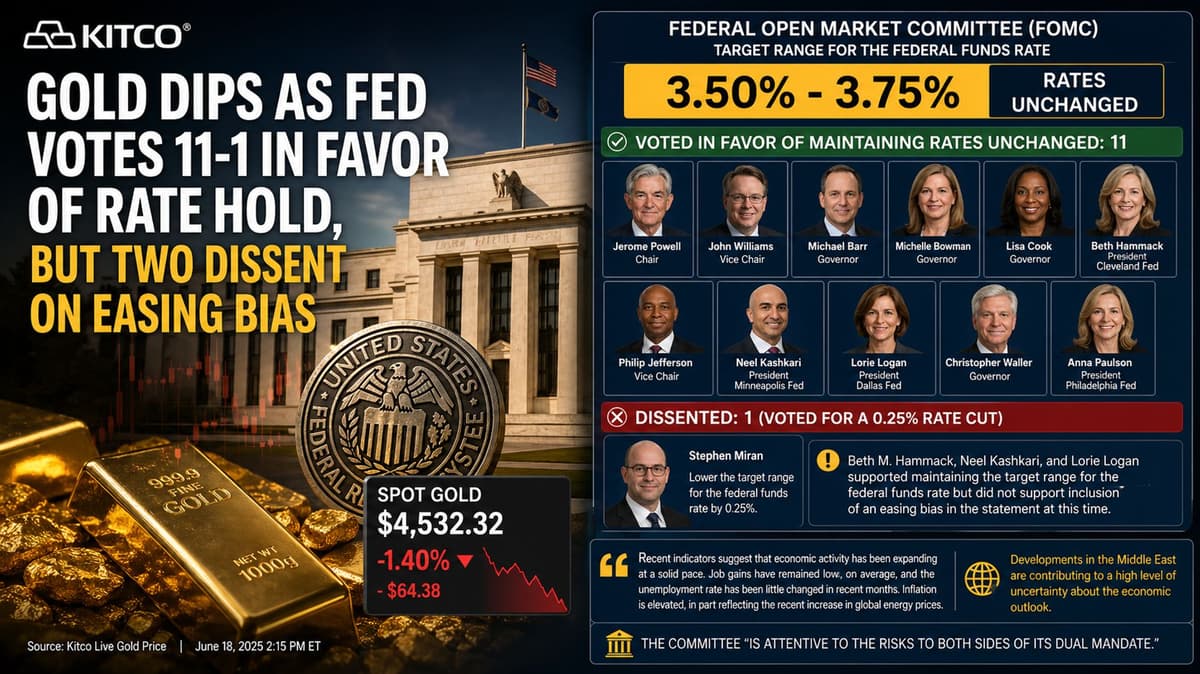
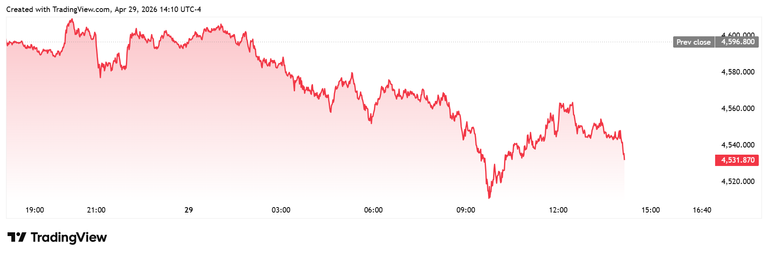
Spot gold was last trading at $4,532.32 per troy ounce, down 1.40% on the session after the announcement. In XAUUSD terms, the reaction showed that traders focused not just on the rate hold itself, but on the message around future policy direction.
For Indian investors, a softer gold price in dollars can sometimes be offset by rupee moves. If the Indian rupee weakens against the U.S. dollar, domestic gold rates may not fall by the same magnitude as international bullion prices.
What did the Federal Reserve decide on interest rates?
The Federal Reserve kept the federal funds target range unchanged at 3.50% to 3.75%. The decision matched market consensus.
The U.S. central bank announced on Wednesday that the Federal Open Market Committee, or FOMC, voted to maintain the current target range. That meant no immediate change in borrowing costs, but the statement still moved financial markets because investors were looking for guidance on the next policy step.
Higher-for-longer interest rates usually weigh on gold because bullion does not pay interest. When the Federal Reserve keeps rates elevated or appears cautious about easing, gold can lose some near-term safe-haven and momentum support.
What did the Fed say about the U.S. economy and inflation?
The Federal Reserve said the U.S. economy continues to expand at a solid pace, while inflation remains elevated. That assessment helps explain why policymakers chose to leave rates unchanged.
In its statement, the Federal Reserve said, “Recent indicators suggest that economic activity has been expanding at a solid pace.” The central bank also said, “Job gains have remained low, on average, and the unemployment rate has been little changed in recent months.”
On inflation, the Federal Reserve said, “Inflation is elevated, in part reflecting the recent increase in global energy prices.” That matters for gold because sticky inflation can support bullion over time as an inflation hedge, but it can also delay rate cuts, which is often a short-term headwind for precious metals.
For Indian gold buyers, elevated global energy prices also carry domestic significance. Higher energy costs can affect India’s import bill, inflation expectations, and the rupee, all of which can shape local bullion pricing.
How divided was the FOMC vote?
The FOMC was mostly united on holding rates, but disagreement emerged over both a rate cut and the inclusion of an easing bias. That split is the key policy signal markets are now parsing.
According to the Federal Reserve, 11 FOMC members voted in favor of maintaining rates unchanged. Those members were Chair Jerome Powell, Vice Chair John Williams, Michael Barr, Michelle Bowman, Lisa Cook, Beth Hammack, Philip Jefferson, Neel Kashkari, Lorie Logan, Christopher Waller, and Anna Paulson.
The lone dissenter on the rate decision was Stephen Miran, who argued for lowering the target range for the federal funds rate by 0.25%. That shows at least one policymaker wanted an immediate cut rather than a hold.
At the same time, the disagreement was not only about cutting rates. The statement said Beth M. Hammack, Neel Kashkari, and Lorie Logan supported maintaining the target range for the federal funds rate but did not support inclusion of an easing bias in the statement at this time.
This means the Committee was split in two directions: one official wanted a 25-basis-point cut, while three others resisted signalling easier policy too early. For gold, that kind of policy divergence can create volatility because it clouds the outlook for real yields, the U.S. dollar, and future safe-haven demand.
What risks did the Fed highlight for markets and gold?
The Federal Reserve flagged Middle East risks and broader uncertainty around the economic outlook. Those geopolitical concerns can support safe-haven demand for gold, even when interest-rate signals pressure bullion in the short term.
The FOMC said that “developments in the Middle East are contributing to a high level of uncertainty about the economic outlook.” It also said the Committee “is attentive to the risks to both sides of its dual mandate.”
For precious metals markets, this creates a two-way push. On one side, steady rates and a less clearly dovish message pressured gold lower on the day. On the other side, geopolitical uncertainty and elevated inflation can still underpin medium-term demand for bullion.
Indian investors should watch this balance closely. If geopolitical risks intensify, global gold prices may regain support quickly, and any rupee weakness could amplify gains in local gold rates.
What does the Fed split mean for the gold price outlook in India?
The Fed split suggests gold may remain volatile as traders reassess the path of U.S. rates. Indian investors should track both XAUUSD and USD/INR because domestic pricing depends on both.
A rate hold at 3.50% to 3.75% is not, by itself, a shock. The bigger market takeaway is that the FOMC no longer looks fully aligned on whether policy should begin easing or whether it should avoid signalling cuts too soon.
That matters for bullion because gold responds sharply to changes in expectations for U.S. interest rates, Treasury yields, and the dollar. If markets start pricing a slower easing cycle, gold could face near-term pressure. If geopolitical risks in the Middle East worsen or inflation stays elevated, safe-haven flows could return.
For Indian households, jewellers, and investors in digital gold, gold ETFs, and physical bullion, the next watchpoint is whether future Federal Reserve communication becomes more clearly dovish or more firmly divided. That will likely shape the next move in international gold prices and, by extension, India’s rupee-denominated gold market.