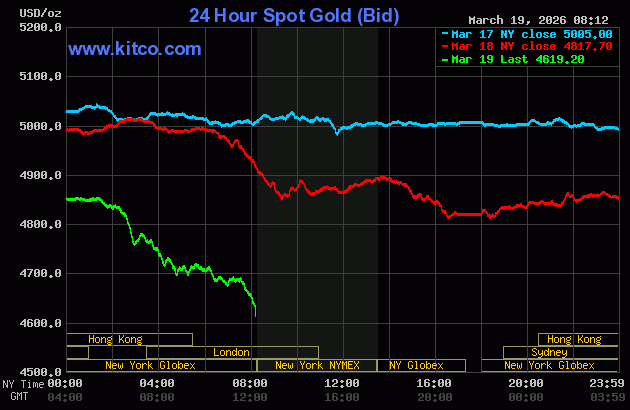
Gold prices slumped to a six-week low in early U.S. trading on Thursday as inflation worries, higher energy prices, and a firmer U.S. dollar hit bullion and broader precious metals sentiment. For Indian investors, the global selloff in XAUUSD matters because any sustained weakness in dollar-denominated gold can be partly offset or amplified by USD/INR moves, especially when crude oil spikes threaten India's import bill and rupee stability.
Why did gold price fall sharply today?
Gold price fell sharply because traders now expect inflation to stay sticky enough to keep major central banks, especially the Federal Reserve, tighter for longer. That mix supported the U.S. dollar and raised concerns that consumer and commercial demand for gold and silver could weaken.
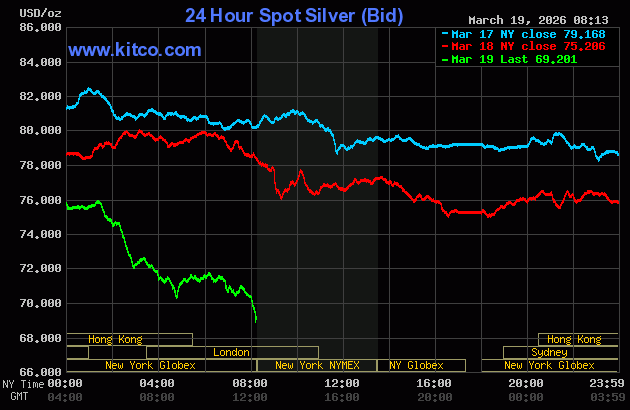
In early U.S. trading on Thursday, April gold was last down $226.60 at $4,669.20 per troy ounce. May silver was down $6.852 at $70.735.
Gold futures have now dropped more than $900 an ounce from the late-January record high. Silver prices have fallen more than $50 an ounce from their late-January record high.
For Indian investors, a global correction in bullion often influences domestic gold rates through imported price transmission. However, if crude oil remains elevated and pressures the rupee, local gold prices in INR may not fall as much as international gold prices suggest.
How is the Middle East war affecting gold, silver, and metals markets?
The worsening war in the Middle East is hurting metals markets by driving energy prices higher and increasing fears of broader damage to the global economy. Instead of boosting safe-haven buying decisively, the conflict has intensified inflation fears, which in turn has pressured gold and silver.
The article described metals markets as being punished amid the war in the Middle East. Broad declines were seen on the London Metal Exchange after Iran and Israel traded strikes on energy facilities in the region.
Copper also lost momentum. Copper, which began the year in bullish form and reached an all-time high in late January, has now shed more than 9% this month and has given up its gains for the year.
What were the key war-related developments?
The latest reported developments were highly market-sensitive:
- Donald Trump pressed for de-escalation of attacks on gas facilities in Iran and Qatar.
- Iran struck a crucial Saudi Arabian refinery on the Red Sea and an LNG export plant in Qatar.
- The Israeli military earlier attacked Iran's giant South Pars gas field.
- WTI crude oil hit $100 overnight.
- Brent crude reached $119 a barrel.
- Stocks slumped on fears that higher energy prices will feed inflation.
- European gas futures surged as much as 35% to more than double their pre-war level.
- Asia bought the most U.S. oil in three years as the war blocked Middle East flows.
What did the Federal Reserve say and why does it matter for gold?
The Federal Reserve kept U.S. interest rates unchanged on Wednesday, as markets expected, but signaled that inflation and war-related uncertainty could delay easier monetary policy. That is bearish for non-yielding assets like gold because higher real rates and a stronger dollar tend to reduce bullion's appeal.
The Federal Open Market Committee said it expects one interest rate cut this year due to increased uncertainty from the war in the Middle East. Fed Chair Jerome Powell said progress on reducing inflation is still needed before the Federal Reserve resumes lowering rates.
Fed officials also raised their outlook for inflation in 2026 to 2.7% annually. That shift reinforced the market's view that inflation risks remain alive.
Powell also said in his press conference that he has no intention of resigning as a member of the Federal Reserve Board of Governors until a Department of Justice investigation of the Fed has concluded.
Why does tighter policy pressure bullion?
Gold and silver usually perform best when investors expect lower interest rates, weaker bond yields, or softer currency conditions. When the Federal Reserve stays restrictive, the U.S. dollar often strengthens and Treasury yields remain elevated, making interest-bearing assets relatively more attractive than bullion.
That dynamic was visible again on Thursday. The U.S. dollar index was slightly higher, while the yield on the benchmark 10-year U.S. Treasury note stood at 4.3%.
For Indian investors, U.S. rates matter because they shape global capital flows, the dollar, and emerging-market currencies. If the dollar remains firm, imported gold in India can stay expensive in rupee terms even during a pullback in international spot or futures prices.
What are the key outside markets telling traders now?
The outside markets are signaling a classic inflation-risk environment: a firmer U.S. dollar, stronger crude oil, and elevated Treasury yields. That combination usually creates a difficult near-term backdrop for gold price and silver price action.
On Thursday, Nymex crude oil was firmer and trading around $97.25 a barrel. The U.S. dollar index was slightly up, and the benchmark 10-year U.S. Treasury yield was at 4.3%.
These cross-market signals help explain why precious metals sold off even as geopolitical stress intensified. In this case, inflation fears and tighter-policy expectations outweighed gold's normal safe-haven support.
What happened in copper and broader industrial metals?
Copper weakened because traders started to price in slower global growth and higher energy costs as the Middle East conflict worsened. That shift dragged on industrial metals sentiment across the board.
There were broad declines on the London Metal Exchange. Copper had started 2026 strongly, reached a record high in late January, and then lost more than 9% this month.
That is relevant for precious metals investors because broad commodity liquidation can spill into gold and silver futures, especially when traders need to cut risk or raise cash.
Why was Brazil mentioned in the market backdrop?
Brazil was mentioned because its central bank delivered a smaller-than-expected rate cut, a sign of policy caution that supports the Brazilian real and limits pressure on short-term yields. That fits the wider global theme that central banks remain wary of cutting too aggressively while inflation risks stay elevated.
Bloomberg reported that policymakers led by Gabriel Galipolo delivered their first cut to the benchmark Selic rate since 2024, lowering it by a quarter point to 14.75%. Money managers said that cautious easing should support local assets and the currency.
The report quoted this view: "The rate cut was important, even though it was smaller than initially expected, and the statement also showed caution, but if external risks ease, there's room for the market to recover."
For gold investors, the Brazil example underlines a bigger message: central banks globally still see inflation and external shocks as serious risks. That backdrop can keep markets volatile across bullion, currencies, and bonds.
What are the key technical levels for gold price now?

Gold price remains under clear technical pressure, but traders are now focused on whether April futures can defend nearby support and avoid a deeper breakdown toward the February low. The technical map remains balanced rather than outright bearish, with Wyckoff's Market Rating at 5.0.
Gold futures technical levels
According to the technical outlook in the source report:
- April gold futures bulls' next upside price objective is a close above solid resistance at $5,000.00.
- Bears' next near-term downside price objective is pushing futures below solid technical support at the February low of $4,423.20.
- First resistance is at $4,750.00.
- Second resistance is at $4,800.00.
- First support is at $4,650.00.
- Second support is at $4,600.00.
- Wyckoff's Market Rating: 5.0.
What are the key technical levels for silver price now?
Silver price looks weaker than gold on the charts, with a lower Wyckoff rating and nearby support levels under pressure. If May silver futures lose $70.00 decisively, traders may start looking more closely at a deeper move toward the February low.
Silver futures technical levels
The source report listed the following levels for May silver futures:
- Bulls' next upside price objective is a close above solid technical resistance at $90.00.
- Bears' next downside price objective is a close below solid support at the February low of $64.66.
- First resistance is at $72.50.
- Second resistance is at $75.00.
- Next support is at $70.00.
- Second support is at $67.50.
- Wyckoff's Market Rating: 4.0.
How do spot and futures gold prices differ?
Gold trades through both the spot market and the futures market, and the difference matters when investors interpret quoted prices. Spot gold reflects on-the-spot purchase and immediate delivery, while futures prices reflect delivery at a later date.
The source note added that, due to year-end positioning market liquidity, the December gold futures contract is currently the most actively traded contract on the CME. That matters because front-page gold price moves in the media may refer to a futures contract rather than the international spot quote.
For Indian readers, this distinction is important when comparing international XAUUSD prices, CME futures, and domestic retail or MCX prices, which can all diverge because of contract structure, taxes, currency moves, and local premiums.
Gold investors now need to watch whether inflation fears intensify further through oil and gas prices, or whether geopolitical tensions cool enough to ease pressure on the Federal Reserve and the U.S. dollar. For India, the next key watchpoint is how global bullion prices interact with USD/INR and crude oil, because that combination will shape whether domestic gold prices correct meaningfully or stay elevated despite the global selloff.