Why did gold prices fall more than 10% in a week?
Gold prices fell more than 10% this week because traders faced a mix of hawkish central bank signals, hotter-than-expected U.S. inflation data, rising yields, a stronger U.S. dollar, and war-related uncertainty around Iran. Those forces hit bullion after gold failed to hold key support levels in XAUUSD trading.According to the Kitco News report, spot gold started the week at $5,023.53 per troy ounce and spent nearly three days trading in a relatively stable range. Through Sunday evening, Monday, Tuesday, and most of Wednesday's Asian and European sessions, gold moved between $5,040 and $4,975, often within a tighter $30 range.
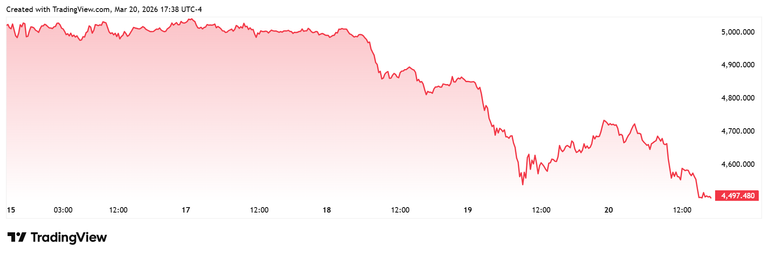
That calm broke at 6:30 a.m. Wednesday, when spot gold slipped below critical support at $4,970 per ounce. Once that level gave way, gold collapsed by about $120 in a little over two hours, only stabilizing near $4,860 per ounce.
The market then absorbed a hotter-than-expected Producer Price Index (PPI) print before the Federal Reserve's policy decision at 2:00 p.m. While the Fed's rate hold was widely expected, Fed Chair Jerome Powell's press conference triggered another wave of selling that pushed gold toward $4,800 per ounce by the U.S. equity market close.
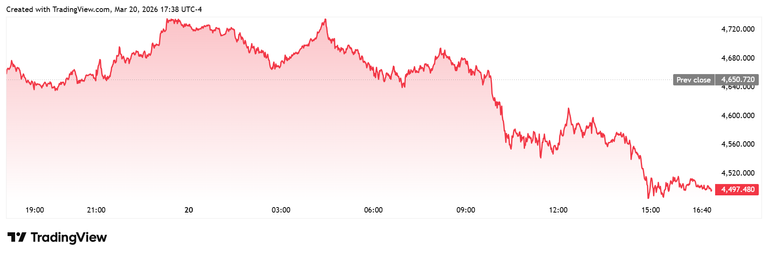
A second capitulation followed during the Asian session on Thursday. Gold fell from $4,833 at 2:00 a.m. Thursday to $4,538 half an hour before the North American equity open, marking its sharpest decline since the early February collapse.
What happened to spot gold prices during the week?
Spot gold saw repeated breakdowns, a brief rebound, and then another sharp selloff into the weekly close. The price action showed how quickly bullish sentiment in precious metals evaporated once support levels failed.How did gold trade early in the week?
Gold opened at $5,023.53 per ounce and reached the weekly high at just above $5,040 on Tuesday. For much of the first half of the week, traders saw unusually steady price action, with gold mostly holding between $5,040 and $4,975.When did the first major breakdown begin?
The first major breakdown began at 6:30 a.m. Wednesday when gold broke below $4,970. The move quickly accelerated, sending bullion down to $4,860 per ounce in a little over two hours.How did gold react after the Federal Reserve decision?
Gold initially did little after the Federal Reserve left interest rates unchanged. But Powell's remarks drove XAUUSD down to the edge of $4,800 per ounce by the close of the U.S. equity session.What was the biggest drop of the week?
The steepest fall came in Thursday's Asian session. Gold plunged from $4,833 at 2:00 a.m. Thursday to $4,538 just before North American markets opened.Did gold recover at all?
Yes, gold staged a short-lived rebound. It bounced to $4,630 within half an hour, then built near-term support around $4,575, and spent Thursday on its only sustained uptrend of the week.That rebound peaked at $4,733 per ounce by 11:15 p.m. Eastern. But when a second attempt near $4,730 failed, selling resumed.
Where did gold finish the week?
Gold then lost the remaining half of its weekly decline. It dropped from $4,722 at 4:15 a.m. to below $4,500 by 3:00 p.m., setting the weekly low at $4,477.54 per ounce and closing the week just under the $4,500 per ounce mark.For Indian investors, that global gold price weakness may partly cushion domestic bullion rates, but the final impact depends on the USD/INR exchange rate. If the rupee weakens while international gold falls, the correction in Indian gold prices may look smaller in rupee terms.
Why did Wall Street and Main Street turn bearish on gold?
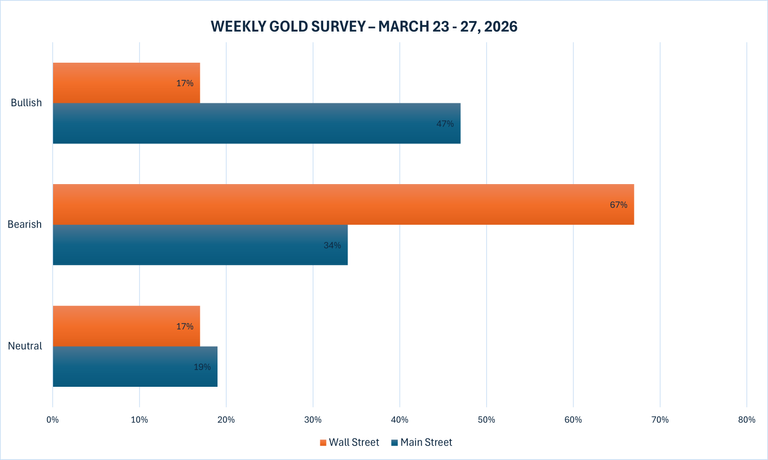
Wall Street experts broadly gave up on gold's near-term momentum, and Main Street investors also turned negative after another poor weekly performance. The latest Kitco News Weekly Gold Survey captured that sharp shift in sentiment.The survey showed that professional market participants no longer expected an immediate rebound after gold's collapse. Retail investors also moved to a bearish bias as the week closed with bullion below $4,500 per ounce.
That mood reversal matters because sentiment often amplifies price action in the gold market. When traders see failed rebounds, broken technical support, and more cautious guidance from central banks, they tend to reduce exposure even if the longer-term bull case remains intact.
For Indian gold buyers, this kind of sentiment washout can create short-term volatility in both international and domestic prices. Investors tracking MCX gold and imported bullion costs should watch whether global spot gold can reclaim former support zones near $4,575, $4,730, and $4,970.
What are analysts saying about the gold price outlook now?
Analysts are split on gold's next move, but most of the experts cited by Kitco News still see the long-term bull market as intact. Their main disagreement is over whether the latest collapse marks a deeper downtrend or a temporary correction.What did Rich Checkan say?
Rich Checkan, president and COO of Asset Strategies International, stayed constructive on gold.“Up,” said Rich Checkan. “The markets dipped this week as expected due to the FOMC meeting, rate decision, and subsequent remarks from Chairman Powell. Now that that is behind us, and since nothing in the past month or so has fundamentally changed with regards to gold and silver, it is time to start climbing back up from this overdone correction.”
Checkan's view suggests that the weekly selloff was driven more by event risk and policy messaging than by a change in gold's underlying fundamentals.
What did Darin Newsom say?
Darin Newsom, senior market analyst at Barchart.com, also leaned bullish despite the brutal decline.“Up,” said Darin Newsom. “Yes, I know the gold market collapsed this week. But to say the trend has turned down is to apply short-term thinking to a long-term problem. Inflation is going to increase, of that there is no doubt. Short-term, this has driven some of the investment money to energies as a hedge against the tsunami-sized ripple effects of the US president’s war in Iran. But it is that same situation, creating more geopolitical uncertainty, that will bring buyers back to gold as a safe-haven market. Eventually.”
Newsom added a note of caution about timing:
“Next week? I have no idea,” Newsom added. “But I’d rather say ‘Up’ than ‘Down’ at this time.”
His view highlights a key theme for Indian investors: short-term flows can leave gold for oil and energy trades during geopolitical shocks, but prolonged uncertainty often restores safe-haven demand for bullion.
What did Adrian Day say?
Adrian Day, president of Adrian Day Asset Management, said gold prices could still move lower in the near term, though he does not expect that weakness to last long.“Sentiment has changed, and the market is focused on the negatives, including central banks around the world – including the Federal Reserve – being more reluctant to cut interest rates in the face of higher oil prices,” he said. “This is only temporary, in my view.”
Day argued that the U.S. economy is moving toward recession and that the Federal Reserve will eventually have to loosen policy again.
“It may be another round of QE rather than significantly lower interest rates,” he said, but quantitative easing “would have an equally positive impact on gold.”
He also stressed that the structural reasons behind central bank and investor buying have not disappeared.
“And the buyers of gold the last few years – and the reasons they were buying – have not gone away,” Day emphasized. “So we may see gold weaker in the near term, but the fundamental monetary and fiscal problems behind gold’s bull market will re-emerge once the war ends or settles down.”
How does the Iran conflict affect gold prices?
The Iran conflict has pressured gold in the short term because markets had already priced in much of the geopolitical risk, while the U.S. dollar and interest rates moved higher after the event. Adrian Day said this is a classic buy the rumor, sell the news setup.Day pushed back against the idea that gold always rallies during geopolitical crises.
“It's a safe-haven asset, but it typically moves up ahead of these events,” he said. “Rarely does something just come completely out of the blue. 9/11 was out of the blue, but the Iran-Iraq war wasn't out of the blue. The Iraq invasion wasn't out of the blue. The Ukraine invasion wasn't out of the blue, and [the current Iran conflict] was well-telegraphed. We had gold move up $500 in the week ahead of the bombing in anticipation, and that's a normal pattern. The same thing happened with the Russian invasion of Ukraine, it moved up ahead of it. So it's ‘buy the rumor, sell the news.’”
That explanation matters because many investors assume any military escalation automatically boosts gold prices. In reality, gold often rallies before a conflict peaks, then retreats once the feared event actually occurs.
Why does gold sell off after a geopolitical event?
Day said traders often take profits after a big pre-event rally.“If I bought at $4,800 and a week later it's $5,500, I say, ‘Wow, nice profit, let's take it,’” he said.
He added that geopolitics can also strengthen the U.S. dollar.
“But I think more importantly, when you have a geopolitical event – and this was clear with Iran – the dollar moves up, and all other things being equal, gold moves down.”
Higher interest rates create another headwind for bullion.
“So now you've got the dollar moving up and interest rates moving up, and so gold is less attractive comparatively,” he noted.
For Indian investors, this matters because a stronger dollar can hit imported commodities in two ways. It can weigh on international gold demand while also pushing up the USD/INR exchange rate, which may support local rupee-denominated gold prices even when global XAUUSD falls.
How could liquidity stress and central bank signals shape gold next?
Liquidity stress and more cautious central bank messaging could keep gold volatile in the near term, even if the long-term case for precious metals survives. The source article notes that a liquidity crunch also worked against gold, though the quoted section ends before that explanation is fully developed.What is clear from the available text is that markets reacted negatively to central banks becoming more reluctant to cut rates, especially as higher oil prices complicated the inflation outlook. When traders expect interest rates to stay elevated, non-yielding assets like gold become less attractive versus yield-bearing alternatives.
At the same time, several analysts still believe any recession-driven policy easing, including potential quantitative easing (QE), would eventually support bullion again. That leaves the gold market caught between near-term macro pressure and longer-term monetary support.
For Indian investors, the next key watchpoints are straightforward: the path of the Federal Reserve, the direction of the U.S. dollar, oil prices tied to the Iran conflict, and whether spot gold can rebuild support above $4,500 per ounce. If those factors stabilize, Indian bullion demand could recover quickly, especially ahead of major jewellery and investment buying cycles.