# Gold Price Could Smash $5,000 Despite Near-Term Headwinds
State Street Investment Management says gold still has a credible path above $5,000 per troy ounce by year-end, even as elevated oil prices, higher real yields, and shifting Federal Reserve expectations create near-term pressure on bullion. For Indian investors, that means the global gold price outlook remains constructive, but volatility in XAUUSD, the U.S. dollar, and crude oil could keep domestic gold rates moving sharply in INR terms.
Why Does State Street Still Expect Gold Price to Top $5,000?
State Street remains bullish because it sees strong structural support for gold despite short-term macro headwinds. The firm said there is a 50% probability that gold trades in a range of $4,750 to $5,500 through the rest of the year.
Commodity analysts at State Street Investment Management, led by Aakash Doshi, said they still see a path for gold prices to move above $5,000 an ounce by year-end. That view comes even after the firm trimmed some of its more aggressive upside expectations.
In its monthly report, State Street said it reduced the odds of its most bullish scenario. Specifically, the analysts cut the probability of the $5,500 to $6,250 per ounce bull-case range to 30% from 35%.
At the same time, the firm said downside levels still look relatively firm. State Street now expects $4,000 to $4,100 to act as a floor for the gold market, and it added that all-time highs could be re-tested into 2027.
The analysts also assigned a 20% probability to a bear-case range of $4,000 to $4,750, which is where trading ended in March. That framing suggests State Street still sees more upside than downside for bullion over the medium term.
What Is Pressuring Gold Prices in the Near Term?
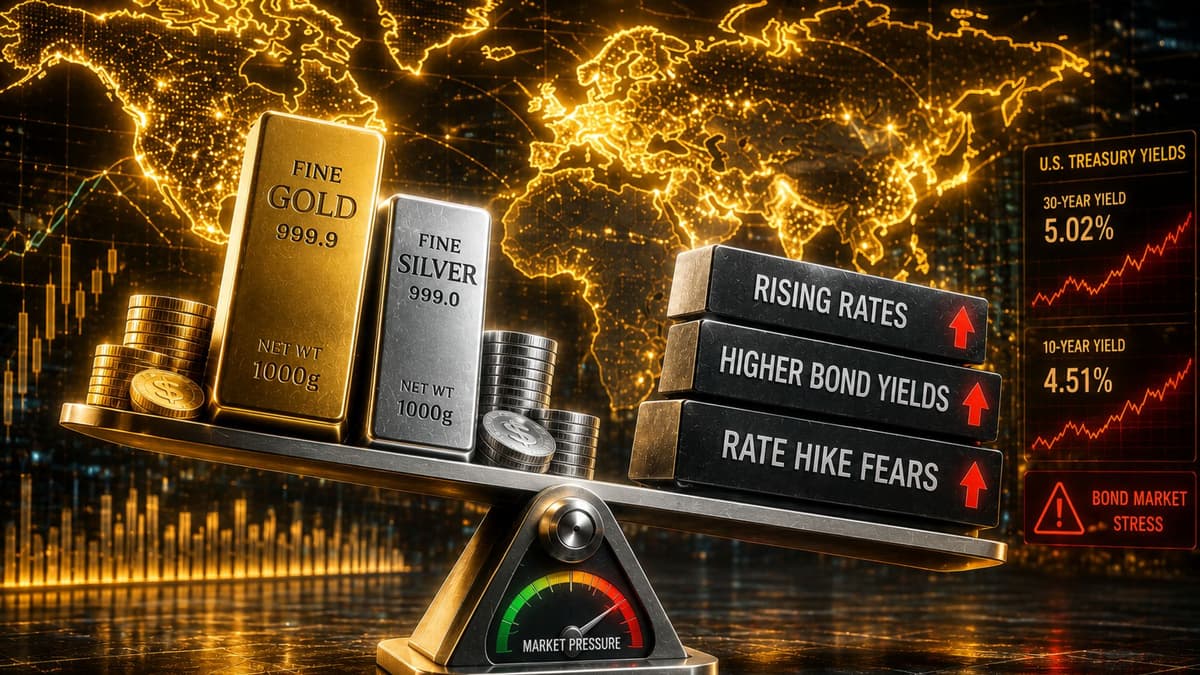
Gold faces short-term pressure from rising oil prices, stronger real yields, and changing expectations for U.S. interest rates. Those forces have raised the opportunity cost of holding non-yielding assets such as gold.
State Street said gold’s selloff last month and its current consolidation were not surprising. The firm linked that shift in sentiment to the joint U.S.-Israel war against Iran, which has changed how global financial markets are pricing inflation, energy risks, and monetary policy.
At the start of the new year, markets were pricing in 58 basis points of easing from the Federal Reserve this year. But the Middle East conflict, and the resulting supply-chain disruption in energy markets, sharply changed that outlook.
According to State Street, in mid-to-late March, markets were at one point pricing in a more than 60% chance of a Federal Reserve rate hike this year. That is a dramatic reversal from expectations of easing.
The report added that the March correction in gold was “largely a function of Fed re-pricing and higher real yields,” which in turn supported a stronger U.S. dollar. A stronger dollar typically weighs on gold price performance because bullion is priced globally in dollars.
State Street emphasized that this move should not be mistaken for a collapse in the broader gold demand story. The firm said the correction was “probably not a breakdown of the global gold demand thesis driven by debasement concerns and allocations for alt-fiat.”
That matters for investors in India because domestic gold prices depend not only on the international spot gold price but also on the USD/INR exchange rate. If the U.S. dollar stays strong, Indian buyers may see elevated local bullion prices even if XAUUSD pauses or consolidates.
What Are Markets Pricing for the Federal Reserve Now?
Markets now expect the Federal Reserve to stay on hold for the rest of the year. Even with that neutral stance, gold has stayed relatively resilient below $4,800 per ounce.
The CME FedWatch Tool currently shows a 71% chance that interest rates remain unchanged at current levels through year-end. That suggests investors no longer expect aggressive easing, but they also do not see a strong immediate case for higher rates.
Despite this neutral monetary policy outlook, gold has held up well. Spot gold was last trading at $4,774.20 per ounce, up more than 1% on the day.
That resilience is important. It suggests safe-haven and long-term allocation demand for precious metals remains intact, even when short-term monetary conditions are less supportive.
For Indian investors, a stable-to-firm gold price near $4,774.20 means local prices could remain elevated, especially if the rupee weakens or import-related costs stay high. In practical terms, global macro events are still feeding directly into India’s jewellery and investment bullion market.
How Do Oil Prices Affect Gold Price Outlook?
Oil prices matter because they influence inflation, Federal Reserve policy, the U.S. dollar, and recession risk. State Street called this a double-edged sword for gold.
On one side, persistently high crude prices can push inflation higher and keep interest-rate expectations elevated. That can hurt gold in the near term by lifting real yields and supporting the dollar.
State Street said a prolonged conflict that sends ICE Brent crude above $150 per barrel would likely weigh on gold through the Federal Reserve and dollar channel. In other words, higher oil could make central banks more cautious about cutting rates, which would be a near-term negative for bullion.
But the firm also said that same oil shock would increase the risk of recession or stagflation. That could eventually revive safe-haven demand for gold and support higher prices later.
State Street offered a more constructive alternative scenario as well. It said that if oil prices normalize to around $80 to $85 per barrel, gold could quickly move back above $5,000 per ounce.
This matters in India because oil and gold both have strong macro effects on inflation, the current account, and the rupee. Higher crude prices can weaken the INR and raise imported inflation, which may keep domestic gold prices elevated even when international prices face temporary resistance.
Why Does Rising Global Debt Support Gold Over the Long Term?
State Street sees government debt and currency debasement risk as major long-term bullish drivers for gold. The firm argues that rising deficits and fiscal stress historically support demand for precious metals.
Looking beyond U.S. monetary policy, State Street highlighted the rapid rise in public debt as a structural reason to stay positive on bullion. The analysts cited Congressional Budget Office estimates showing that net interest payments on U.S. federal debt are forecast to exceed $1 trillion this year for the first time on record.
The firm said the debt problem is not limited to the United States. It noted that rising deficits caused by war spending, higher interest expense, and reduced revenue are creating a backdrop of elevated debt and long-term currency debasement risk.
According to State Street, total global debt has risen to a record roughly $348 trillion, equal to about 3 to 4 times world GDP. The analysts said debt growth has been most acute in the government sector rather than in private-sector borrowing.
That trend may signal embedded fiscal pressure across the global economy. For gold, that is usually supportive because investors often turn to hard assets such as bullion when they worry that fiat currencies will lose purchasing power over time.
For Indian investors, this long-term argument is especially relevant. Gold has traditionally served as both a store of value and a hedge against currency weakness, inflation, and policy uncertainty. If global debt continues to rise and fiscal strains deepen, strategic allocations to gold may remain attractive in Indian portfolios.
What Does State Street’s Gold Forecast Mean for Indian Investors?
The message for Indian investors is clear: short-term volatility may continue, but the bigger gold trend still looks supportive. State Street’s outlook suggests dips driven by rates or oil shocks may not necessarily break the broader bull case.
The firm believes the market can absorb near-term headwinds and still hold a broad trading framework of $4,750 to $5,500 through the rest of the year. It also sees a floor at $4,000 to $4,100, which implies that deep pullbacks may continue to attract buying interest.
Indian investors should watch three variables closely: Federal Reserve policy expectations, ICE Brent crude prices, and the USD/INR exchange rate. These three drivers can shape both the international gold price and the local rupee price of bullion.
If crude retreats toward $80 to $85 per barrel, State Street believes gold could reclaim $5,000 per ounce relatively quickly. If crude surges above $150 per barrel, near-term pressure could intensify before recession or stagflation fears restore safe-haven demand.
For now, gold’s ability to hold near $4,774.20 per ounce while markets price a 71% probability of unchanged U.S. rates through year-end suggests the market still has strong underlying support. The next key watchpoint for Indian investors is whether oil cools, the Federal Reserve stays patient, and the U.S. dollar eases enough to let bullion resume its march toward the $5,000 mark.