# Fed Rate Regime Change? Warsh Hearing Raises Market Stakes
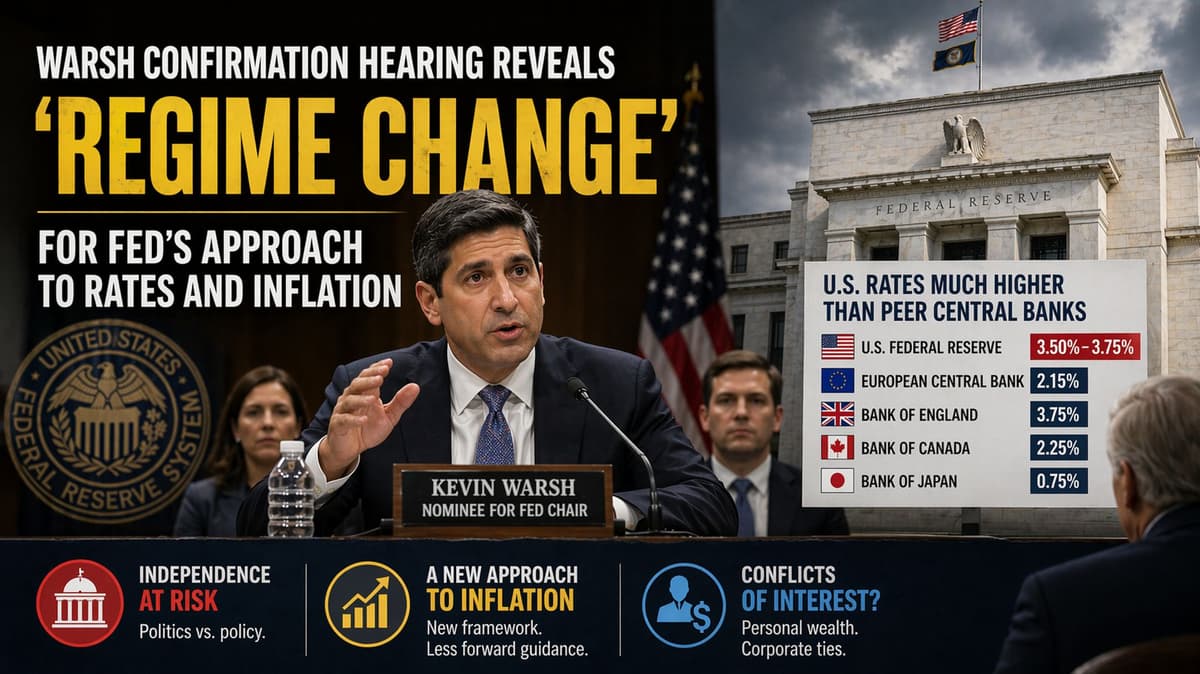
Kevin Warsh’s confirmation hearing for Federal Reserve chair signaled a possible regime change in how the Fed approaches interest rates and inflation, while also raising fresh questions about central bank independence. For gold investors in India, that matters because any shift in U.S. rate policy, bond yields, and the U.S. dollar can quickly feed into global bullion prices, XAUUSD sentiment, and domestic gold rates in INR.
What happened at Kevin Warsh’s confirmation hearing?
Kevin Warsh’s confirmation hearing showed that the battle to lead the Federal Reserve will likely be contentious and prolonged. According to Jeffrey Roach, Chief Economist at LPL Financial, the hearing revealed sharp political tension, legal uncertainty, and pointed questions about Warsh’s independence from President Trump.
Roach wrote on Wednesday that Warsh’s bid to become the next chair of the Federal Open Market Committee unfolded under heavy scrutiny. During a combative Senate confirmation hearing on Tuesday, Warsh tried to reassure lawmakers that he would not let political pressure dictate monetary policy.
However, an unresolved Department of Justice investigation into current Fed Chair Jerome Powell threatens to delay the process. That issue has amplified wider concerns about the politicization of the Federal Reserve.
Why could Warsh’s confirmation extend beyond May 15?
Warsh’s confirmation could stretch beyond May 15 because legal and political hurdles remain unresolved. Roach said the process will likely extend beyond the end of Powell’s term on May 15.
A key obstacle is the criminal investigation into Powell’s handling of the Federal Reserve’s headquarters renovation. According to Roach, Senator Thom Tillis has vowed to block Warsh’s confirmation until that probe is resolved.
If Warsh is not confirmed by May 15, Powell has said he would continue serving as chair on an interim basis. That would add uncertainty to Fed leadership at a sensitive moment for U.S. monetary policy and global markets.
How political pressure is shaping the process
Warsh repeatedly said he would not cut interest rates at President Trump’s behest. Roach noted that Warsh insisted Trump had never asked him to pre-commit to specific policy actions and pledged to remain “strictly independent” if confirmed.
Lawmakers argued that political pressure on the Federal Reserve is already intense. Roach said senators pointed to Trump’s effort to remove Fed Governor Lisa Cook and the Department of Justice investigation into Powell as examples that have raised alarms over institutional independence.
How does Warsh’s rate stance differ from the current Fed approach?
Warsh suggested a more sweeping rethink of monetary policy, not just a minor adjustment to interest rates. Roach said Democratic senators pressed Warsh on his shift from being an inflation hawk during his earlier Fed tenure to recently supporting rate cuts.
Warsh defended that shift by pointing to balance sheet reduction and possible productivity gains from artificial intelligence. He argued that inflation overshoots in 2021 and 2022 reflected Federal Reserve policy mistakes.
He also called for “regime change” in the Fed’s framework. That included support for a new inflation framework and less forward guidance, including scaling back the Fed’s “dot plot.”
What the current global rate gap looks like
The debate is especially important because U.S. monetary policy remains more restrictive than that of most advanced economies. As of April 21, 2026, the Federal Reserve’s target range for the federal funds rate stands at 3.50% to 3.75%.
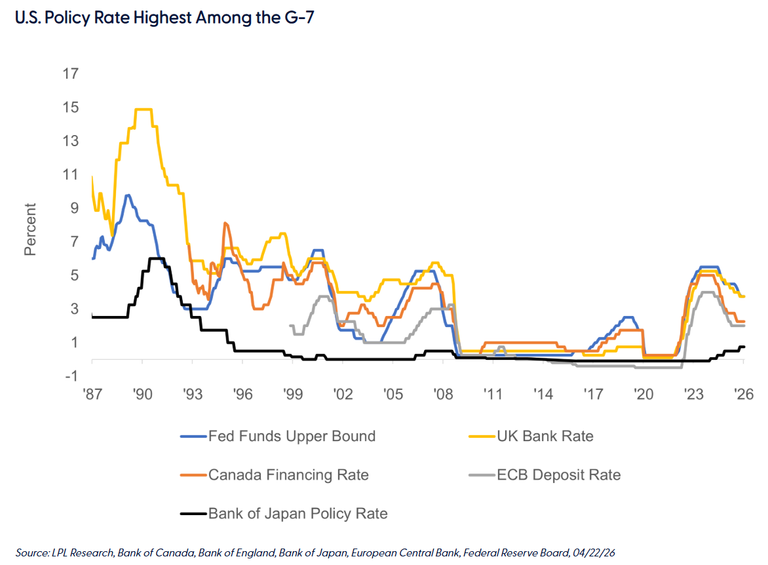
Roach compared that with several major central banks:
- European Central Bank policy rate: 2.15%
- Bank of England Bank Rate: 3.75%
- Bank of Canada overnight rate: 2.25%
- Bank of Japan policy rate: 0.75%
What senators were testing
Lawmakers used the hearing to test whether Warsh would try to narrow the gap between U.S. rates and global policy rates through faster easing. They also wanted to know whether he would stick to the Fed’s traditional data-driven approach despite political and external pressure.
Why does Fed independence matter for gold prices and Indian investors?
Fed independence matters because it influences interest rate credibility, U.S. Treasury yields, the dollar, and safe-haven demand for gold. Any perception that the Federal Reserve is becoming more politicized can alter market expectations for bullion, precious metals, and risk assets.
For gold, lower U.S. rates usually support XAUUSD by reducing the opportunity cost of holding non-yielding bullion. But if markets believe the Fed is losing credibility on inflation, Treasury yields and the dollar can become more volatile, creating two-way pressure on gold price action.
For Indian investors, that global shift affects both international gold prices per troy ounce and domestic prices in rupees. Even if global bullion rises, INR movement against the U.S. dollar can amplify or offset gains in the Indian gold market.
India angle: what to watch in INR gold
Indian investors should watch three channels closely:
1. U.S. rate expectations: If Warsh is seen as favoring rate cuts later in 2026, that could support gold prices globally.
2. U.S. dollar movement: A weaker dollar often helps gold, but a stronger dollar can pressure emerging-market currencies, including the rupee.
3. Risk sentiment: If political uncertainty around the Fed increases, safe-haven demand for gold may strengthen.
This means domestic gold buyers should track not only XAUUSD but also USD/INR, because imported bullion prices in India depend on both.
What concerns were raised about Warsh’s conflicts of interest?
Warsh faced scrutiny over his personal wealth and financial ties. Roach said senators, especially Elizabeth Warren, questioned Warsh about his substantial wealth and opaque investment holdings.
According to the hearing details cited by Roach, Warsh’s financial assets range between $135 million and $226 million. He and his billionaire heiress wife also have deep corporate ties, which added to concerns among some committee members.
Warsh responded by pledging to divest all financial assets and move to “plain vanilla” investments if confirmed. That promise was aimed at easing concerns about conflicts of interest during his potential tenure as Fed chair.
What is LPL Financial’s outlook after the hearing?
LPL Financial believes the hearing points to a Fed approach that could combine tighter and looser conditions at the same time. Roach said the hearing strengthens the view that Warsh may tighten conditions through balance sheet normalization while simultaneously loosening conditions by lowering interest rates.
Roach added that those actions may not occur until much later this year, depending on economic conditions. That makes the timing critical for investors across gold, bonds, and currency markets.
For bullion investors, the key watchpoint is whether Warsh’s nomination changes expectations for the Federal Reserve’s reaction function. If markets begin to price in lower rates later in 2026 while also weighing institutional uncertainty, gold could remain highly sensitive to every shift in Fed communication, U.S. yield moves, and dollar strength.