Why did China silver imports jump to a record high in early 2026?
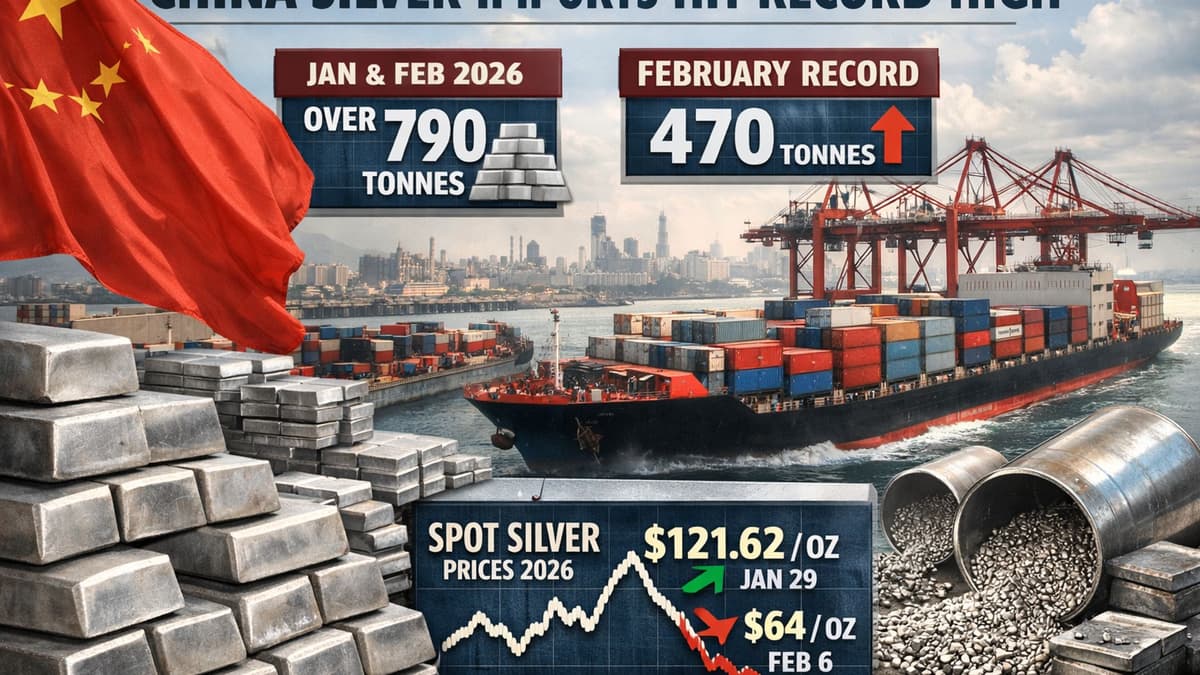
China silver imports surged because strong industrial and investment demand pushed domestic silver prices above the global benchmark, drained local stockpiles, and made overseas buying more attractive. According to customs data released on Friday, China imported more than 790 tonnes of silver in January and February 2026.February alone accounted for 470 tonnes of silver imports, marking a year-over-year record for that month. That made the first two months of 2026 the strongest start for Chinese silver imports in eight years.
Higher local premiums played a central role. As Chinese buyers paid more for bullion inside the domestic market than traders were paying in the international market, import incentives strengthened and foreign purchases accelerated.
For Indian investors, the move matters because China is one of the world’s biggest consumers of precious metals. When Chinese silver demand tightens regional supply chains, it can influence global silver price trends, bullion sentiment, and spill over into gold and other precious metals markets that Indian traders watch closely.
What happened to silver prices in 2026?
Silver prices have been extremely volatile in 2026, with spot silver posting the wildest opening to a year on record. Spot silver climbed to a nominal all-time high of $121.62 per troy ounce on January 29, 2026, before collapsing to $64 per ounce by February 6.That means silver lost nearly half its value in just over a week. The scale of the move highlights how quickly localized shortages, thin inventories, and speculative flows can distort price discovery in precious metals.
This volatility matters beyond silver alone. Sharp swings in silver often affect broader bullion positioning, including gold price expectations, safe-haven demand, and cross-market trading in XAUUSD and other precious metals.
For Indian investors, such turbulence can feed directly into domestic bullion pricing when combined with rupee moves against the U.S. dollar. Even if international silver prices retreat, INR weakness can keep local prices elevated.
How did domestic shortages push China to buy more silver overseas?
Domestic shortages increased imports because local inventories were already thin and stronger demand quickly absorbed available metal. As Chinese silver prices rose far above the global benchmark, buyers turned to foreign markets to secure supply.The article notes that exchange reserves were already depleted before the latest surge in demand. Once local stockpiles tightened further, imports became the fastest way to refill supply.
This dynamic shows that the market stress was not simply about headline demand growth. It was also about where the silver was located and how quickly participants could access deliverable bullion.
For Indian market participants, that distinction is important. Precious metals prices can spike even without a true global shortage if supply is trapped in the wrong region or if logistics and trade rules prevent metal from moving efficiently.
What did Goldman Sachs say about the silver market disruption?
Goldman Sachs said the turbulence reflects localized supply bottlenecks rather than a global shortage of silver. In January, Goldman Sachs analysts Lina Thomas and Daan Struyven warned that China’s new export controls would likely worsen local shortages, deepen global dislocations, and potentially fragment the global silver market.They wrote: “Thinner inventories have created conditions for squeezes, where rallies accelerate as investor flows absorb remaining metal in the London vaults and reverse sharply when tightness eases.” That assessment points to a market where small shifts in available inventory can trigger outsized price moves.
Lina Thomas and Daan Struyven said the main driver is not a worldwide lack of silver, but regional bottlenecks that keep the market distorted. In other words, silver may exist globally, but it is not necessarily available where traders and industrial users need it most.
That distinction is relevant for Indian investors tracking bullion, ETFs, and physical precious metals. Local premiums, import channels, and regional inventory stress can move prices independently of the broader international benchmark.
How are China’s 2026 export restrictions affecting silver prices?
China’s 2026 export restrictions are adding to volatility because outbound silver shipments now require official approval. Goldman Sachs said the policy could reduce market liquidity and amplify price swings by limiting the free movement of silver across regions.According to the analysts, disruption risk may encourage participants to build and hold their own stockpiles instead of relying on shared global inventory buffers. That behavior can make the silver market less efficient and more vulnerable to sudden squeezes.
Goldman Sachs warned: “Disruption risk may prompt participants to secure their own stockpiles rather than share buffers globally. This shift from a pooled global system to isolated regional inventories would create an inefficient structure — transforming a smooth, integrated market into one prone to sharp, localized price swings.”
In practical terms, that means silver could trade less like a unified global commodity and more like several regional markets with different price pressures. For Indian investors, that raises the importance of tracking not just international spot prices per troy ounce, but also import trends, domestic premiums, and rupee-dollar movements.
What does China’s silver import surge mean for Indian investors?
China’s silver import spike signals that regional supply stress can drive major moves in precious metals prices even when there is no global shortage. Indian investors should watch this closely because strong Chinese demand can reshape price expectations for silver, influence broader bullion sentiment, and affect trading across the precious metals complex.A tighter regional silver market can lift volatility in bullion generally, especially when speculative flows chase momentum. That can affect not only silver bars and coins in India, but also gold price sentiment, safe-haven allocations, and portfolio hedging decisions.
Indian buyers should also consider the INR angle. If global silver prices stay volatile while the rupee weakens against the U.S. dollar, local precious metals prices may remain firm even after international pullbacks.
The next key watchpoint is whether China’s import pace remains elevated beyond February 2026 and whether export approvals continue to constrain market liquidity. If regional inventories remain thin, silver and broader bullion markets could face more sharp, localized price swings in the months ahead.