# Central Bank Gold Buying Surges as Poland, China Add Reserves
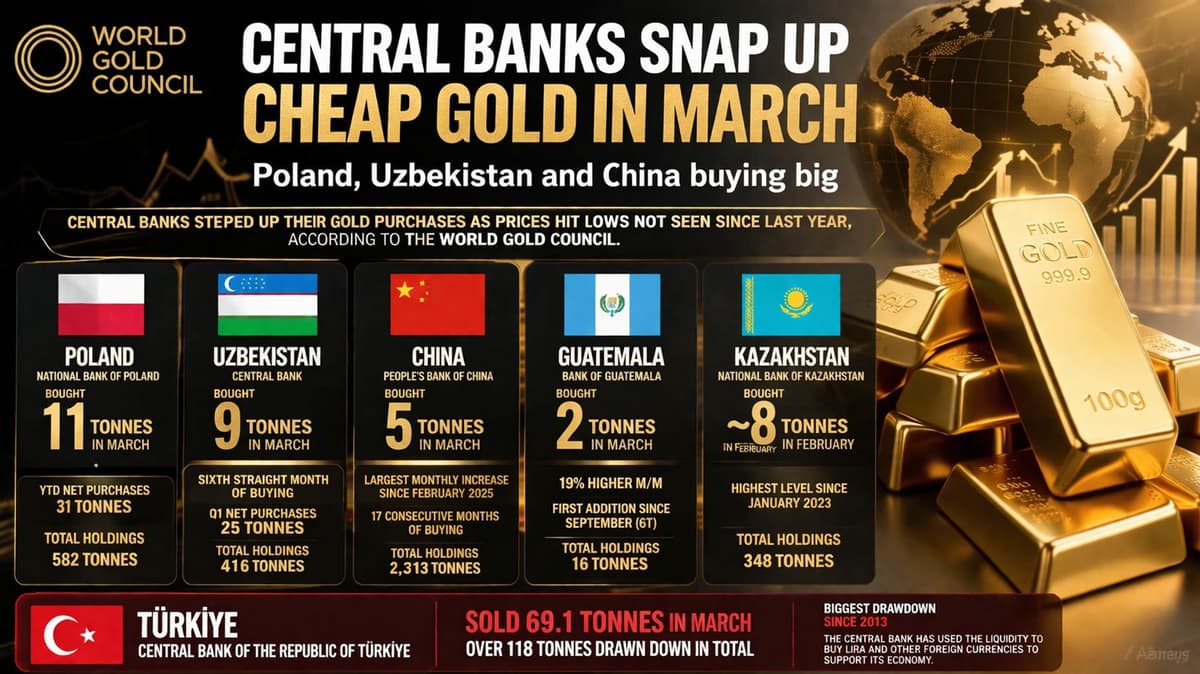
Central bank gold buying accelerated in March as bullion prices fell to lows last seen in 2024, according to Krishan Gopaul, Senior Analyst, EMEA, at the World Gold Council. Fresh reserve data showed official-sector buyers used the dip to add gold, with Poland, Uzbekistan, and China among the biggest purchasers.
For Indian investors, the trend matters because sustained sovereign demand often supports global gold price floors. When central banks keep buying on weakness, it can cushion downside in XAUUSD and influence domestic gold rates in rupee terms, especially when the Indian rupee moves against the U.S. dollar.
Why did central banks buy more gold in March?
Central banks bought more gold in March because bullion prices dropped to lows not seen since last year, creating a cheaper entry point for reserve managers. According to Krishan Gopaul of the World Gold Council, the latest sovereign data shows official buyers stepped in aggressively when prices weakened.
This pattern reinforces a key theme in the gold market: central banks treat price pullbacks as strategic buying opportunities. For long-term investors, that behavior signals that official institutions still view gold as an important reserve asset and safe-haven holding.
What did the World Gold Council say?
Krishan Gopaul documented the purchases in a series of social media posts. He said multiple central banks increased their gold reserves in March, while separate IMF and national central bank data confirmed additional buying in both March and February.
Which central banks bought the most gold in March?
Poland, Uzbekistan, and China were among the biggest official gold buyers in March. Their purchases added to an already strong first quarter for central bank demand.
How much gold did Poland buy?
The National Bank of Poland increased its gold reserves by 11 tonnes in March. According to Krishan Gopaul, that lifted Poland’s year-to-date net purchases to 31 tonnes and took its total gold holdings to 582 tonnes.
Poland has been one of the strongest sovereign buyers across 2024 and 2025. Continued accumulation at that scale keeps Poland at the center of the global official-sector gold story.
How much gold did Uzbekistan buy?
The Central Bank of Uzbekistan added 9 tonnes in March, extending its buying streak to six straight months. Its Q1 net purchases totalled 25 tonnes, lifting overall gold holdings to 416 tonnes.
That steady pace suggests Uzbekistan remains a price-sensitive but persistent buyer of bullion. For the wider gold market, sustained month-after-month purchases from reserve managers help support sentiment even during volatile periods.
How much gold did China buy?
The People’s Bank of China added 5 tonnes in March, marking its largest monthly increase since February 2025. The March purchase also extended China’s buying streak to 17 consecutive months, taking its official gold holdings to 2,313 tonnes.
China’s reserve strategy matters globally because even modest monthly additions from the world’s second-largest economy can shape long-term expectations for gold demand. Indian investors also watch China closely because strong Asian central bank demand can support regional bullion premiums and broader precious metals sentiment.
Which other central banks increased gold reserves?
The Czech National Bank and the Bank of Guatemala also added gold in March. Both purchases, while smaller, added to the broader official-sector bid.
The Czech National Bank increased its gold reserves by 2 tonnes in March. Its Q1 net purchases reached 5 tonnes, lifting total gold holdings to 77 tonnes.
The Bank of Guatemala added 2 tonnes in March. Gopaul said that was 19% higher month-on-month and marked its first addition since September, when it bought 6 tonnes. Guatemala’s gold reserves now total 16 tonnes.
What did February data show about central bank gold demand?
February data also showed strong sovereign demand, with Kazakhstan reporting a sizable increase. Revised data pushed global central bank net purchases for February higher.
According to Krishan Gopaul, National Bank of Kazakhstan data showed its gold reserves rose by almost 8 tonnes in February. That lifted Kazakhstan’s gold reserves to 348 tonnes, the highest level since January 2023.
Gopaul added that Kazakhstan’s update would raise the global central bank net purchases figure for February to 27 tonnes. That revision suggests official demand remained firm even before the March buying wave.
Why is Turkey’s gold reserve decline important?
Turkey matters because it shows the other side of the sovereign gold story: some central banks are not just buying gold, but also monetizing reserves to stabilize their economies. Since the outbreak of the war with Iran, analysts say the sovereign segment of the gold market has become much more volatile.
How much gold did Turkey lose in March?
Turkey’s central bank reported that its gold holdings declined by another 69.1 tonnes in March. That brought last month’s total decline to more than 118 tonnes.
According to reports cited in the source article, this was the biggest drawdown in Turkey’s gold reserves since 2013. The scale of the reduction stands out sharply against the broader trend of net buying by other central banks.
Why did Turkey monetize gold reserves?
Turkey’s central bank said it sold some gold and monetized most of it through swap agreements. It used that liquidity to buy lira and other foreign currencies to support its economy.
This matters for gold investors because official-sector activity is no longer a one-way story of accumulation. In periods of geopolitical or currency stress, central banks may use bullion reserves as a liquidity tool.
What does central bank gold buying mean for Indian investors?
Central bank gold buying is generally supportive for gold prices because it creates steady structural demand beneath the market. For Indian investors, that can help limit deep corrections in international gold prices even when speculative flows weaken.
If global reserve managers continue buying dips, imported gold costs in India may remain firm, especially if the rupee weakens against the U.S. dollar. Since Indian gold prices reflect both international bullion moves and USD/INR trends, strong central bank demand abroad can still translate into elevated local prices per 10 grams.
Indian investors should also note the contrast between official accumulation in countries such as Poland, Uzbekistan, and China and reserve monetization in Turkey. That split shows gold’s dual role: it acts both as a long-term reserve asset and as a source of emergency liquidity during financial stress.
The next watchpoint is whether March’s broad-based buying continues into April and whether more central banks follow Poland, Uzbekistan, and China in adding reserves on price weakness. If that happens, it would reinforce gold’s status as a strategic safe-haven asset for both sovereign institutions and private investors in India.