
# Bitcoin Price Trend Turns Up as Bulls Target Breakout
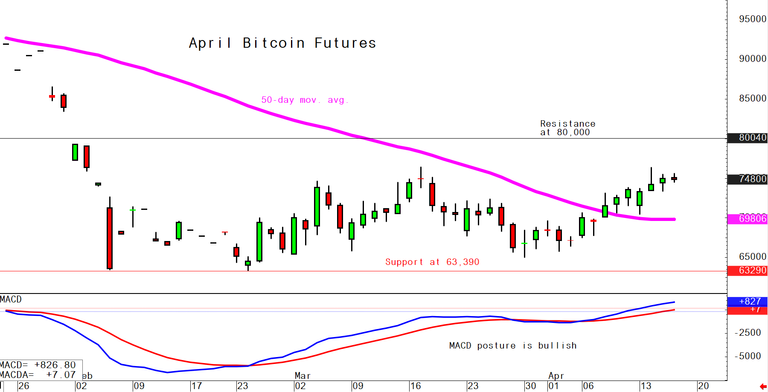
April bitcoin futures were near steady in early U.S. trading on Thursday, April 16, but the chart setup remained constructive after prices stayed close to Tuesday’s four-week high. The latest technical picture suggests bitcoin bulls have started to build upside momentum, with a possible breakout forming after several weeks of range-bound trade.
For Indian investors, the move matters even on a precious metals-focused radar because bitcoin, gold, and other safe-haven or alternative assets often compete for capital when global risk appetite shifts. If bitcoin extends its uptrend, it could influence broader sentiment across bullion, XAUUSD, and other precious metals markets.
What Is Happening to Bitcoin Price on April 16?
Bitcoin price was holding nearly steady in early U.S. trading on Thursday, April 16, while staying not far below Tuesday’s four-week high. That price action shows the market has not given back its recent gains.
The steadiness in April bitcoin futures suggests buyers are still active after the recent advance. Instead of a sharp reversal lower, the market is consolidating close to the upper end of its recent range.
That is often an important signal in technical analysis. When a market stays firm near a multi-week high, traders read it as a sign that bullish momentum is still intact.
Why Do Analysts Say Bitcoin Bulls Are Building Momentum?
Bitcoin bulls are building momentum because the daily bar chart has started to show an emerging uptrend. According to the source analysis, bulls have gained momentum recently and are now working on a price uptrend on the daily chart.
This matters because trend development often shapes short-term trading decisions. A market that moves from a weak or sideways structure into an upward-sloping pattern can attract fresh speculative buying.
The report also says bulls and bears remain on a level overall near-term technical playing field. However, the balance has started to tilt slightly toward buyers because momentum is now on the bulls’ side.
What Does Wyckoff’s Market Rating of 5.0 Mean?
Wyckoff’s Market Rating of 5.0 means bitcoin’s near-term technical outlook is neutral, but no longer clearly bearish. On the Wyckoff scale, 1.0 is the most bearish and 10.0 is the most bullish.
A 5.0 reading places the market in the middle. That tells traders the technical setup is balanced overall, even though recent price action has improved.
For investors, this means the bullish case is strengthening, but the breakout is not yet decisive. Confirmation would require bitcoin to keep holding support and push through resistance.
Could Sideways Trading Signal a Bigger Bitcoin Breakout?
Yes, the recent sideways and choppy trading at lower levels could be a bullish base that leads to a larger bitcoin price uptrend. The source article describes the past several weeks of low-level consolidation as possible “basing” or “coiling” action.
In chart analysis, basing happens when a market stops falling and starts trading in a tighter range. Coiling refers to compressed price movement that can precede a stronger directional move.
If that interpretation is correct, bitcoin may be preparing for a bigger upside move rather than simply drifting sideways. Traders often monitor such periods closely because they can mark the transition from consolidation to trend expansion.
Why Does Basing Matter for Market Direction?
Basing matters because it can show that sellers are losing control while buyers gradually rebuild positions. A stable range after weakness often reflects absorption of supply.
Once that supply gets absorbed, prices can break higher if buying pressure increases. That is why technicians pay close attention when a market holds together after several weeks of choppy trade.

What Support and Resistance Levels Should Traders Watch?
Traders should watch the key technical support and resistance lines on the daily chart because those levels will likely decide whether bitcoin confirms a stronger uptrend. The source article specifically highlights the importance of chart-based support and resistance.
Resistance marks the zone where sellers may try to cap the rally. Support marks the area where buyers need to defend price to keep the constructive setup intact.
If bitcoin futures break above resistance, bulls would strengthen their case for a larger upside move. If prices fall back below support, the market could return to a more neutral or choppy pattern.
Why Do These Technical Levels Matter for Indian Investors?
These technical levels matter for Indian investors because global crypto risk sentiment can spill over into broader alternative-asset flows, including gold price behaviour in rupee terms. When traders rotate aggressively into risk assets like bitcoin, bullion demand can soften at the margin.
At the same time, a failed bitcoin breakout can revive safe-haven demand for gold and precious metals. Indian investors tracking both bitcoin and gold should therefore watch cross-asset sentiment, the U.S. dollar, and INR moves together.
How Does Bitcoin’s Setup Compare With Gold and Other Alternative Assets?
Bitcoin’s current setup looks like a momentum-building alternative asset trade, while gold typically attracts flows during macro stress, inflation hedging, or safe-haven demand. Both assets can benefit from distrust in fiat currencies, but they often react differently in the short term.
For precious metals investors in India, bitcoin’s strength does not automatically weaken gold. However, short-term speculative money can shift between bitcoin, bullion, silver, and broader commodities depending on risk appetite.
That makes this chart development worth watching even for readers focused mainly on gold price trends, XAUUSD, and physical bullion demand. If bitcoin confirms a larger uptrend after this basing phase, it could influence sentiment across the wider alternative-asset complex.
The immediate watchpoint is simple: whether April bitcoin futures can push above nearby chart resistance after holding close to Tuesday’s four-week high on April 16. A successful breakout would strengthen the bullish case, while failure would keep the market in a neutral, range-bound technical structure.