
# Bitcoin Price Near Five-Week Low as Bears Tighten Grip
Bitcoin prices were weaker in early U.S. trading on Tuesday, March 31, with April bitcoin futures hovering near a five-week low. The technical picture remained bearish, with sellers holding a clear near-term advantage and extending a downtrend on the daily chart.
For Indian investors tracking global risk sentiment, bitcoin weakness can matter even on a gold-focused watchlist. When crypto prices slide, investors often reassess broader risk appetite across assets, including bullion, precious metals and other safe-haven trades.
Why Is Bitcoin Price Under Pressure on March 31?
Bitcoin was under pressure because April bitcoin futures weakened in early U.S. trading on Tuesday, March 31 and stayed close to a five-week low. That price action signaled that sellers remained in control of the near-term market trend.
The source article did not cite a fresh macro trigger, but the chart structure itself was negative. In technical terms, bitcoin bears were maintaining downside momentum rather than allowing a recovery bounce to take hold.
This matters for market participants because futures weakness often shapes short-term sentiment in the broader crypto complex. A soft bitcoin market can also influence cross-asset positioning, especially when traders compare risk assets with traditional safe-haven holdings such as gold.
What Does the Daily Chart Say About Bitcoin’s Trend?
The daily chart showed that bitcoin bears kept their firm overall near-term technical advantage. According to the source analysis, sellers were actively working on a price downtrend on the daily chart.
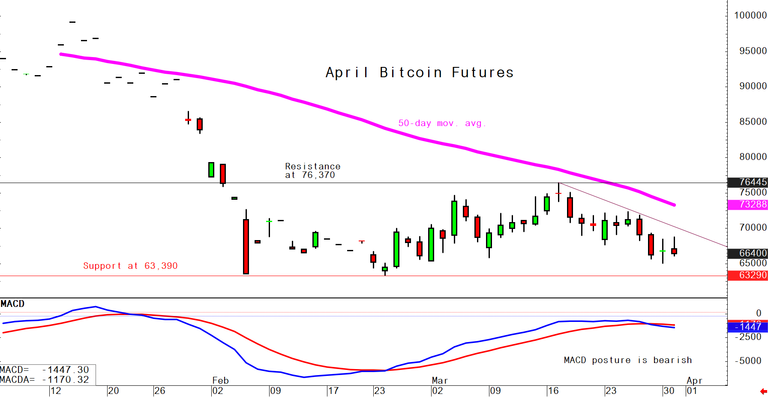
That means the prevailing pattern was still lower, not higher. Until buyers break that downtrend with stronger upside price action, chart-focused traders would likely continue to view rallies with caution.
In practical terms, a daily-chart downtrend reflects persistent selling pressure over multiple sessions. For Indian investors watching global financial markets, this kind of pattern usually points to weaker short-term confidence in speculative assets.
Why does a downtrend matter to traders?
A downtrend matters because it helps define market bias. When prices keep making weaker moves and remain under pressure, many traders wait for support to hold or resistance to break before changing their view.
In bitcoin, that can trigger momentum-driven positioning. In gold, by contrast, periods of stress in risk assets sometimes revive safe-haven demand, although that relationship is not always immediate.
How Bearish Is Bitcoin Right Now According to Wyckoff’s Rating?
Bitcoin’s technical setup was clearly bearish, with Wyckoff’s Market Rating at 3.0 out of 10.0 on March 31. In this system, 1.0 is the most bearish and 10.0 is the most bullish, so a 3.0 rating signals that sellers have a notable edge.
This rating reinforces the message from the daily chart. It suggests the market was not simply pausing after a decline, but instead remained tilted toward the bears in the near term.
For investors who follow technical analysis, Wyckoff’s rating is a quick measure of market control. A reading of 3.0 does not guarantee further losses, but it does indicate that bullish conviction remained weak at the time of the report.

What does Wyckoff’s Market Rating mean?
Wyckoff’s Market Rating is a technical sentiment scale used to summarize chart strength or weakness. A low reading such as 3.0/10.0 points to a bearish structure, while a high reading would indicate stronger bullish control.
What Support and Resistance Levels Should Traders Watch?
Traders should watch the key technical support and resistance lines on the chart, because those levels will help determine whether bitcoin extends its decline or attempts a rebound. The source article specifically highlighted the importance of those chart markers, even though it did not publish the exact price levels in the text provided.
Support levels matter because they show where selling pressure may slow. Resistance levels matter because they show where recovery attempts may fail if buyers cannot force a breakout.
For short-term traders, these levels often guide entry points, stop-loss placement and momentum strategies. For longer-term Indian investors, they offer a useful framework for reading sentiment in global speculative markets alongside moves in gold price, XAUUSD, bullion and the U.S. dollar.
How Could Bitcoin Weakness Matter for Indian Gold Investors?
Bitcoin weakness can matter for Indian gold investors because it may reflect softer global risk appetite. When speculative assets struggle, some investors rotate toward defensive holdings such as gold, silver and other precious metals.
That said, the relationship is not mechanical. Gold prices in India depend not only on global safe-haven demand, but also on the rupee-dollar exchange rate, import costs, local premiums and international bullion prices per troy ounce.
If risk sentiment worsens further, Indian investors should watch whether capital shifts away from crypto and into traditional stores of value. In that environment, global moves in bitcoin and XAUUSD can both offer clues about investor psychology.
The next watchpoint is whether bitcoin futures can stabilize above key support or whether bears press prices to fresh short-term lows. If the downtrend on the daily chart continues, traders across asset classes—including gold market participants in India—may read it as another sign that caution is still dominating speculative markets.