# Tether Gold Holdings Hit Sovereign Scale as Big Four Audit Starts
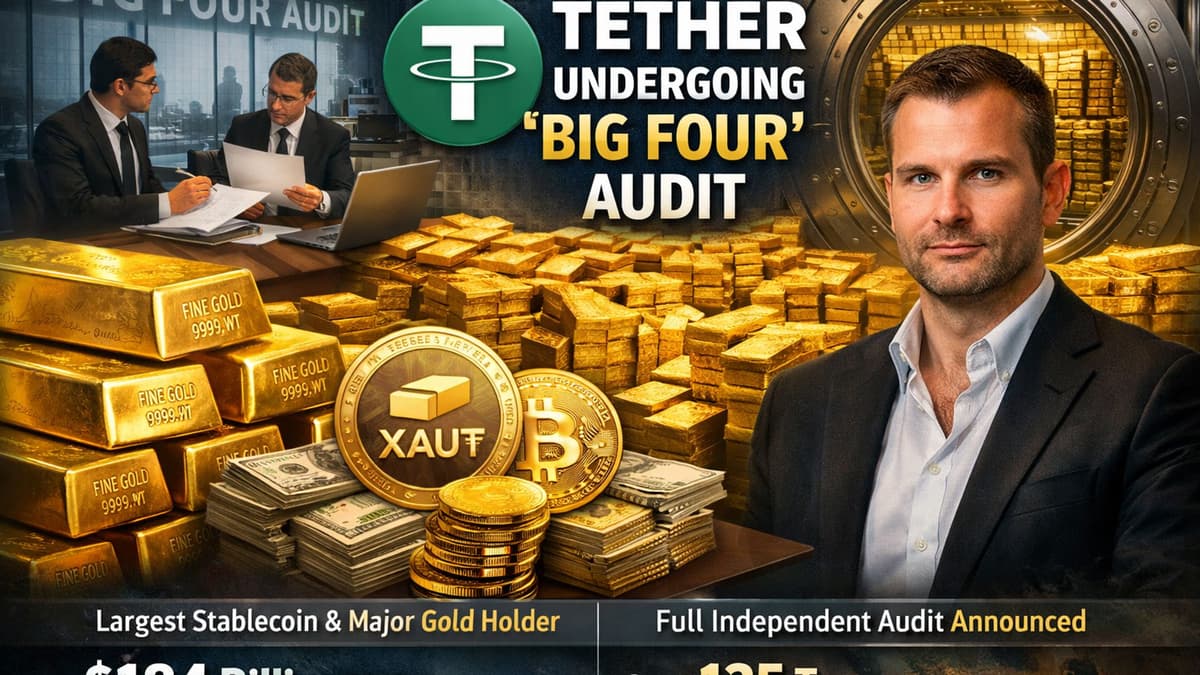
Tether says it has hired one of the Big Four accounting firms for its first full independent audit, a move that matters for both crypto markets and bullion investors. The announcement is notable because Tether is not only the world’s largest stablecoin issuer, but also one of the largest non-sovereign holders of physical gold.
For Indian investors, the development matters because a fast-growing digital buyer of bullion can influence global gold demand, international spot prices, and eventually imported gold costs in rupees when combined with USD-INR moves.
Why is Tether’s full audit a major event for gold and crypto markets?
Tether’s audit is significant because the company now operates at a scale usually associated with sovereign institutions, while holding large reserves across cash-like assets, securities, digital assets, and gold. Tether said on Tuesday that the engagement would be the largest-ever inaugural audit in financial market history.
In its statement, Tether described the review as a defining moment for modern finance. The company said a full audit by a Big Four firm is among the most rigorous and globally recognised forms of financial assessment and would provide deeper assurance that USDT is fully backed, highly liquid, and managed with world-class risk controls.
Tether added that attestations remain the standard across stablecoin issuers, but it is now moving beyond that benchmark toward a full audit. The company said several audit firms showed interest in the mandate because of Tether’s scale and its central role in the digital asset ecosystem.
What did Tether say about the audit process?
Tether said the audit will provide full visibility into the strength and positioning of its reserves. As part of the process, the company also said it would move listed securities over the coming days.
Paolo Ardoino, Chief Executive Officer of Tether, said the company’s mission is to build trust through action rather than promises. He said the audit reflects years of work to strengthen Tether’s systems so the company can meet the highest standards used in global finance.
Ardoino said the process is about accountability, resilience, and confidence for the hundreds of millions of people and businesses that rely on USDT every day. Simon McWilliams, Tether’s Chief Financial Officer, said the Big Four firm was selected after a competitive process and that Tether intends to complete a comprehensive, fully independent audit.
How large are Tether’s stablecoins and gold-linked products?
Tether’s footprint is already enormous. Its U.S. dollar stablecoin, USDT, has a market capitalisation of more than $184 billion and a global user base of over 550 million people.
Its gold-backed token, XAUT, has a market capitalisation of nearly $2.5 billion, making it the 32nd-largest cryptocurrency in the world. That gives Tether an unusual position at the intersection of digital assets and precious metals.
How much gold does Tether hold?
Analysts estimate Tether holds between 125 tonnes and 150 tonnes of gold. That is a sovereign-scale bullion position for a private issuer.
Fahad Tariq, Senior Vice President, Equity Research at Jefferies, said in early February that Tether remains the largest non-sovereign buyer of physical gold. He added that Tether now ranks within the top 30 global gold holders, ahead of countries including Australia, the UAE, Qatar, South Korea, and Greece.
Tether also holds gold not only for XAUT, but as a reserve asset backing its U.S. dollar stablecoin. Roughly 7% of Tether’s total holdings are in gold.
For Indian gold investors, that matters because any large and rapid accumulation of bullion by a single player can tighten global supply-demand balances. That can influence the international gold price, bullion premiums, and the landed cost of gold in India when the rupee weakens against the U.S. dollar.
How important is XAUT in the global bullion market?
XAUT is already large enough to be compared with major gold ETFs. Commodity analysts at Societe Generale said XAUT’s holdings would rank as the eighth-largest ETF globally by tonnage, even though XAUT is not an ETF but a digital-asset product.
The French bank also said that flows into XAUT in December were the second-highest among all global ETFs, behind only SPDR Gold Shares (NYSE: GLD), the world’s largest gold-backed ETF. That shows Tether is no longer a niche participant in gold demand.
What did Societe Generale say about Tether’s market impact?
Societe Generale said Tether’s flows were increasingly competing with speculative activity from hedge funds. The analysts said that in the last week of January, Tether’s flows became dominant and clearly drove market behaviour into month-end, especially compared with ETFs.
At the same time, Societe Generale said aggregate hedge funds still had the larger influence on prices into month-end and early February. After the sharp price decline on Friday the 30th, Tether added another 11 metric tonnes of gold, effectively buying the dip.
The bank said those Tether flows outpaced ETF flows, though not total hedge fund activity. For gold traders tracking XAUUSD, that suggests Tether has become a meaningful source of incremental demand in the global bullion market.
How fast has Tether been buying gold?
Tether has been buying gold at a pace that is now material for the broader precious metals market. In late January, the company said it added 27 tonnes of gold in the fourth quarter of 2025 after purchasing an estimated 26 tonnes in the third quarter.
As gold prices appreciated, Tether became a significant source of gold demand because of the speed of purchases linked to reserves backing both the $187 billion USDT stablecoin in circulation and the XAUT gold token. The buying has added a fresh structural demand channel for physical bullion.
What are Tether’s future plans for gold exposure?
Tether plans to increase its gold exposure further. Paolo Ardoino said the company aims to raise gold to between 10% and 15% of its total portfolio.
That target is important for Indian investors because additional reserve diversification into bullion could create another layer of long-term support for gold prices if the strategy continues. If global gold prices strengthen while the rupee stays under pressure, domestic gold rates in India could rise faster than international spot benchmarks.
What does this mean for gold price outlook and Indian investors?
Tether’s growing bullion position adds a new non-traditional driver to the gold market. Gold prices are still shaped mainly by U.S. interest rates, the Federal Reserve, the dollar, bond yields, ETF flows, and safe-haven demand, but Tether now appears large enough to influence short-term physical demand trends.
For Indian investors, the key point is that global bullion demand is broadening beyond central banks, ETFs, and jewellery buyers. A private digital-asset issuer holding 125 to 150 tonnes of gold and planning to lift gold to 10% to 15% of its portfolio could become an increasingly relevant factor for imported bullion costs, local premiums, and sentiment in the domestic gold market.
The next watchpoint is whether the Big Four audit gives markets more confidence in Tether’s reserves and whether that, in turn, supports further expansion in USDT and XAUT. If both products continue growing, Tether’s role in global gold demand could become even more important for tracking gold price trends in XAUUSD and in India’s rupee-denominated market.