Spot gold fell because higher U.S. Treasury yields, a firmer U.S. dollar, and hawkish Federal Reserve commentary outweighed safe-haven demand linked to U.S.-Iran tensions and the Strait of Hormuz. For Indian investors, that mix matters because global bullion weakness can cap gains in domestic gold prices even when geopolitical risks stay elevated.
Why did gold prices weaken on Friday?
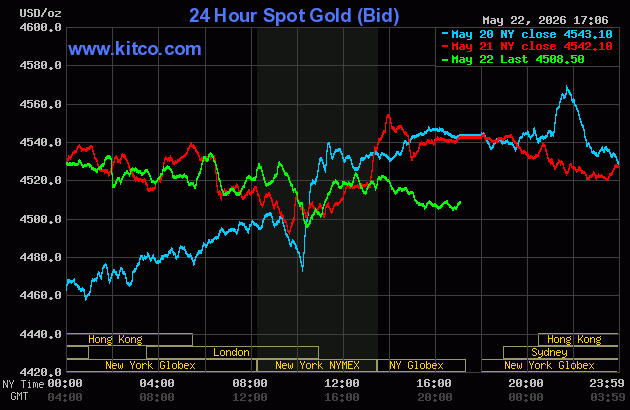
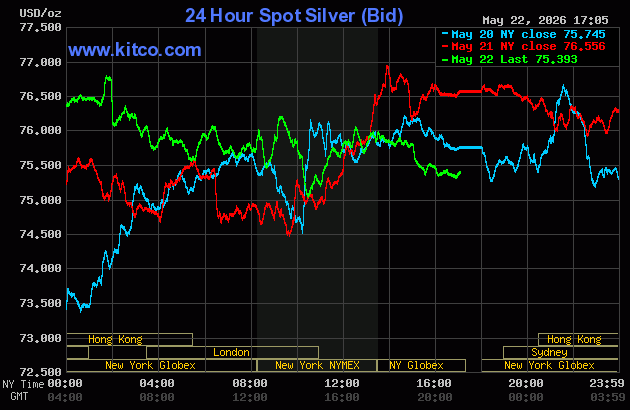
Gold prices weakened on Friday because macro pressure from yields, the dollar, and inflation fears proved stronger than geopolitical safe-haven buying. Spot gold traded near $4,506.30 per ounce, down 0.79% on the session at the time of writing, while spot silver traded at $75.430, down 1.47%.The market faced a difficult balance. Traders still saw residual safe-haven demand from the Strait of Hormuz and U.S.-Iran talks, but that support did not hold because the same energy risk also increased concern that the Federal Reserve may stay hawkish for longer.
How did silver perform alongside gold?
Silver also remained under pressure as the broader precious metals complex turned defensive. Spot silver traded at $75.430, down 1.47%, showing that bullion demand was not strong enough to overcome the broader risk from rates and the U.S. dollar.What U.S. data and Federal Reserve signals pressured bullion?
Weak consumer sentiment did not help gold because inflation expectations rose sharply, reinforcing the case for tighter monetary policy. The final University of Michigan consumer sentiment index fell to 44.8 in May from 49.8 in April.At the same time, one-year inflation expectations rose to 4.8% and long-run inflation expectations climbed to 3.9%. That combination kept markets focused on inflation rather than growth concerns.
What did Christopher Waller say about rates?
Federal Reserve Governor Christopher Waller said the Middle East energy shock has shifted his focus back toward inflation. He also said he would not hesitate to support a rate hike if inflation expectations became unanchored.That comment mattered for XAUUSD because higher-for-longer rates typically raise the opportunity cost of holding non-yielding assets such as gold. Firm Treasury yields and a stronger dollar tone therefore remained direct headwinds for bullion.
How are U.S.-Iran talks and the Strait of Hormuz affecting gold?
The U.S.-Iran story is supporting energy-market volatility, but it is not giving gold a clean bullish boost. Washington saw some progress toward a deal, yet major sticking points remained over enriched uranium and control of the Strait of Hormuz.Because the Strait of Hormuz remains the market’s central energy-risk channel, crude oil stayed volatile. That volatility fed an inflation-risk premium into bond markets and interest-rate expectations.
Why did safe-haven demand fail to lift gold?
Safe-haven demand failed to lift gold because the oil channel also increased the risk of a stronger Federal Reserve response. In other words, geopolitical tension helped support crude, but rising oil also threatened to keep inflation elevated, which pushed yields up and reduced gold’s appeal.This is an important signal for Indian investors. Gold often benefits from global stress, but when that stress drives oil and U.S. yields higher at the same time, bullion can struggle despite safe-haven flows.
What happened in equities, bonds, oil, and the dollar?
U.S. equities firmed into the close, while Treasury yields eased from recent highs, but precious metals still stayed defensive. That price action suggested gold traders remained more focused on the broader inflation and rates backdrop than on short-term relief in bond yields.In outside markets, Nymex WTI crude oil traded around $98.25 a barrel at one point, while Brent crude reached $105.19 during Friday’s volatile session. The U.S. dollar index was firmer, and the yield on the benchmark 10-year U.S. Treasury note traded near the 4.6% area.
Why do these markets matter for Indian gold buyers?
These markets matter because Indian gold prices track global gold, the U.S. dollar, and crude oil closely. A firmer dollar can pressure international gold prices, while higher oil can widen India’s inflation risks and affect the rupee, which may offset some global weakness in domestic bullion rates.For Indian investors, that means MCX gold and local jeweller prices may not move in a straight line with spot gold in dollars. If the rupee weakens while XAUUSD softens, domestic gold prices can remain relatively supported.
How did gold and silver perform for the week?
Gold and silver both posted weekly losses, confirming that the precious metals market remains under pressure. Comex gold settled at $4,521.00 per ounce, down 0.76% on the week.Comex silver settled at $75.893, down 1.64% on the week. Gold has now logged two straight weekly losses, and its broader two-week decline stands at 4.22%.

That trend shows traders have been reducing exposure as yields and inflation concerns stay elevated. It also tells Indian investors that near-term momentum in bullion has weakened even though geopolitical risks have not disappeared.
What are the key gold price levels to watch now?
Gold bulls need a move back above resistance to regain control of the near-term trend. The next upside price objective for spot gold is to push prices back above the $4,530 to $4,550 resistance zone.If gold clears that range on a sustained basis, the next upside targets are $4,660 to $4,680, followed by $4,774. Those are the main technical levels traders will watch in the sessions ahead.
Where is gold support on the downside?
Gold bears want a break below recent lows to extend the decline. The deeper downside target comes in at $4,350 to $4,370.First support is seen at $4,491.20, followed by the broader support band at $4,350 to $4,370. For short-term XAUUSD traders, these zones are critical because a break below them would suggest the recent corrective phase is deepening.
What are the key silver price levels to watch?
Silver bulls need to recover the 50-day moving average near $75.98 to improve the technical picture. A move above that level would open the way toward $78.00 to $79.00 and then $85.00 to $86.00.On the downside, silver bears are targeting a break below $75.00. If that level fails, deeper downside targets come in at $71.00 to $72.00.
Where are silver support and resistance levels?
First resistance in spot silver stands at $75.98, followed by $78.00 to $79.00. Next support is seen at $75.00 and then at $71.00 to $72.00.For Indian investors tracking precious metals, silver remains more volatile than gold and can react sharply to shifts in industrial sentiment, U.S. yields, and dollar strength. The next major watchpoint is whether oil-driven inflation fears keep Treasury yields near the 4.6% area and prevent gold from reclaiming the $4,530 to $4,550 zone, because that will shape the near-term direction for bullion and domestic gold prices in India.