# Gold Price Drops Toward $4,500 After US Consumer Sentiment Sinks
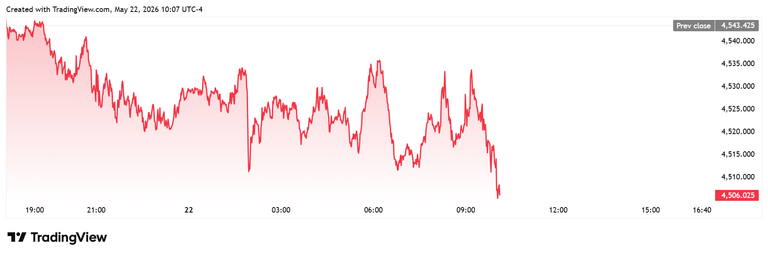
Gold prices fell to session lows on Friday after weak U.S. consumer sentiment data and rising inflation expectations rattled markets. Spot gold slipped near the key $4,500 per ounce level after the University of Michigan said its final May Consumer Sentiment Index fell to 44.8, well below the 48.2 consensus forecast and April’s 49.8 reading.
For Indian investors, the move matters because softer U.S. growth signals and firmer inflation expectations can reshape Federal Reserve rate bets, the U.S. dollar, Treasury yields, and in turn the gold price in India. Any sustained move in XAUUSD around $4,500 could filter into domestic bullion rates, especially when combined with rupee volatility.
Why did gold price fall toward $4,500 today?
Gold price fell because the market reacted to a fresh batch of U.S. macro data that showed weakening consumer confidence but rising inflation expectations. That mix often creates uncertainty around the Federal Reserve’s next move and can trigger short-term volatility in bullion.
After the 10 a.m. ET data release, spot gold hit a fresh session low and tested $4,500 per troy ounce. It was last trading at $4,506.05 per ounce, down 0.82% on the day.
The immediate catalyst was the University of Michigan’s final sentiment reading for May. The index came in at 44.8, missing economists’ consensus estimate of 48.2, which matched the preliminary reading, and falling below April’s final 49.8.
What did the University of Michigan consumer sentiment report show?
The report showed that U.S. consumers turned more pessimistic for a third straight month. It also showed that Americans expect higher inflation both over the next year and over the longer run.
The University of Michigan said its final Consumer Sentiment survey for May was 44.8. According to Joanne Hsu, Director of the Surveys of Consumers, sentiment weakened as supply disruptions in the Strait of Hormuz continued to push up gasoline prices.
Hsu said, “Consumer sentiment fell for the third straight month as supply disruptions in the Strait of Hormuz continue to boost gasoline prices.” She added that sentiment is now just below the previous historical trough seen in June 2022.
How are high prices affecting households?
High prices are pressuring household finances more intensely. Hsu said the cost of living continues to be a first-order concern, with 57% of consumers spontaneously saying that high prices were eroding their personal finances, up from 50% last month.
She also noted that lower-income consumers and those without college degrees posted especially sharp declines in sentiment. According to Hsu, these groups are more sensitive to rising costs for gasoline and other essentials.
Which political groups saw sentiment weaken?
Sentiment fell among Independents and Republicans, and both groups reached their lowest readings of the current presidential administration. By contrast, Democrats’ sentiment was little changed from the prior month.
Hsu said consumers increasingly fear that inflation will spread beyond fuel costs and remain elevated over time. That concern is important for gold because inflation expectations often influence real yields, safe-haven demand, and Federal Reserve policy expectations.
How much did inflation expectations rise in the May survey?
Inflation expectations rose on both a one-year and long-run basis. The increases pushed both measures above levels seen over the past year and added to concerns that inflation pressures are broadening.
According to Hsu, year-ahead inflation expectations edged up from 4.7% in April to 4.8% in May. She said the current reading is well above the 3.4% level recorded in February 2026, before the start of the Iran conflict, and also above all 2024 readings.
Long-run inflation expectations climbed from 3.5% in April to 3.9% in May. That is notably above the 2.8% to 3.2% range seen in 2024.
Why does the jump in long-term inflation expectations matter for gold?
The rise matters because long-term inflation expectations can affect how investors price future interest rates, bond yields, and safe-haven assets like gold. If markets believe inflation will stay higher for longer, that can complicate the Federal Reserve’s path.
Hsu said, “This month’s increase in long-run expectations reflects sizable jumps among independents and Republicans.” She added that for Republicans, long-run inflation expectations are now more than double their February 2025 reading on a monthly basis.
What does this mean for gold investors in India?
For Indian investors, the data points to near-term volatility in global bullion prices and possible knock-on effects for domestic gold rates. A weaker U.S. consumer backdrop can support safe-haven demand over time, but rising inflation expectations can also lift yields and pressure gold in the short term.
If XAUUSD struggles to hold above $4,500 per ounce, Indian bullion traders will also watch the USD/INR exchange rate closely. Even when international gold prices dip, rupee weakness can cushion the decline in local gold prices.
The report also carries a geopolitical angle for India. The University of Michigan linked weaker sentiment to Strait of Hormuz supply disruptions and higher gasoline prices, a reminder that energy-market stress can feed into inflation expectations globally. That matters for Indian investors because imported energy costs influence inflation, currency trends, and domestic precious metals demand.
What should markets watch next after gold tested $4,500?
Markets should now watch whether gold can hold the $4,500 per ounce zone and how the Federal Reserve outlook shifts as inflation expectations rise. Investors will also track whether consumer inflation fears remain tied to fuel or start spreading more broadly across the U.S. economy.
The combination of a 44.8 sentiment reading, 4.8% one-year inflation expectations, and 3.9% long-run inflation expectations suggests that markets are dealing with both growth concerns and sticky price pressures. For Indian investors, that makes the next move in bullion highly sensitive to U.S. yields, the dollar, geopolitical risk, and the rupee’s response in the days ahead.