# Swiss Gold Exports Jump 30% as Safe-Haven Demand Surges
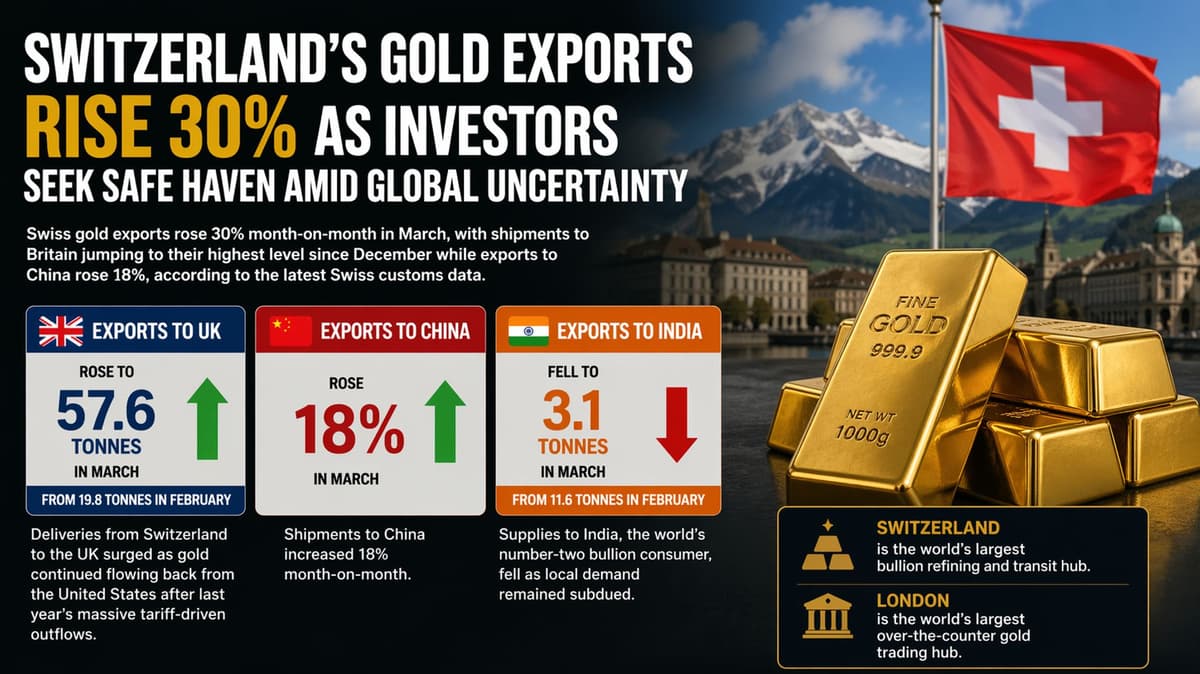
Swiss gold exports rose 30% month-on-month in March, signalling a sharp rebound in bullion flows as investors sought safe-haven assets amid global uncertainty. The biggest shifts came from stronger shipments to Britain and China, while exports to India fell sharply, a trend Indian investors should watch for clues on local demand, import trends, and rupee-priced gold.
Why did Swiss gold exports rise in March?
Swiss gold exports rose because safe-haven demand strengthened and bullion flows normalised after February's weakness. According to the latest Swiss customs data, total Swiss gold exports increased 30% month-on-month in March.
The rebound followed a weak February, when Switzerland’s gold exports fell 18% from the previous month to the lowest level since last August’s tariff-induced collapse. That earlier drop was driven by slower shipments to Britain and India.
March’s recovery shows that global bullion logistics remain highly sensitive to geopolitics, trade policy concerns, and investor demand for defensive assets like gold.
Why Switzerland matters in the gold market
Switzerland matters because it is the world’s largest bullion refining and transit hub. Gold moving through Swiss refineries often reflects broader shifts in physical demand across major markets.
London also plays a central role because it is the world’s largest over-the-counter gold trading hub. That makes Swiss-to-UK shipments an important indicator for institutional bullion demand and vault flows.
How much gold did Switzerland export to Britain, China, India and the United States?
Switzerland exported much more gold to Britain and China in March, while shipments to India and the United States remained weak. The country sent 57.6 tonnes to the UK in March, up sharply from 19.8 tonnes in February.
That was the highest level of Swiss gold exports to Britain since December. The increase suggests that gold continued flowing back from the United States after last year’s tariff-driven dislocations.
Exports to China also rose. Swiss customs data showed shipments to China increased 18% in March.
By contrast, supplies to India fell to 3.1 tonnes in March from 11.6 tonnes in February. India is the world’s second-largest bullion consumer, so the decline points to subdued local demand.
Swiss gold exports to the United States were almost nonexistent during the month. Customs data showed that shipments from Switzerland to the U.S. dropped by more than 99% to only 0.3 tonnes in August 2025 compared with July’s figures, after a shock U.S. customs ruling appeared to impose tariffs on Swiss gold bar exports.
Why are Swiss bullion trade flows being watched so closely?
Swiss bullion trade flows are under close scrutiny because a shock U.S. customs ruling last August disrupted one of the world’s most important physical gold channels. Over the last six months, traders, refiners, banks, and investors have closely tracked Swiss exports to understand how tariff fears and policy uncertainty are reshaping gold movement.
According to the source article, Switzerland’s massive bullion sector was upended after a U.S. customs decision appeared to impose tariffs on exports of gold bars last August. That policy shock sharply altered normal trade patterns.
The result was dramatic. Gold exports to the U.S. nearly stopped altogether, with shipments from Switzerland collapsing to 0.3 tonnes in August 2025 after being far higher in July.
What happened to gold flows after the tariff shock?
Gold flows were redirected after the tariff scare, with metal moving back from the United States to other major hubs, including Britain. March’s jump in Swiss shipments to the UK suggests that this rebalancing process is still underway.
For bullion traders, this matters because gold trade routes affect physical premiums, refining margins, and short-term market liquidity in global centres such as London, New York, Zurich, Mumbai, and Shanghai.
What did the Swiss Bankers Association say about gold demand and volatility?
The Swiss Bankers Association said gold’s role as a store of value will grow in a more fragmented global financial system, even if that does not always translate into straight-line price gains. On March 25, the Swiss Bankers Association said gold’s relevance will increase as geopolitical and economic tensions deepen.
Nina-Alessa Michel, policy advisor for regulation and economics at the Swiss Bankers Association, said recent events show how tightly gold prices are linked to global uncertainty. She wrote, “Against a backdrop of geopolitical and economic tensions and rising government debt, demand for safe investments is increasing.”
But Michel also stressed that gold has become more volatile than many investors expect from a classic safe-haven asset. She said gold “has recently undergone massive swings in various market phases.”
Why did the Swiss Bankers Association warn that gold is not always a perfect safe haven?
The Swiss Bankers Association warned that gold does not always move smoothly higher during crises because geopolitical and monetary policy shocks can trigger abrupt reversals. Michel pointed to a sharp move when gold fell 14% in the space of three days after Donald Trump nominated the next Chairman of the US Federal Reserve.
She said that move also placed assets such as silver and Bitcoin under pressure. Her conclusion was direct: “Movements like this clearly show that gold isn’t always the safest of havens and can in fact react sensitively to geopolitical and monetary policy shifts.”
Michel added that geopolitical developments remain a strong catalyst for gold demand. She wrote that investors increasingly seek safe havens while global capital markets are pressured by fragmentation, conflicts, and changing balances of power.
How exposed is Switzerland to shifts in global gold demand?
Switzerland is highly exposed because its refineries, trading networks, and financial links sit at the centre of the physical bullion market. Michel said Switzerland is particularly sensitive to changes in gold demand because the country’s banking centre finances these global trade flows.
She wrote, “Its refineries, trading networks and international links make the banking centre, which finances these, especially sensitive to news flow from global politics.” That means rising demand, export restrictions, or international sanctions can affect Switzerland’s real economy directly.
How large were Swiss gold exports to the United States in 2025?
Swiss gold exports to the United States were enormous in early 2025 before the disruption. Michel noted that in the first half of 2025 alone, Switzerland exported more than 476 tonnes of gold worth CHF 39 billion to the U.S.
She said demand in the U.S. was driven by uncertainty, inflation, and concerns about a further increase in government debt. Those forces substantially boosted demand from investors.
Michel also highlighted the role of non-traditional buyers. She said stablecoins like Tether played a key role, with Tether buying around 70 tonnes of gold in 2025, more than most central banks.
How did trade policy affect gold prices and bullion flows?
Trade policy changed gold prices and bullion flows quickly because even suspected tariff changes can trigger major market reactions. Michel said gold rose when the U.S. government appeared to suggest tariffs on gold and then fell back when it became clear that no such tariffs were planned.
That pattern shows how sensitive XAUUSD and physical bullion markets remain to policy headlines. For investors, this means gold can react not only to inflation, yields, and Federal Reserve expectations, but also to customs rulings, sanctions, and global trade restrictions.
What happened to gold prices in 2026?
Gold prices surged sharply at the start of 2026 before correcting violently. Michel said gold began the year at around USD 4,330 per troy ounce and then rallied rapidly on sustained demand and a market environment still marked by uncertainty.
The precious metal broke records almost daily in mid-January. It then reached an all-time high of almost USD 5,600 on January 28, including a record intraday high of USD 5,597.23 per ounce.
That move also pushed gold decisively through the psychologically important USD 5,000 per troy ounce level within just a few weeks.
Why did gold correct after hitting record highs?
Gold corrected because profit-taking and speculation over the future direction of US monetary policy triggered a sharp reversal. Michel said the marked correction came at the end of January and the start of February.
Over a few days, gold dipped below USD 5,000 at times before stabilising slowly. Michel also noted that since the outbreak of the Iran War on February 28, there has been a renewed drop in gold prices.
The broader message for gold investors is clear: even during a strong long-term uptrend, bullion can experience deep and sudden pullbacks.
What does this mean for Indian gold investors?
Indian gold investors should read the fall in Swiss exports to India as a sign of softer near-term physical demand, not necessarily weaker long-term interest in gold. Switzerland shipped only 3.1 tonnes to India in March, down from 11.6 tonnes in February.
That matters for India because lower imports can reflect weaker jewellery demand, high local prices, seasonal slowdowns, or cautious buying behaviour. If global gold prices remain elevated and the Indian rupee weakens against the U.S. dollar, domestic gold rates can stay firm even when import volumes soften.
Why INR investors should track Swiss export data
Indian investors should track Swiss customs data because it offers an early signal on global bullion availability and regional demand shifts. Changes in Swiss shipments to India, the UK, China, and the U.S. can influence refining flows, import trends, and eventually local premiums in the Indian market.
For buyers of jewellery, coins, bars, and digital gold, the combination of global XAUUSD prices and USD/INR moves remains critical. A strong dollar can lift domestic gold prices in rupee terms even when international prices correct.
What could drive gold prices next?
Gold prices will likely be driven by structural trends, not just one-off events. The Swiss Bankers Association said the medium-term direction for gold will depend on geopolitical uncertainty, central bank reserve diversification, inflation trends, and liquidity conditions.
Michel said, “Geopolitical uncertainty will play a central role: the bigger the shifts in global balances of power, the more attractive gold will become as a strategic reserve.” She added that central banks are likely to increase gold’s importance as they diversify currency reserves and reduce dependence on traditional hard currencies.
She also said monetary policy will remain a key influence, though not simply through individual rate decisions. Instead, its impact on risk perception and liquidity conditions may matter more.
For Indian investors, the key watchpoints now are global safe-haven demand, Federal Reserve signals, USD/INR moves, and whether physical imports into India recover from March’s weak 3.1-tonne level. If geopolitical tensions remain elevated and central-bank buying stays firm, gold and broader precious metals markets may remain volatile but structurally supported.