# Silver Imports in China Surge 78% as Demand Shock Grips Market
China’s silver imports jumped sharply because retail investors rushed to buy small silver bars and solar manufacturers accelerated purchases before export tax rebates ended on April 1. That combination pushed China’s March silver imports to a record and reinforced concerns about a tightening global silver market.
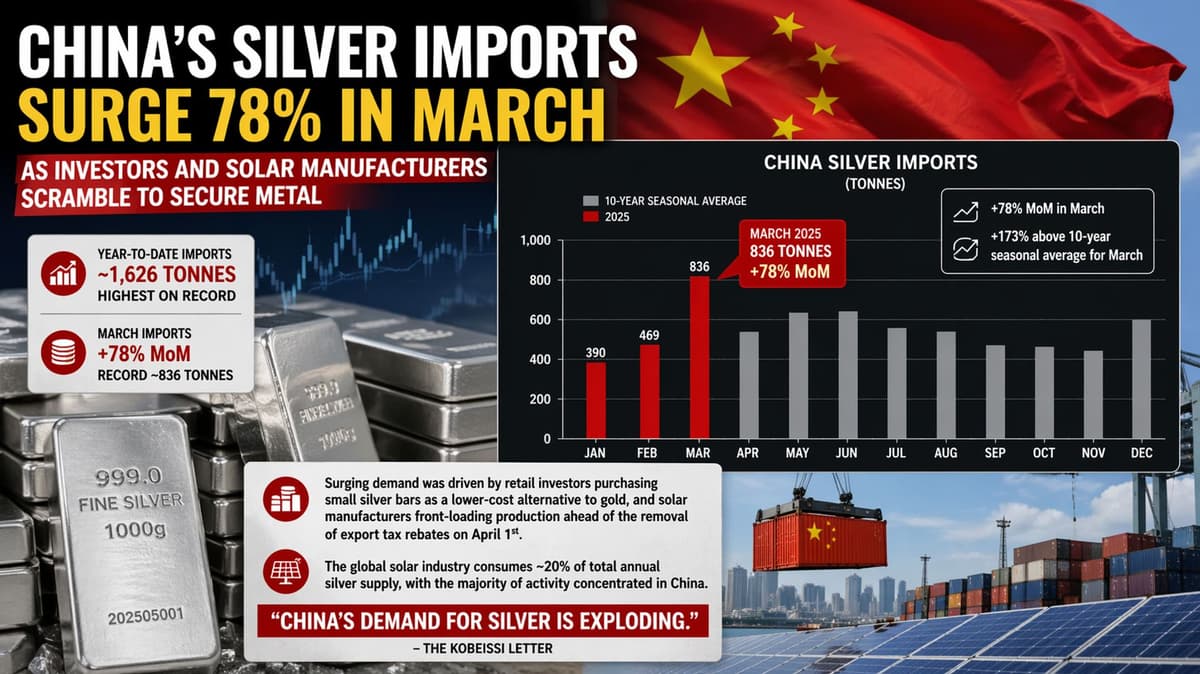
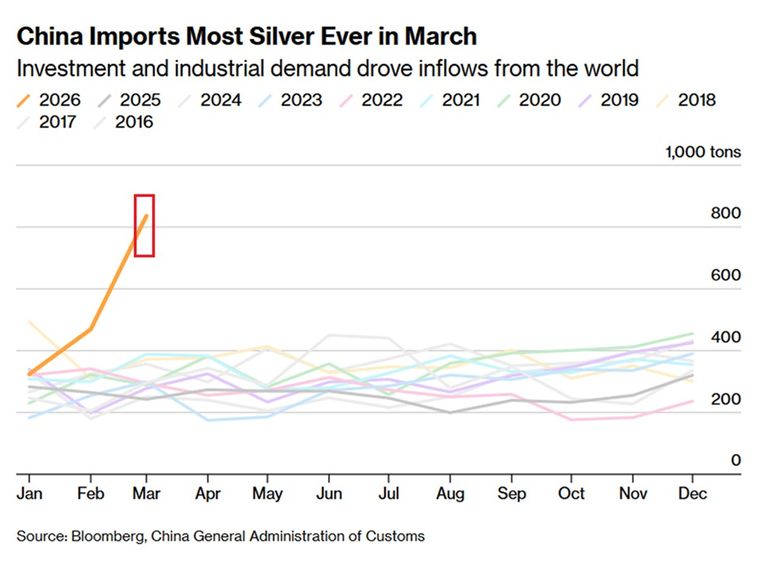
According to The Kobeissi Letter, Chinese silver imports rose 78% month-on-month to about 836 tonnes in March. That figure was 173% above the 10-year seasonal average for March. Year-to-date, silver imports reached about 1,626 tonnes, the highest level on record.
For Indian investors, the move matters because China is one of the world’s biggest consumers of precious metals and industrial raw materials. When Chinese demand for silver spikes, it can affect global bullion pricing, silver availability, and import costs in India, especially when the rupee weakens against the U.S. dollar.
Why did China’s silver imports surge 78% in March?
China’s silver imports surged because investment demand and industrial demand hit the market at the same time. Retail buyers snapped up small silver bars as a cheaper alternative to gold, while manufacturers bought aggressively ahead of a policy deadline.
The Kobeissi Letter said Chinese silver imports rose +78% MoM to a record ~836 tonnes in March. It added that the total was +173% above the 10-year seasonal average for March. For the year so far, imports climbed to ~1,626 tonnes, also a record.
How did retail investors fuel demand?
Retail investors boosted silver demand by treating silver as a lower-cost alternative to gold. As gold prices remain elevated, smaller investors often move into silver bullion, coins, and bars because the entry cost is lower.
The Kobeissi Letter explicitly said surging demand was driven by retail investors purchasing small silver bars as a lower-cost alternative to gold. That shift is important for India as well, where investors often compare gold and silver prices when making precious metals allocations.
How did solar manufacturers add to the rally?
Solar manufacturers added to the demand spike by front-loading production before export tax rebates were removed on April 1. That led companies to secure silver quickly while the economics still favored accelerated manufacturing.
According to Kobeissi, manufacturers ramped up solar panel production ahead of the removal of export tax rebates on April 1st. The report noted that the global solar industry consumes about 20% of total annual silver supply, with most of that activity concentrated in China.
What does China’s silver demand mean for the global silver market?
China’s buying surge signals that the global silver market remains vulnerable to shortages and sharp price swings. Strong physical demand is colliding with already tight supply conditions.
Some analysts argue the tax rebate change was the main driver and may prove to be a one-off event. Even so, the broader backdrop remains supportive for silver because supply is constrained, investment appetite is still firm, and renewed interest in non-hydrocarbon energy after the Iran conflict could lift demand again.
If that happens, the next leg of silver demand may last much longer than a single policy-driven spike. That would matter for bullion traders, industrial users, and investors tracking XAGUSD and broader precious metals trends.
Is the silver market already in deficit?
Yes, the silver market is expected to remain in deficit. According to the Silver Institute’s annual Silver Survey published on April 15, investors should expect more volatility and possible liquidity stress through the rest of the year.
The survey, conducted by Metals Focus, projected the silver market will post its sixth consecutive annual deficit, totaling 46.3 million ounces in 2026. The report said years of undersupply have steadily reduced above-ground stocks and left the market exposed to fresh volatility.
Why are liquidity issues a concern?
Liquidity issues matter because when physical supply is tight, even modest shifts in investment or industrial buying can move prices sharply. In precious metals, that can amplify rallies and deepen corrections.
The Silver Survey said investors should brace for further volatility and potential liquidity issues. Tight above-ground inventories mean silver can become difficult to source when demand accelerates, especially during periods of market stress.
What did Philip Newman and Metals Focus say about silver demand?
Philip Newman said the silver market is increasingly being driven by investment flows, macro uncertainty, and tightening liquidity. That view suggests silver is no longer only an industrial metal story.
In an interview with Kitco News, Philip Newman, Managing Director of Metals Focus, said the latest survey shows a market increasingly shaped by investment flows, macroeconomic uncertainty, and tightening liquidity conditions.
Is industrial demand falling in 2026?
Yes, industrial demand is expected to decline, but it will still remain historically strong. That means silver’s industrial base is softening, not collapsing.
The report said industrial demand for silver is expected to decline by 3% this year to 639.6 million ounces, which would mark a second consecutive annual drop. Even so, Newman said industrial demand remains well above pre-pandemic levels, underscoring silver’s importance in modern technologies.
What is happening in the solar sector?
Silver demand from solar is expected to weaken because higher prices are forcing manufacturers to use less silver or find substitutes. Price pressure is now changing production behavior.
Analysts expect silver consumption in the solar sector to decline 19% this year. The report said higher prices are pushing manufacturers to thrift more silver or use alternative materials in photovoltaic panels.
Newman said substitution pressures emerged even before silver reached extreme price levels. He added that the speed of the rally over the past year has been a major reason manufacturers have moved to adapt.
Which sectors are supporting silver demand?
Data centers, electrification, and electric vehicles are helping support silver demand even as solar demand cools. That broader industrial mix is preventing a sharper slowdown.
Newman said resilience in industrial consumption comes from a more diverse landscape. He pointed to data centers, the broader electrification of the global economy, and electric vehicle manufacturing as important growth drivers for silver consumption.
How is investment demand changing the silver price outlook?
Investment demand is becoming a major force in the silver market again. Retail buying and exchange-traded products are tightening supply and increasing price volatility.
Newman said that even if some industrial demand weakens, retail investment could absorb those losses. In his words: “You could see losses in the industrial sectors being mopped up by the retail investment. It’s not out of the realms of impossibility.”
What role do ETFs and ETPs play in the silver market?
ETFs and ETPs matter because they can remove physical silver from circulation when inflows rise. That can create supply tightness in the spot market and intensify bullion price moves.
The report said ETP holdings are projected to increase again following record inflows in 2025. Metals Focus expects global ETFs to record modest inflows of around 30 million ounces.
However, Newman said the net figure hides major swings underneath the surface. He said: “This is quite a swing from where we are given the sizable liquidations we’ve already seen this year.”
Large ETF inflows can pull metal out of the market, reducing available supply and worsening liquidity squeezes. By contrast, outflows can quickly return metal to the market and amplify volatility in silver prices.
What is happening in coin and bar demand?
Physical investment demand remains strong and is expected to rise further. That is a bullish signal for the silver bullion market.
The survey said coin and bar demand is expected to rise 18% in 2026, reaching its highest level since 2022. Strong physical buying continues to tighten supply conditions, especially when silver prices gain momentum or markets face stress.
How could this affect silver and gold investors in India?
Indian investors should watch China’s silver demand because it can raise global bullion prices and make imports more expensive in rupee terms. A stronger U.S. dollar or weaker Indian rupee can magnify that effect.
For Indian households and traders, silver often acts as a more affordable precious metals entry point when gold prices look expensive. China’s record imports show that this pattern is not limited to India. If global silver supply tightens further, domestic silver prices in India could react quickly, especially during festival buying periods or broad safe-haven demand.
There is also an indirect gold angle. If retail investors worldwide continue shifting into silver as a lower-cost alternative to gold, silver may outperform at times, but both metals could benefit from safe-haven flows, inflation hedging, and concerns about supply tightness in precious metals markets.
The key watchpoint now is whether China’s March spike proves temporary after the April 1 rebate change or becomes the start of a longer demand cycle. Indian investors should track Chinese import data, Silver Institute supply forecasts, ETF flows, and rupee-dollar moves for the next signal in global silver and gold price direction.