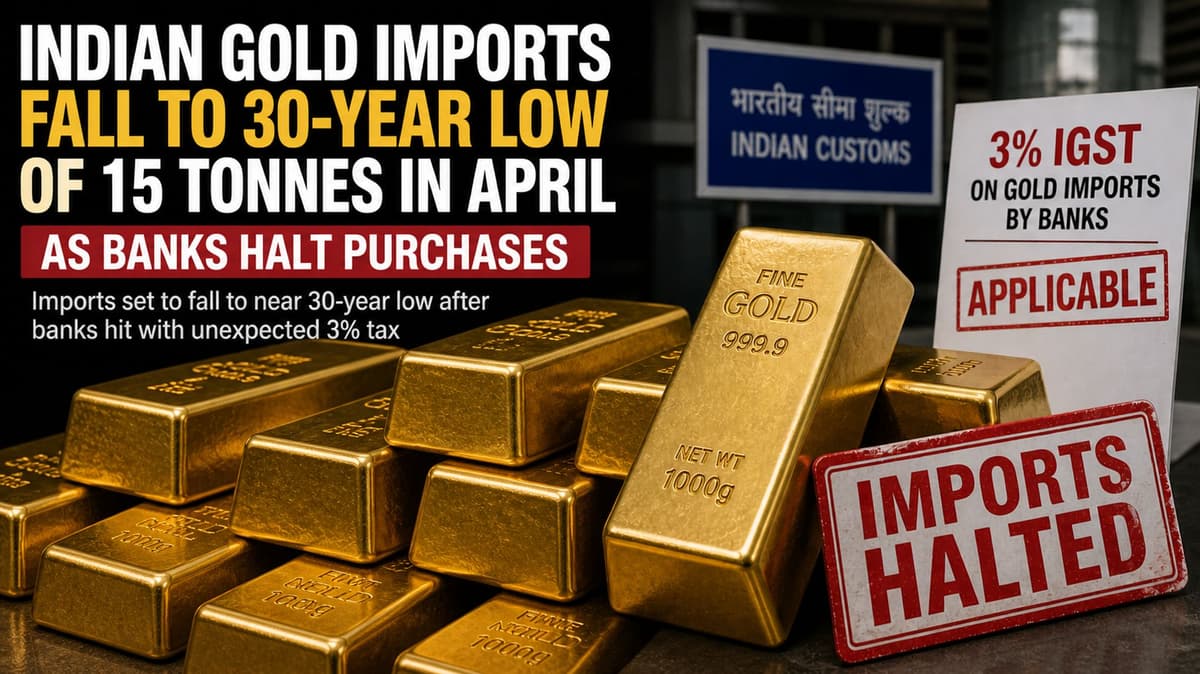
India’s gold imports are set to fall to around 15 tonnes in April, marking a near 30-year low, after banks stopped buying refined gold when customs authorities began demanding a 3% integrated goods and services tax (IGST) on imports. For Indian investors, the disruption matters because India is the world’s second-largest gold consumer, and weaker imports can tighten domestic bullion supply, alter local premiums, and influence rupee-priced gold.
Why did Indian gold imports fall to a 30-year low in April?
India’s gold imports plunged because banks halted shipments after customs started charging a 3% IGST on imported gold. Banks handle most of India’s refined gold imports, so their withdrawal sharply reduced inbound volumes.According to Surendra Mehta, secretary at the India Bullion and Jewellers Association, banks have completely halted shipments since Indian customs began demanding the tax. That abrupt change disrupted the normal bullion import pipeline in April.
India is now expected to import only about 15 tonnes of gold in April. That compares with 35 tonnes in April 2025 and an average of about 60 tonnes a month in fiscal year 2025-26, which ended in March.
Local industry and government sources told Reuters on Friday that April’s import figure would be the lowest for the month in around three decades, excluding 2020, when the Covid-19 pandemic forced jewellery shops in India to shut.
What is the 3% IGST issue affecting bank gold imports?
The immediate problem is that customs authorities are now requiring banks to pay a 3% integrated goods and services tax on gold imports. That is a major shift because banks had previously been exempt.When India adopted the IGST in 2017, gold-importing banks were exempted from paying the 3% levy. The current tax demand appears to stem from a delay in issuing a formal government order that authorizes bullion imports by banks, according to an earlier Reuters report cited in the source article.
That administrative delay has created a policy gap. Until the government issues the required order or clarifies the tax treatment, banks appear unwilling to clear shipments under the new cost structure.
A government official, speaking on condition of anonymity because they were not authorized to speak to the media, said “Banks did not clear any gold from customs this month.” The official added that only a small quantity of imported gold was cleared through the India International Bullion Exchange (IIBX).
India’s tax authorities did not immediately respond to requests for comment from local media on the IGST now being imposed on banks’ gold imports.
How could lower Indian gold imports affect gold prices and the domestic market?
A sharp drop in Indian gold imports could weigh on global gold prices, according to local sources cited in the report. That may sound counterintuitive, but India’s role as a major physical bullion buyer means a sudden decline in imports can signal softer immediate demand in the global gold market.For the Indian market, the picture is more complex. If banks remain absent from the import channel, domestic supply of refined gold could tighten even as headline import volumes fall. That could affect local bullion availability, import premiums, and the rupee price of gold depending on how quickly alternative channels, including the IIBX, fill the gap.
Indian investors should also watch the INR alongside XAUUSD. If global gold prices soften due to weaker Indian imports but the rupee weakens against the U.S. dollar, domestic gold prices may not fall by the same magnitude.
What does recent World Gold Council data say about Indian gold demand?
India’s gold demand profile is shifting toward investment demand, even as jewellery buying slows under the pressure of high prices. That change is important because it shows Indian households and investors still want exposure to gold, but increasingly through bars, coins, and ETFs rather than jewellery.On April 29, the World Gold Council (WGC) said India’s investment demand for gold exceeded jewellery consumption for the first time on record in the March quarter. Investors moved into the precious metal as equity market returns remained subdued.
According to the WGC, stronger investment demand helped offset weaker jewellery buying and kept overall demand stable. Sachin Jain, chief executive of the WGC’s Indian operations, told Reuters: “For the first time investment demand surpassed jewelry demand.”
Jain added: “Investment demand will become increasingly prominent in the coming quarters, with both financial and retail investors showing more interest in gold.” That is a notable signal for Indian investors tracking long-term bullion demand trends.
How strong was India’s investment demand for gold in the March quarter?
India’s investment demand for gold surged sharply in the March quarter. The WGC said investment demand jumped 52% from a year earlier to 82 tonnes.At the same time, jewellery demand fell 19.5% to 66 tonnes. Even with that drop, total gold consumption in India still rose 10.2% to 151 tonnes during the quarter.
For the first time, investment demand accounted for a larger share of total gold consumption than jewellery. Investment demand rose to 54.3% of total consumption in the quarter.
That is a major departure from the usual pattern. Investment demand typically accounts for about a quarter of India’s total gold consumption, but rising gold prices have encouraged investors to buy coins, bars, and gold exchange-traded funds (ETFs) instead of jewellery.
How fast are Indian gold ETF inflows rising?
Indian gold ETF inflows are rising at a record pace. The WGC said inflows into Indian gold ETFs surged 186% in the March quarter from a year earlier to a record 20 tonnes.That increase reinforces the idea that Indian demand for gold is not disappearing despite the collapse in April imports. Instead, demand is rotating toward financial and investment products tied to bullion.
For Indian investors, this trend matters because ETF demand can support domestic sentiment toward gold even when physical jewellery demand weakens. It also means any policy disruption in the import market may hit supply chains and pricing before it changes the broader investment case for gold.
The key watchpoint now is whether New Delhi issues the pending order that resolves the IGST problem for banks. If the government restores clarity on bullion imports, April’s 15-tonne figure could prove to be a temporary shock rather than the start of a prolonged slowdown in India’s gold market.