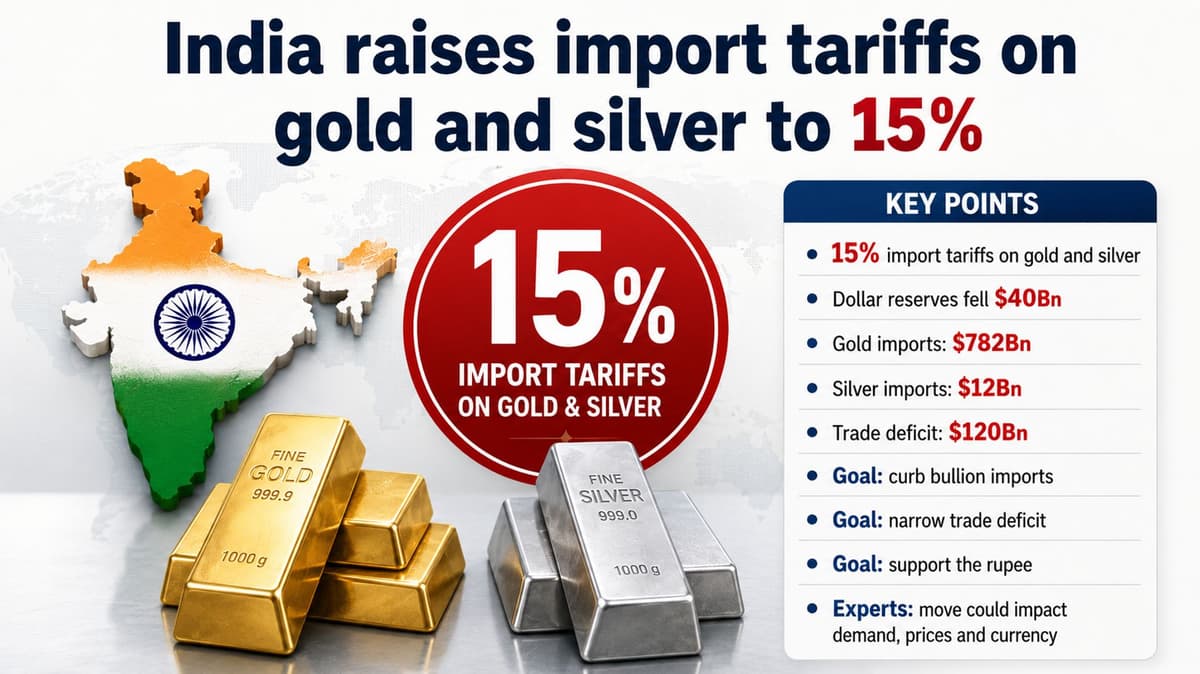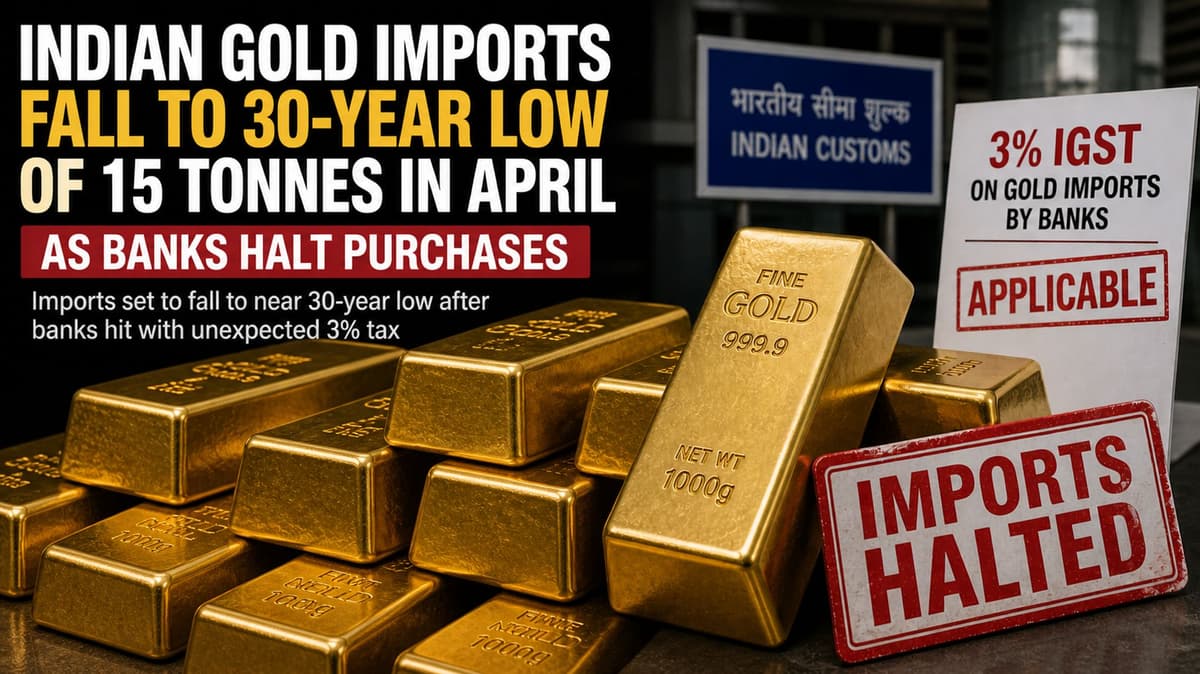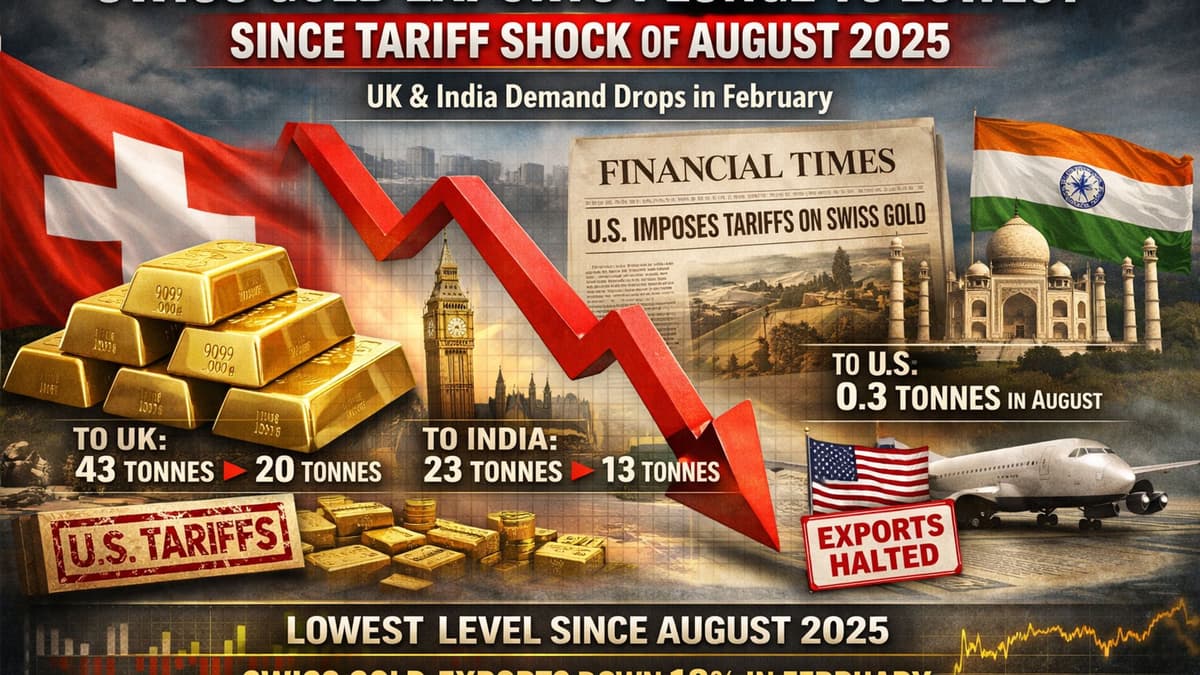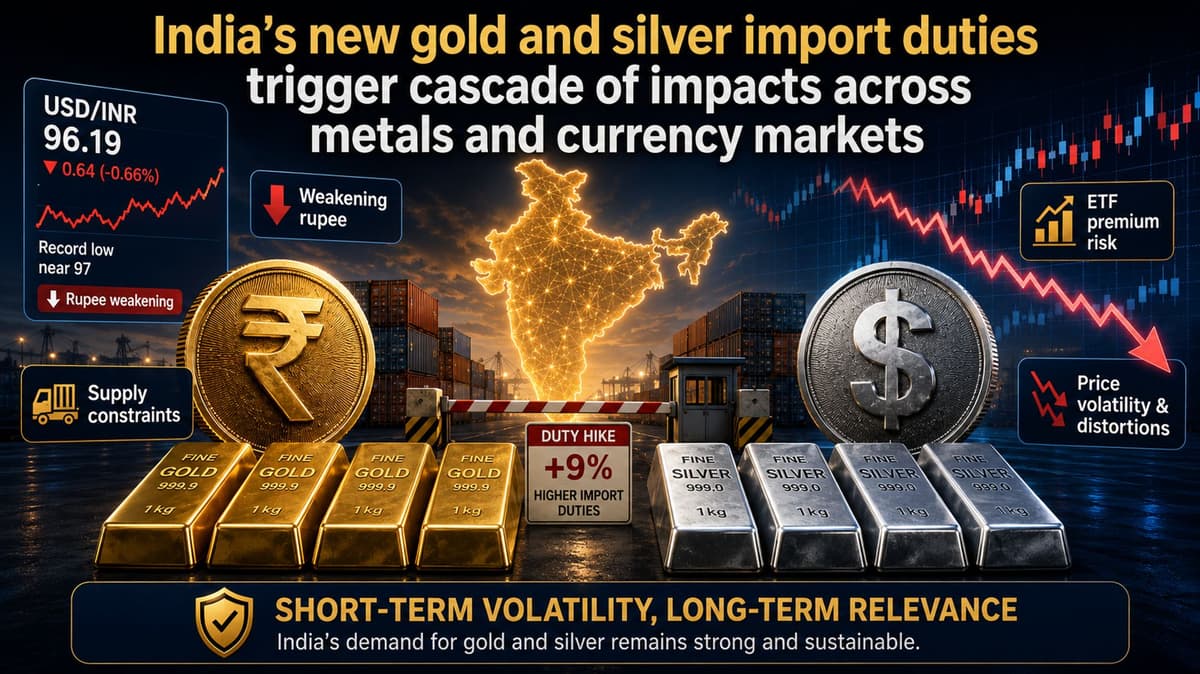
India’s new gold and silver import duties are already reshaping domestic bullion pricing, ETF premiums, and currency-market sentiment. While global precious metals remain capped in the short term by the Iran war, analysts say India’s policy shift has created a new layer of volatility for the world’s second-largest gold and silver market.
Why are India’s new gold and silver import duties moving prices?
India’s new import duties are pushing domestic gold price and silver price trends higher, but the initial move has been smaller than the tax change itself. According to Mariya Paliwala, Senior Editor at Juris Hour, the immediate domestic market response did not fully match the duty increase.Paliwala cited an industry source who said that despite a net 9% increase in duties, domestic prices rose only 5% to 6% in the first phase after the announcement. The source attributed that muted move to existing inventories purchased at earlier rates and held with comfortable margins, along with weak consumer willingness to absorb a sudden and sharp increase in prices.
That gap may not last. As lower-cost inventories run down, Indian bullion prices are expected to reflect more of the full impact of the higher import costs.
Why did prices not rise fully right away?
The answer is inventory cushioning. Dealers and traders were still selling gold and silver stocks imported at older, lower duty levels, which slowed the transmission of the full increase into retail and wholesale prices.Demand conditions also mattered. Buyers did not immediately accept the entire rise in prices, limiting how quickly sellers could pass on the higher tax burden.
How could the duty hike affect gold and silver ETFs in India?
The duty hike could widen ETF premiums if physical supply tightens, especially in silver. Paliwala said market experts are closely watching ETF premiums, which measure how much investors pay above the underlying net asset value, or NAV, of a fund’s holdings.Restrictions on silver imports have raised concern that supply channels could tighten if investor demand jumps. If that happens, pricing in exchange-traded funds could diverge from physical availability in the local market.
Why is silver seen as more vulnerable than gold?
Silver faces a bigger supply risk because market participants view silver import restrictions as more binding. Paliwala’s industry source warned that silver could face relatively greater challenges than gold if demand rises aggressively while supply stays constrained.In that scenario, silver ETF premiums could increase substantially. If investor demand remains moderate, however, pressure on ETF pricing may stay more contained.
What happens if panic buying starts?
Sudden investor enthusiasm or panic buying could push ETF premiums well above normal levels. That would matter for Indian investors because ETF buyers could end up paying significantly more than the value of the underlying bullion.For investors tracking precious metals through paper instruments rather than physical bars or coins, that premium risk becomes a key part of portfolio timing.
What global factors are analysts watching for the next big gold move?
Analysts still see the broader case for gold and silver as intact, even though the Iran war has created short-term headwinds. The same supportive macro backdrop that helped precious metals hit record highs in early 2026 remains in place, according to the source article.Paliwala said investors are monitoring several international drivers to judge the next direction for gold price and silver price moves.
Which market signals matter most now?
The key signals include:- Interest rate decisions by the U.S. Federal Reserve under its new leadership
- Policy actions by major global central banks
- Fluctuations in the U.S. dollar against the Indian rupee
- Movements in Comex prices
- Oil price trends
Why does this matter for Indian investors?
Indian investors do not only track XAUUSD or global troy ounce prices. They also face a layered pricing structure shaped by import duties, rupee weakness, local supply conditions, and ETF premium distortions.That means even if international bullion prices stay range-bound, domestic gold price in India can still rise sharply if the rupee weakens or import restrictions bite harder.
How is the falling Indian rupee affecting gold and silver prices?
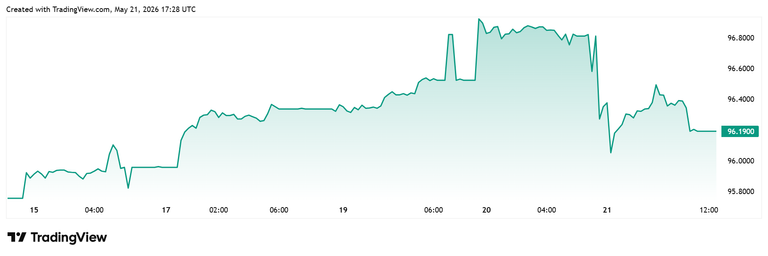
The weaker Indian rupee is adding fresh upward pressure to domestic gold and silver prices. The policy changes were partly designed to address pressure on the currency, but the rupee still fell to a new record low this week.The Indian rupee hit 96.923 per U.S. dollar on Wednesday and spent several hours pressing against the 97 level before recovering part of the loss on Thursday. A weaker rupee makes imported bullion more expensive in local currency terms, which directly feeds into Indian gold price and silver price calculations.
Why does USD/INR matter so much for bullion?
India depends heavily on imported precious metals. When USD/INR rises, importers need more rupees to buy the same amount of gold or silver priced internationally in dollars.That currency effect can amplify any increase already caused by higher import duties. For Indian households, jewellers, and investors, the result is a steeper local price even without a major jump in global XAUUSD.
What is the IBJA proposing to ease import pressure?
The India Bullion and Jewellers Association, or IBJA, wants India to monetize nearly 1,000 tons of idle “temple gold” to reduce import dependence. The industry body says that could ease pressure on imports while protecting jobs in the small jeweller and artisan segment.IBJA Gujarat State President Nainesh Pachchigar said gold is the second-largest contributor to foreign exchange outflow from India, with the country importing around 800 tonnes of gold per year. He said trusts hold nearly 1,000 tons of idle gold, and even partial use of that stock could help significantly.
Is the IBJA asking the government to take ownership of temple gold?
No, the IBJA is not calling for permanent government ownership. The association said it is proposing a structured monetisation mechanism that would keep the metal circulating inside the formal economy without permanently transferring ownership to the state.That distinction is important because it positions the proposal as a liquidity and supply solution rather than a confiscation measure.
How could temple gold monetisation help the domestic market?
Temple gold monetisation could reduce the need for fresh imports, lower pressure on foreign exchange reserves, and cushion supply disruptions caused by the new duty structure. It could also support domestic bullion availability at a time when higher duties are increasing costs across the value chain.For India’s gold market, this kind of internal recycling could become a major policy lever if price distortions worsen.
Why are jewellers being asked to limit bullion sales?
The IBJA has directly asked jewellers to stop bullion trading activities and restrict direct bullion sales in response to the duty hike. Pachchigar appealed to jewellers not to engage in bullion trading and not to sell bullion directly to customers.He also said jewellers should not sell bullion above five grams. According to Pachchigar, the advisory was issued immediately after the duty increase to align with the government’s objective of curbing speculative demand.
What sales are still allowed?
Pachchigar said jewellery sales for ceremonies and essential needs can continue. However, he urged the trade to limit non-essential sales and continue transactions only to the extent genuinely required by customers.This guidance shows how seriously the industry is taking the risk of speculative buying after the tax increase.
What does this mean for jobs in India’s jewellery sector?
The stakes extend beyond gold price moves because higher duties and weaker demand can threaten employment across the jewellery supply chain. Pachchigar said small labourers and workers whose livelihoods depend on the jewellery industry face particular risk.He added that if the temple gold monetisation proposal and other mitigation measures move forward, they could help protect employment opportunities. That matters especially for small jewellers, artisans, and workshop workers who are most exposed to demand disruptions.
Will India’s duty hike change the longer-term outlook for gold and silver?
Probably not on its own. Analysts believe the new policies may create temporary pricing distortions and market volatility, but they do not change the broader bullish case for precious metals.Paliwala said that investment demand for gold and silver remains supported by inflation concerns, monetary policy uncertainty, and global economic conditions. In other words, India’s import measures may alter local pricing, supply, and ETF behavior, but the larger macro case for bullion remains in place.
For Indian investors, the key watchpoint now is whether the combination of higher import duties, rupee weakness, silver supply constraints, and global central-bank decisions drives another leg higher in domestic bullion prices before local demand starts to crack.