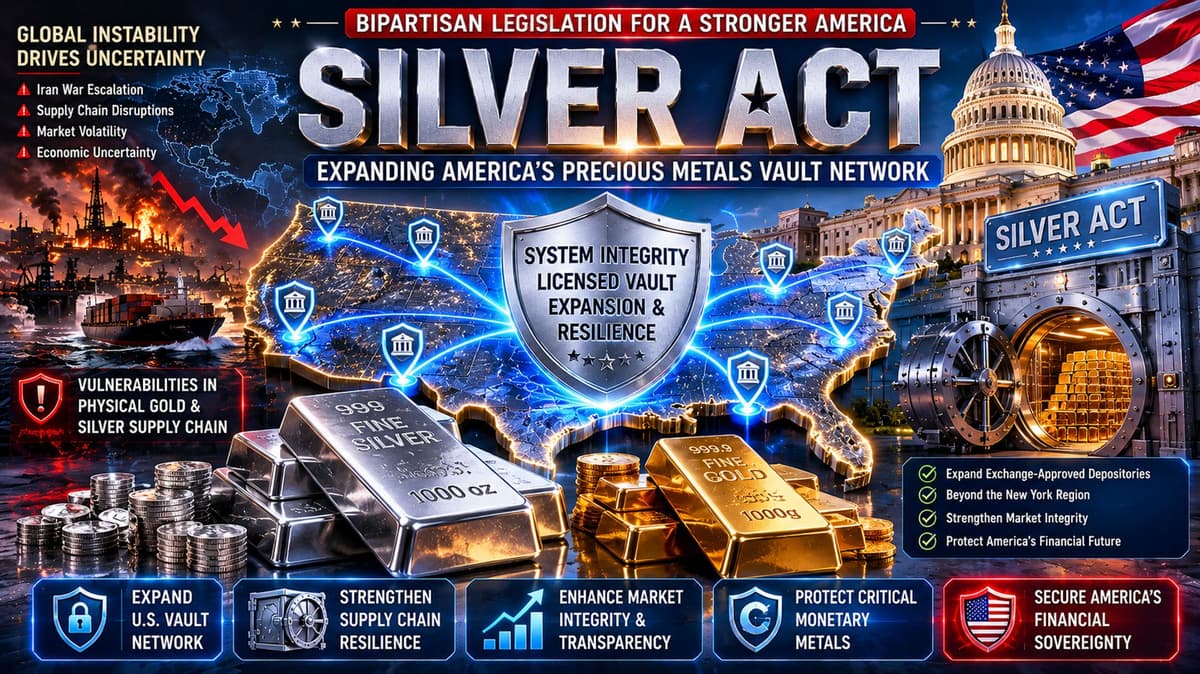
The proposed U.S. federal legislation could widen the approved precious metals vault network beyond the New York area, aiming to reduce concentration risk in bullion storage and improve market resilience during supply-chain disruptions. For Indian investors, the bill matters because stronger U.S. gold and silver market infrastructure can support smoother global bullion flows, liquidity, and price discovery during geopolitical stress.
What Is the New U.S. Precious Metals Vault Bill?
The new bill is the “System Integrity through Licensed Vault Expansion and Resilience Act,” or the SILVER Act. U.S. Representative Russ Fulcher of Idaho and U.S. Representative Mark Harris of North Carolina introduced it on Thursday.The legislation seeks to expand the geographic footprint of exchange-approved depositories for precious metals linked to regulated futures markets. In practical terms, it would loosen the existing concentration of approved bullion vaults near New York City.
According to the bill, current legislation requires exchange-approved precious metals vaults to be located within roughly 150 miles of New York City. Lawmakers and industry participants argue that this creates concentration risk for market stability, national security, liquidity, and investor access.
Who introduced the SILVER Act?
Rep. Russ Fulcher (R-ID) and Rep. Mark Harris (R-NC) introduced the measure. Their proposal focuses on diversifying where approved gold and silver depositories can operate inside the United States.What would the bill require?
The SILVER Act would require the approval of at least two depositories in the Eastern, Central, Mountain, and Pacific time zones. That means the U.S. precious metals storage framework would become more geographically distributed instead of remaining heavily centered around New York.Why Does the U.S. Want to Expand Its Bullion Vault Network?
The main reason is risk reduction. Policymakers want to mitigate supply-chain and market infrastructure risks at a time when the Middle East crisis and the war in Iran continue to disrupt global logistics and unsettle financial markets.Kitco News reported that the physical precious metals market has not been directly impacted by the war in Iran. Even so, volatility in global financial markets shows that gold, silver, and the wider precious metals ecosystem are not immune to geopolitical shocks.
Lawmakers say a concentrated vault network can become a weak point during a national emergency, extreme weather event, or broader market disruption. A more dispersed system could keep gold and silver moving more smoothly through regulated markets.
What risks does the current system create?
Under the current framework, the clustering of approved vaults within roughly 150 miles of New York City creates a single-region dependency. Supporters of the bill say that raises systemic risk, reduces flexibility, and may limit access for investors and market participants outside the U.S. Northeast.How does the Middle East crisis affect bullion markets?
The Middle East crisis is affecting the global supply chain, even if it has not directly disrupted the physical precious metals market so far. It has also added volatility to financial markets, which can influence safe-haven demand, futures market functioning, and bullion logistics.For Indian investors tracking XAUUSD and domestic gold price moves in rupees, this matters because global supply-chain stress can affect imported bullion premiums, local availability, and price transmission into the Indian market.
How Could More U.S. Vaults Affect Gold and Silver Markets?
A broader depository network could increase storage capacity, improve liquidity, and lower transport and storage friction for market participants. That could make the U.S. futures-linked bullion market more efficient and more resilient under stress.Industry stakeholders say expanding approved depositories would make it easier for investors, producers, and institutions to participate in the market without unnecessary transportation and storage costs. In bullion markets, lower friction often supports better access and stronger price discovery.
What did Russ Fulcher say?
Russ Fulcher said a multi-region depository system would strengthen the precious metals supply chain. In his statement, he said, “Having metal depositories located in more than one region in the United States will provide Americans across the country with affordable access to metal exchanges and safeguard assets in the event of a national emergency or extreme weather event.”He added, “I’m proud to introduce the SILVER Act, which requires the approval of at least two depositories in the Eastern, Central, Mountain, and Pacific time zones, strengthening system integrity and resiliency.”
What did market participants say?
Supporters say a diversified vaulting network would help at a time when gold and silver are increasingly recognized as important monetary assets in global financial markets. They argue that the storage system should reflect how real-world bullion supply chains actually operate.Some proponents, including the Sound Money Defense League, said secure depositories in other regions would improve access and resilience. They highlighted the Western United States in particular because much of the nation’s mining and refining activity takes place there.
Why Are Western U.S. Depositories Important for the Precious Metals Supply Chain?
Western U.S. depositories matter because much of the country’s mining and refining activity is based there. Placing approved gold and silver vaults closer to those operations could reduce logistical bottlenecks and better align storage with production flows.Supporters of the SILVER Act say that current infrastructure does not fully reflect where bullion enters the supply chain. A broader network could therefore improve the movement of precious metals from mine and refinery to storage and exchange delivery points.
What is the Sound Money Defense League's view?
The Sound Money Defense League supports expanding secure depositories into more regions, especially the Western United States. The group believes that this would improve market resiliency and investor access as gold and silver retain their strategic and monetary value.How could this improve market access?
A larger vault network could help investors, producers, and institutions avoid unnecessary transportation and storage costs. It could also give more participants direct access to regulated precious metals infrastructure without routing activity through a single region.What Did Stefan Gleason Say About the Proposal?
Stefan Gleason said wider access to qualified storage facilities would enhance efficiency and lower barriers to entry. He framed the issue as both a financial-system resilience question and a real-world supply-chain alignment issue.Gleason, who is CEO of Money Metals Depository, said, “Greater access to qualified storage facilities across the country will enhance efficiency and reduce barriers to entry.” He added, “This is not just about de-risking the financial system given the monetary and strategic roles of gold and silver; it’s also about aligning market infrastructure with real-world supply chains.”
Money Metals Depository is described as one of the largest commercial gold and silver vaults in North America. That gives his remarks added relevance for bullion investors and the broader precious metals industry.
Why Should Indian Gold Investors Watch This U.S. Legislation?
Indian investors should watch this bill because U.S. bullion infrastructure influences global liquidity, futures delivery confidence, and the wider precious metals trading ecosystem. Changes in storage and delivery systems can eventually affect global gold price behavior, including XAUUSD benchmarks that feed into Indian gold rates.India imports a significant share of its gold, so global supply-chain resilience matters for domestic pricing. If the U.S. market reduces storage concentration risk and improves logistics, it could help stabilize parts of the international bullion chain during periods of geopolitical stress.
For Indian buyers, that does not mean immediate changes in jewellery prices or MCX gold contracts. But over time, stronger global market infrastructure can influence premiums, safe-haven flows, and investor confidence in precious metals as a strategic asset class.