# Gold Price Tests $4,500 as Iran Risk Lifts Oil, Yields Stay High
Spot gold slipped in early U.S. trading on Thursday, even as geopolitical tension around Iran pushed oil prices higher and kept U.S. Treasury yields elevated. For Indian investors, that mix matters because stronger crude and firmer yields can influence global bullion prices, risk sentiment, and the rupee-denominated gold rate.
Why did gold price slip even as Iran risk returned?
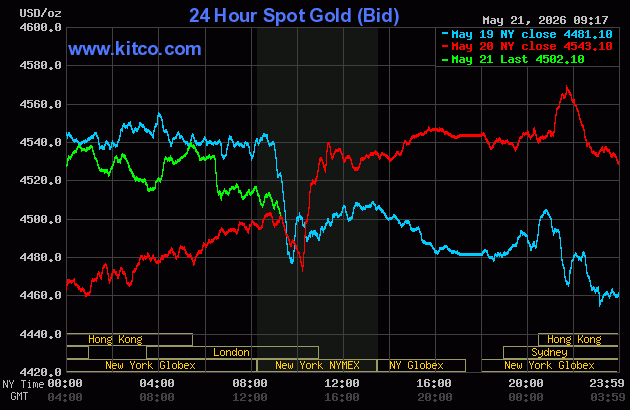
Gold price fell because higher oil did not translate into immediate safe-haven buying strong enough to offset pressure from firm U.S. Treasury yields and a stronger U.S. dollar. At the time of writing, spot gold traded near $4,512.90 per troy ounce, down 0.69% on the session.
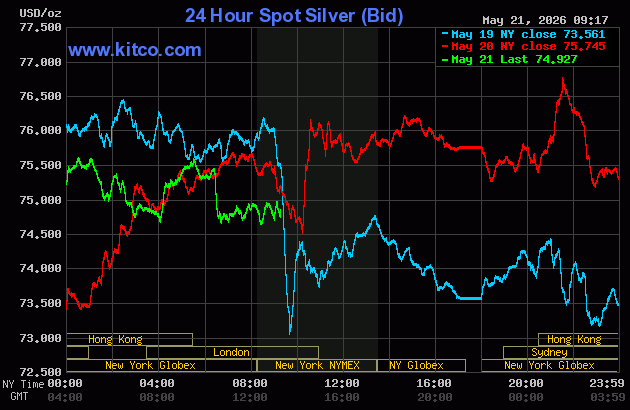
Spot silver also weakened. Silver traded near $75.065, down 1.06% in early U.S. trading.
The market tone showed that precious metals were reacting to multiple cross-currents at once. Renewed U.S.-Iran friction supported crude oil, but bullion still faced resistance because the benchmark 10-year U.S. Treasury yield held near 4.6% and the U.S. dollar index was firmer.
For XAUUSD traders, that left gold testing the psychologically important $4,500 region rather than breaking decisively higher on safe-haven flows.
What economic data moved gold and silver on Thursday?
The U.S. macro data painted a mixed picture, which kept traders cautious on gold and silver. Labor data stayed resilient, housing starts weakened, building permits improved, and regional manufacturing momentum stalled.
How strong was the U.S. labor market?
Weekly jobless claims fell by 3,000 to 209,000 for the week ended May 16. That came in below the 213,000 consensus estimate.
The four-week average slipped by 1,500 to 202,500, reinforcing the signal that layoffs remain relatively contained. However, continuing claims rose by 6,000 to 1.78 million for the week ended May 9.
For gold, resilient labor data can reduce urgency for Federal Reserve easing expectations, which tends to support yields and weigh on non-yielding bullion.
What did the housing data show?
April housing starts fell 2.8% to a 1.465 million seasonally adjusted annual rate. That pointed to softer activity at the construction-start stage.
At the same time, building permits rose 5.8% to 1.442 million. That suggested a firmer forward pipeline, even as actual starts cooled.
What happened in manufacturing?
The Philadelphia Fed manufacturing index fell to -0.4 in May from 26.7 in April. That sharp drop signaled that regional factory momentum stalled.
Taken together, the data delivered a mixed macro read. Labor remained firm, housing construction softened at the start stage, and manufacturing lost momentum.
How is the Iran-Hormuz story affecting gold, oil and markets?
The Strait of Hormuz remains the most important geopolitical transmission channel for oil, yields and precious metals. Any threat to flows through Hormuz can quickly lift energy prices, shift inflation expectations and alter safe-haven demand for gold.
Wednesday’s tanker movement through the strait had briefly reduced the immediate supply-risk premium. But that relief faded after Iran’s supreme leader hardened Tehran’s negotiating stance by ordering that enriched uranium remain inside the country.
That shift pushed energy markets higher again. WTI crude moved back above $100 a barrel, while Brent crude traded near $107, reversing part of Wednesday’s oil-led disinflation trade.
In the broader outside markets, Nymex WTI crude oil was trading around $100.50 a barrel and Brent crude was near $106.90. Higher oil matters for Indian investors because India is a major crude importer, and a sustained crude rally can pressure the rupee and support domestic gold prices in INR terms even if international gold softens.
How did stocks and risk assets react to higher oil and yields?
Risk assets weakened in the U.S. premarket because rising oil and elevated yields offset positive earnings news. U.S. equity futures moved lower before the open.
S&P 500 futures fell 0.2%, Dow futures lost 0.2%, and Nasdaq futures declined 0.4%. Even stronger earnings from Nvidia were not enough to offset the drag from higher energy prices and rates.
Asian markets were mixed but saw some strong moves. South Korea’s Kospi surged 8.4% and Japan’s Nikkei gained 3.1%, while Chinese markets weakened.
European stocks were softer in early trading. Energy risk and higher bond yields offset Wednesday’s rebound.
For precious metals investors, this backdrop matters because falling equities can sometimes support safe-haven gold, but rising real and nominal yields can limit that support.
What levels should gold traders watch now?
Gold bulls need to reclaim the nearby resistance zone to regain momentum. Bears need a clean break below support to confirm a deeper pullback.
Gold resistance levels
Spot gold bulls’ next upside price objective is to push prices back above the $4,531 to $4,546 resistance zone. A sustained move above that area would target $4,573 and then $4,600.
The first resistance is seen at $4,531 and then at $4,546.
Gold support levels

Bears’ next near-term downside price objective is a break below $4,502.70. If gold breaks that level, deeper downside targets come in at $4,500 and then $4,401.
The first support is seen at $4,502.70 and then at $4,481.78.
For Indian investors tracking MCX gold and imported bullion trends, the $4,500 area is especially important because a decisive break could influence near-term sentiment across global and domestic precious metals markets.
What technical levels matter for silver price today?
Silver remains under pressure, but bulls still have a defined recovery zone to target. At the time of writing, spot silver traded near $75.065 per troy ounce, down 1.06% on the session.
Silver resistance levels
Spot silver bulls’ next upside price objective is to drive prices back above the $75.77 to $76.00 area. A move above that zone would target $76.50 and then $77.75.
First resistance is seen at $75.77 and then at $76.00.
Silver support levels
The next downside price objective for silver bears is a break below $74.68. If that level fails, deeper downside targets are $74.47 and then $73.90.
Next support is seen at $74.68 and then at $74.47.
What should gold investors watch next?
The immediate focus is the S&P Global U.S. flash PMI at 9:45 a.m. ET, along with any update on U.S.-Iran negotiations and Hormuz shipping flows. Those three inputs could quickly reshape expectations for oil, inflation, Treasury yields and short-term gold price direction.
For Indian investors, the next move in bullion will likely depend not just on XAUUSD, but also on whether crude stays above $100, whether the 10-year U.S. Treasury yield remains near 4.6%, and whether geopolitical stress feeds into the rupee and local gold premiums.