# Gold Price Surges to 3-Week High After U.S.-Iran Ceasefire
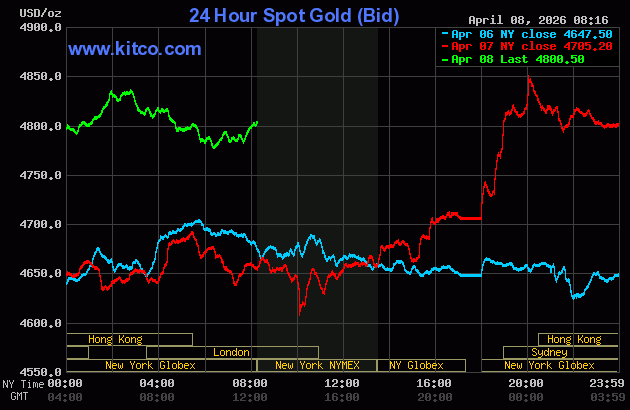
Gold and silver prices jumped sharply after the U.S., Israel and Iran agreed to a two-week ceasefire, lifting bullion to three-week highs. The move came as the U.S. dollar index fell to a four-week low and oil prices tumbled, improving the near-term backdrop for precious metals including XAUUSD.
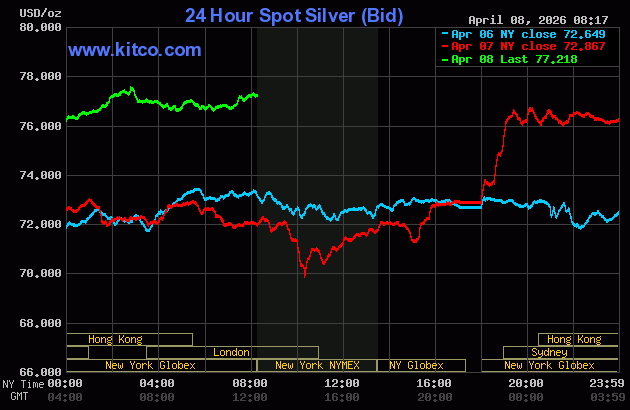
June gold futures were last up $140.60 at $4,827.60 per troy ounce, while May silver futures rose $5.50 to $77.45. For Indian investors, the jump in global gold price matters directly, but the impact on domestic bullion rates will also depend on how the Indian rupee moves against the U.S. dollar.
Why did gold price jump after the U.S.-Iran ceasefire?
Gold price rallied because the ceasefire news weakened the U.S. dollar sharply, and a weaker dollar usually supports bullion prices. The overnight announcement also reduced immediate fears around energy supply disruption while still keeping geopolitical risk elevated enough to sustain safe-haven interest.
The latest developments from the Middle East included:
- The U.S., Israel and Iran agreeing to a two-week ceasefire and discussing a broader deal to end the war.
- Donald Trump saying the U.S. and Iran would work together to destroy Iran’s enriched uranium.
- Israel continuing combat in Lebanon.
- The U.S. moving to help with Strait of Hormuz shipping traffic.
- Relief rallies sweeping through global stock and financial markets.
- Oil and gas prices tumbling.
- Pakistan saying it will host talks on Friday, although the U.S. had not yet confirmed attendance.
- Earlier explosions reported at Iran’s Lavan refinery, with timing and source still unclear.
For Indian buyers, lower oil prices can ease imported inflation risks over time, but a higher international gold price can still push local rates up, especially if the rupee weakens.
What is happening in the Strait of Hormuz and why does it matter for bullion?
The Strait of Hormuz remains a critical market driver because it is central to global energy shipments, and any disruption there quickly affects inflation, currencies and safe-haven assets like gold. Even with the ceasefire, shipping risks have not disappeared.
According to Bloomberg, details remain limited on how the reopening of the Strait of Hormuz will be carried out. Bloomberg reported that the move “won’t dispel the fears shipowners have been grappling with over the past six weeks, as Iran lobbed missiles and projectiles at vessels.”
Shipowners have been keeping vessels on standby and consulting insurers and security advisers. Bloomberg also reported that ships were seen clustered on either side of Hormuz, around Dubai in the Persian Gulf and Khor Fakkan in the Gulf of Oman.
What did ING say about the market impact?
Vincent Juvyns, chief investment strategist at ING in Brussels, said: “We now have two weeks of respite.” He added, “It remains to be seen whether the crisis is really over but its impact on oil prices will remain. Whatever happens we’re heading towards slower global growth and higher inflation this year.”
That view is important for gold investors in India. Slower global growth and higher inflation often support demand for safe-haven assets and inflation hedges such as bullion. If imported energy costs remain volatile, Indian inflation expectations and RBI policy expectations could also become more relevant for domestic gold prices.
How did oil, the U.S. dollar and Treasury yields affect gold today?
Gold price gained because the U.S. dollar index fell sharply and crude oil dropped, reshaping macro expectations across markets. A lower dollar generally makes gold cheaper for non-dollar buyers, while changing oil prices influence inflation expectations and bond markets.
The key outside markets showed:
- Nymex WTI crude strongly down at around $94.50 a barrel.
- Brent crude trading 13% lower, near $95.
- The U.S. dollar index sharply down at a four-week low early in the day.
- The benchmark 10-year U.S. Treasury note yield at 4.234%.
For Indian investors, the dollar move is especially important. If the dollar weakens globally but the rupee does not strengthen by the same degree, domestic gold prices in INR may still remain elevated even when global volatility eases.
What are traders watching from the Federal Reserve and U.S. inflation data?
Traders are watching the Federal Reserve closely because rate expectations can quickly change gold price direction. Lower real rates and dovish signals usually help XAUUSD, while hawkish signals can cap gains.
The Federal Reserve’s FOMC minutes from the last Open Market Committee meeting held in mid-March were due early this afternoon. Traders and investors were set to scrutinize the minutes for clues on:
- Inflation trends
- The U.S. monetary policy path
- The Middle East war’s impact on the U.S. economy
- The war’s impact on the global economy
What did the New York Fed survey show?
The New York Fed’s Survey of Consumer Expectations showed that near-term U.S. inflation expectations jumped in March. U.S. consumers expected inflation of 3.4% over the next 12 months, which was up 0.4 percentage points from February.
Consumers also expected higher gas and food prices as the Middle East war began to affect sentiment. Households reported greater pessimism about their finances, with a larger share saying their financial condition was worse than a year earlier and likely to deteriorate over the next year.
This matters for gold because persistent inflation concerns can reinforce bullion’s role as a hedge. For Indian investors, sustained U.S. inflation can influence Federal Reserve policy, the dollar, capital flows and ultimately imported gold prices in India.
What is the latest on U.S.-China trade talks and why could gold investors care?
U.S.-China trade diplomacy matters for gold because it can shape global growth, risk appetite and currency moves. Any shift in trade relations between the world’s two largest economies can quickly spill into bullion markets.
Top U.S. trade official Jamieson Greer proposed the creation of a U.S.-China board of trade, while downplaying the chance of a similar body focused on bilateral investment, according to Bloomberg. Greer said at the Hudson Institute in Washington: “We’re looking at that kind of mechanism where we can work with the Chinese to figure what are the non-sensitive goods we should be trading with each other, get a handle on that, figure out what those flows should look like.”
He added: “Then you’re in a better position to talk about stickier issues.”
The planned Trump-Xi summit, originally scheduled for March 31-April 2, was delayed after the Iran war began in late February. Donald Trump is now planning to travel to Beijing from May 14-15.

For precious metals traders, improving U.S.-China dialogue can support broader market confidence. But if trade frictions or geopolitical tensions intensify again, gold could regain stronger safe-haven momentum.
What are the key technical levels for gold and silver now?
Gold bulls remain in a technical near-term advantage, but the market still needs a decisive push above major resistance to extend the rally. Silver also improved, though it faces a key ceiling at $80.00.
Gold technical outlook
For June gold futures, bulls’ next upside price objective is a close above solid resistance at $5,000.00. Bears’ next near-term downside objective is pushing prices below solid technical support at $4,500.00.
Key levels for June gold futures:
- Last price: $4,827.60
- First resistance: $4,888.00
- Next resistance: $4,900.00
- First support: $4,740.50
- Next support: $4,700.00
- Wyckoff Market Rating: 6.0
Silver technical outlook
For May silver futures, bulls’ next upside price objective is a close above solid resistance at $80.00. Bears’ next downside objective is a close below solid support at the March low of $61.21.
Key levels for May silver futures:
- Last price: $77.45
- First resistance: $78.00
- Next resistance: $80.00
- First support: $75.00
- Next support: $73.345
- Wyckoff Market Rating: 5.5
What should Indian investors watch next?
Indian investors should watch whether gold can hold above $4,800 and challenge $4,888.00-$4,900.00, while also tracking USD/INR, crude oil and signals from the Federal Reserve. If the ceasefire holds, oil stays near $95, and the U.S. dollar remains soft, bullion could stay supported; if tensions flare again or Fed messaging turns more hawkish, volatility in global and Indian gold prices could rise quickly.
Note: The gold market operates through two primary pricing mechanisms: the spot market, which quotes prices for immediate purchase and delivery, and the futures market, which sets prices for delivery at a future date. The source notes that due to year-end positioning market liquidity, the December gold futures contract is currently the most actively traded on the CME.