# Gold Price Surges as Weaker Dollar Sparks Powerful Rally
Gold and silver prices climbed sharply on Tuesday as a weaker U.S. dollar, improving risk appetite, and hopes of stronger physical demand lifted precious metals. For Indian investors, the move matters because global bullion gains can support domestic gold rates, especially if the Indian rupee does not strengthen enough to offset the rise in international prices.
Why did gold price rise today?
Gold price rose because the U.S. dollar index fell to a six-week low overnight, making bullion cheaper for buyers using other currencies. A softer dollar typically supports XAUUSD and broader precious metals prices.
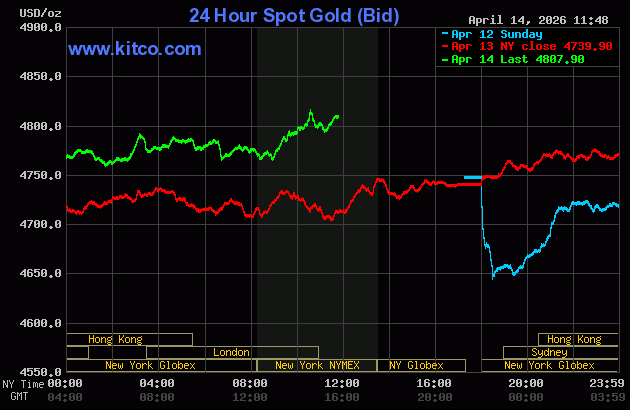
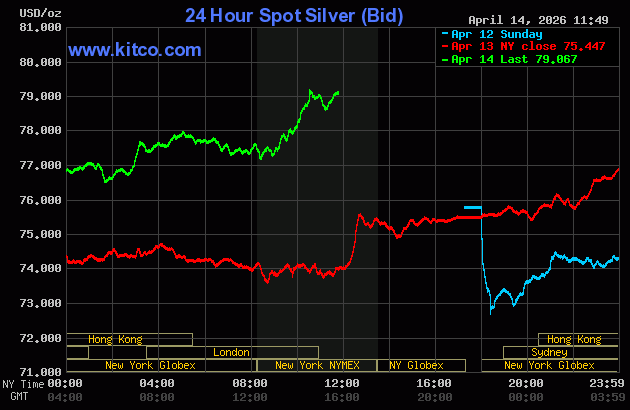
By midday Tuesday, June gold futures were up $63.50 at $4,831.50 per troy ounce. May silver futures jumped $3.59 to $79.27.
The rally was also supported by better demand expectations. Improved sentiment in broader financial markets encouraged traders to expect stronger consumer and commercial demand for gold and silver.
Somewhat ironically, the same improvement in risk appetite also helped safe-haven metals. Traders linked this to the possibility that U.S.-Iran truce talks could resume, which may ease inflation pressure while still supporting demand for bullion and industrial precious metals.
How did the U.S. dollar and outside markets affect bullion?
The weaker U.S. dollar was the main outside-market driver for gold and silver on Tuesday. When the dollar index falls, dollar-denominated bullion often becomes more attractive globally.
At the same time, Nymex WTI crude oil traded solidly lower at around $93.50 a barrel. Lower oil prices can reduce some inflation pressure, although geopolitical risks tied to Iran remained part of the market backdrop.
The yield on the benchmark 10-year U.S. Treasury note stood at around 4.25%. Treasury yields remain important for gold because higher yields can raise the opportunity cost of holding non-yielding assets such as bullion.
For Indian investors, the interaction between the U.S. dollar, U.S. yields, and crude oil is critical. A weaker dollar can support global gold prices, while crude oil moves can influence inflation expectations and India’s import bill, both of which can feed into domestic bullion demand.
What did the March 2026 U.S. PPI data show?
The U.S. producer price index showed inflation was still firm in March 2026, but the data came in below expectations. That helped prevent fresh pressure on gold prices.
According to the report, U.S. producer prices increased 0.5% month-over-month in March 2026, matching the previous month’s growth. The market had expected a larger 1.1% increase.
Energy costs jumped 8.5%, largely due to the ongoing Iran conflict. On a year-over-year basis, U.S. producer prices rose 4.0%, the largest increase since February 2023, but still below the expected 4.6% rise.
The core PPI measure, which excludes food, energy, and trade services, edged up 0.2% month-over-month. That was slower than the 0.5% gains recorded in both January and February.
On a year-over-year basis, the core index climbed 3.6%. Despite the detailed inflation signals, the report had little impact on metals market pricing during the session.
For Indian gold buyers, softer-than-expected U.S. inflation data can matter because it may reduce pressure for tighter Federal Reserve policy. If markets start pricing a less aggressive Fed path, that can support international gold price trends and, by extension, Indian bullion rates.
What are the key technical levels for gold price now?
Gold bulls still hold a near-term technical advantage, but the market faces major resistance before a fresh breakout. The most important upside target is a close above $5,000.00 in June gold futures.
According to the technical setup, bulls’ next upside price objective is to push June gold futures above solid resistance at $5,000.00. Bears’ next near-term downside objective is to force prices below strong technical support at $4,500.00.
First resistance stands at last week’s high of $4,888.00, followed by $4,900.00. On the downside, first support is seen at Tuesday’s low of $4,767.50, followed by $4,700.00.
The session carried a Wyckoff Market Rating of 6.0 for June gold futures. That suggests a modest bullish technical posture, but not a fully dominant one.
For Indian investors tracking MCX gold, these international levels are useful reference points. If COMEX gold pushes toward $4,888, $4,900, or even $5,000, domestic prices in rupee terms could also test higher levels, depending on USD/INR moves.
What are the key technical levels for silver price?
Silver also strengthened, and bulls are now pressing against a major technical ceiling. The immediate upside objective is a close above $80.00 in May silver futures.

May silver futures bulls see their next upside price target at $80.00, followed by resistance at $82.50. A clear break above those levels would strengthen the bullish case for silver.
On the downside, bears want to push prices below solid support at the March low of $61.21. The next support levels are $77.00 and then $75.00.
Silver’s Wyckoff Market Rating is 6.0, the same as gold. That indicates bulls have a technical edge, but the market still needs a confirmed breakout above resistance.
For Indian investors, silver’s move is especially relevant because domestic silver prices often respond sharply to global momentum and rupee volatility. A sustained move above $80.00 in COMEX silver could quickly spill into Indian bullion and jewellery market pricing.
How does the gold futures market work, and why does contract activity matter?
Gold trades through both the spot market and the futures market, and that difference matters when reading price reports. Spot gold reflects immediate purchase and delivery, while futures prices reflect delivery at a later date.
The source article notes that the gold market operates through two primary pricing mechanisms. The first is the spot market, which quotes prices for on-the-spot purchase and immediate delivery.
The second is the futures market, which sets prices for delivery at a future date. Because of year-end positioning market liquidity, the December gold futures contract is currently the most actively traded contract on the CME.
That matters for traders and investors because the most active contract often provides the clearest signal on market sentiment, liquidity, and technical levels. Indian investors following international bullion markets should keep this distinction in mind when comparing spot gold, COMEX futures, and local physical or MCX prices.
Gold remains highly sensitive to the U.S. dollar, Treasury yields, crude oil, and headlines around Iran. The next key watchpoint is whether June gold can decisively clear $4,888.00 and $4,900.00, while silver traders will focus on a confirmed move above $80.00. For Indian investors, the global rally will matter most if it combines with a stable or weaker rupee, which would amplify the upside in domestic bullion prices.