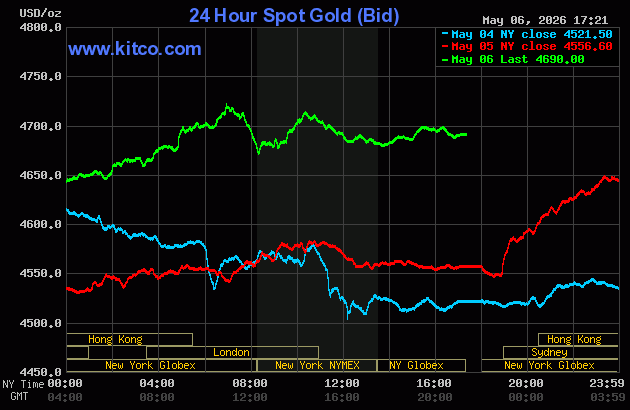
Spot gold jumped above $4,690 per troy ounce on Wednesday as weaker-than-expected U.S. labor data, a softer U.S. dollar, easing Treasury yields, lower oil prices and persistent geopolitical uncertainty lifted safe-haven demand. For Indian investors, the rally in global bullion matters because any sustained rise in XAUUSD can feed into domestic gold rates, especially if the Indian rupee weakens against the U.S. dollar.
Why did gold price jump above $4,690 on Wednesday?
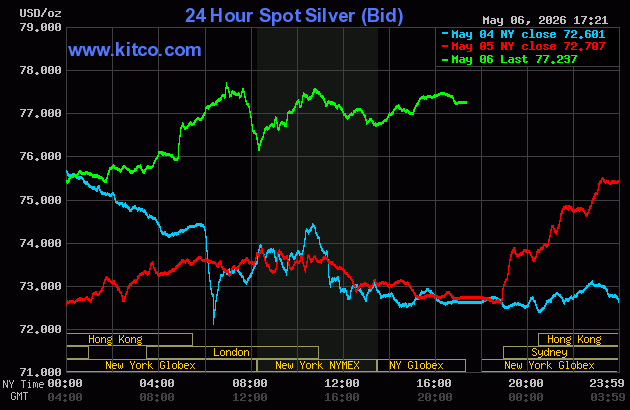
Gold price rose sharply because investors responded to softer U.S. labor data, falling oil prices and renewed geopolitical uncertainty by buying bullion. Spot gold traded near $4,694.05 per ounce, up 2.77% at the time of writing, while spot silver climbed to $77.350, up about 6.23% on the session.The move reflected a classic safe-haven bid in precious metals. Traders also saw support from a weaker U.S. dollar index and lower U.S. Treasury yields, both of which typically improve the appeal of non-yielding assets such as gold.
For Indian market participants, stronger international gold prices can push up import costs and domestic bullion rates. If the rupee does not strengthen enough to offset the move in XAUUSD, local gold prices in INR may remain firm.
What did the ADP jobs data signal for gold and the Federal Reserve?
The ADP report supported gold because it showed U.S. private-sector hiring slowed more than expected in April. ADP said private employment rose 109,000 in April, below the 118,000 consensus estimate, and above a revised 61,000 in March.That weaker-than-expected reading reinforced the view that U.S. labor-market momentum is cooling ahead of Friday’s nonfarm payrolls report. Traders are now recalibrating expectations for the Federal Reserve’s rate path after Monday’s stronger factory-orders data and Tuesday’s mixed ISM services and JOLTS reports.
A softer labor market can strengthen expectations for eventual Federal Reserve easing later this year. That matters for gold because lower expected rates tend to reduce the opportunity cost of holding bullion.
How did the U.S. dollar, Treasury yields and oil prices affect bullion?
Gold benefited because several key macro markets moved in its favor during the U.S. session. Treasury yields eased after the ADP miss, while the U.S. dollar index softened as traders added to expectations for eventual Federal Reserve easing later this year.The yield on the benchmark 10-year U.S. Treasury note traded near the 4.3% area. Lower yields and a weaker dollar generally support gold price momentum because they make bullion more competitive relative to interest-bearing and dollar-denominated assets.
Oil prices also fell sharply. Nymex WTI crude oil traded around $95.33 a barrel, while Brent crude was near the $102 area.
The drop in crude came as reports circulated that Washington and Tehran were nearing a framework to reopen tanker traffic through the Persian Gulf. That development reduced part of the geopolitical risk premium embedded in oil, even as broader uncertainty continued to support precious metals.
For Indian investors, lower crude prices can ease inflation pressure and support macro stability, but a simultaneous rise in gold can still keep domestic bullion prices elevated. India imports both crude and gold, so shifts in oil, the dollar and global risk sentiment can affect rupee-denominated pricing across asset classes.
Why did gold and Wall Street rise at the same time?
Gold and U.S. equities rose together because falling oil prices and easing war concerns improved risk appetite, while softer labor data boosted expectations for easier monetary policy. This cross-asset rally is unusual, but it can happen when multiple markets interpret the same data as supportive.The North American equity session closed strongly higher despite the weaker labor print. The S&P 500 rose 1.5% to a record 7,365.12, the Dow Jones Industrial Average climbed 1.2% to 49,910.59, the Nasdaq Composite jumped 2.0% to 25,838.94, and the Russell 2000 gained 1.5% to 2,886.77.
The Nasdaq, S&P 500 and Dow rallied on rising hopes for a broader Iran ceasefire framework and continued strength in large-cap technology shares. At the same time, lingering geopolitical uncertainty kept safe-haven demand alive in gold and silver.
What geopolitical developments supported safe-haven demand?
Geopolitical uncertainty supported gold because traders continued to weigh both de-escalation hopes and fresh security risks in the Gulf region. According to media reports, U.S. Central Command said it disabled a tanker attempting to violate a blockade near an Iranian port in the Gulf of Oman.At the same time, traders assessed the chances of a broader diplomatic framework to stabilize regional energy flows. That mix of falling oil prices and lingering geopolitical uncertainty helped both equities and precious metals rally simultaneously.
This matters for Indian investors because disruptions or easing in Gulf energy routes can quickly affect crude prices, inflation expectations, currency flows and import costs. Those factors often spill into domestic sentiment around safe-haven assets such as gold.
What are the key technical levels for gold price now?
Spot gold remains in a rebound phase after Monday’s sharp correction, and the next upside zone sits between $4,722.77 and $4,750. A breakout above that resistance band could open the door to a move toward $4,800 to $4,850.On the downside, bears’ next near-term price objective is a break below $4,620.00. If gold falls through that level, deeper downside targets stand at $4,576.74 and then $4,540.
Gold resistance levels

- First resistance: $4,722.77
- Second resistance: $4,750
- Upside extension target: $4,800 to $4,850
Gold support levels
- First support: $4,620.00
- Second support: $4,576.74
- Deeper downside target: $4,540
What are the technical levels for silver price?
Spot silver also posted a strong rally, and bulls are now targeting the $78.00 to $79.50 resistance zone. A move above that area would target $80.00.Bears, however, need a break below $75.50 to regain near-term control. If silver falls under that support, the next downside targets are $74.00 and then $72.65.
Silver resistance levels
- First resistance: $78.00
- Second resistance: $79.50
- Upside target above resistance zone: $80.00
Silver support levels
- First support: $75.50
- Second support: $74.00
- Deeper downside target: $72.65