# Gold Price Surges Above $4,600 After US Confidence Data Shock
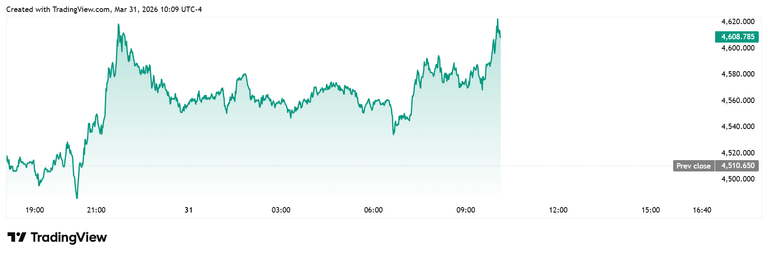
Gold price jumped above $4,600 per troy ounce on March 24, 2026, after fresh U.S. consumer confidence data came in stronger than expected. Spot gold was last seen at $4,610.49 an ounce, up 2.21% on the day after the 10 am EDT release, showing that bullion demand remained firm even as U.S. household sentiment improved modestly.
For Indian investors, the move matters because any sustained rally in XAUUSD can quickly feed into domestic bullion rates. If the Indian rupee weakens against the U.S. dollar at the same time, local gold prices could stay elevated even if global momentum cools.
Why did gold price rise above $4,600 today?
Gold price rose above $4,600 because traders pushed bullion to fresh highs after the latest U.S. consumer confidence report showed a mixed but inflation-sensitive picture. The headline confidence number beat forecasts, but rising inflation expectations, higher-rate fears, and war-linked oil concerns reinforced gold’s safe-haven appeal.
The Consumer Confidence Index rose to 91.8 in March, above the economist consensus forecast of 88. It also improved from the downwardly revised 91.2 reading in February, according to The Conference Board on Tuesday.
After the data release at 10 am EDT, spot gold climbed to fresh session highs. At the time of writing, spot gold traded at $4,610.49 per ounce, marking a daily gain of 2.21%.
That reaction suggests the market focused less on the modest rise in confidence and more on the underlying pressure from inflation, interest-rate expectations, and geopolitical risk. In precious metals trading, that combination often supports demand for safe-haven assets such as gold.
What did the U.S. Consumer Confidence report show in March 2026?
The March 2026 report showed that current-condition views improved, but future expectations weakened further. That split matters because it signals resilience in the present economy while also highlighting rising concern about what comes next.
The Present Situation Index increased by 4.6 points to 123.3. The Conference Board said this measure reflects consumers’ assessment of current business and labor market conditions.
The Expectations Index fell by 1.7 points to 70.9. This index tracks consumers’ short-term outlook for income, business, and labor market conditions.
The survey period for the preliminary results ran from March 1 to March 24, 2026. That timing is important because it overlapped with major geopolitical and energy-market developments, including the ongoing Iran war oil shock mentioned in the report.
Dana M. Peterson, Chief Economist at The Conference Board, said: “Consumer confidence ticked up again in March, as a modest improvement in consumers' views of current conditions outweighed a slight downshift in expectations for the future.”
Peterson added that three of five components of the index firmed in March and that overall confidence improved modestly for a second straight month. Even so, she noted that the index has remained on a general downward trend since 2021.
How did inflation fears and the Iran war affect gold and consumer sentiment?
Inflation fears and the Iran war supported gold because both factors increased demand for protection against economic and market stress. Rising oil prices and tariff-related cost pressures also lifted inflation expectations, which can strengthen the case for owning bullion.
The Conference Board said “the weight of rising costs due to tariff passthrough and spiking oil prices was evident among other measures in the survey like inflation expectations.” That wording is significant because gold often responds strongly when markets expect consumer prices to rise.
The report also said the war in Iran overlapped significantly with the survey sample period. According to Peterson, consumer write-in responses showed a pessimistic tone, with many comments focused on prices, the cost of goods, oil/gas, and war/conflict.
She added: “Consumers' write-in responses on factors affecting the economy continued to skew towards pessimism.” Peterson said comments about the cost of living remained at the top of consumers’ minds, while mentions of trade and tariffs decreased notably.
Amid the ongoing Iran war oil shock, consumers’ average and median 12-month inflation expectations surged in March to levels last seen in August 2025, when U.S. consumers were awaiting more tariff announcements from the federal government. For gold traders, that kind of inflation signal can be bullish because bullion is widely viewed as a hedge against purchasing-power erosion.
What do higher U.S. rate expectations mean for bullion?
Higher U.S. rate expectations can pressure gold, but in this case the inflation and risk backdrop appears to have outweighed that headwind. Gold pays no yield, so rising interest-rate expectations are usually negative, yet safe-haven buying can still dominate when uncertainty intensifies.
The report said the share of consumers expecting higher interest rates over the next 12 months on a net basis jumped from 34.9% to 42.4%. That is a sharp move and shows households are increasingly bracing for tighter financial conditions.
At the same time, expectations for higher stock prices a year from now plunged. That drop points to weaker risk appetite, which can redirect investor flows toward defensive assets including gold and other precious metals.
For Indian investors, this is especially relevant because U.S. interest-rate expectations influence the U.S. dollar, global yields, and foreign portfolio flows. A stronger dollar can sometimes limit upside in commodities, but if risk aversion rises at the same time, Indian bullion prices can remain firm due to safe-haven demand and rupee sensitivity.
Which consumer groups showed weaker or stronger confidence?
Confidence trends varied by age group, but the broader pattern still showed moderation across much of the population. Younger consumers stayed the most optimistic, while older consumers remained the least confident.
The Conference Board said that on a six-month moving average basis, confidence in March continued to moderate for consumers under age 35 and those 55 and over. Confidence was virtually unchanged for those aged 35 to 54 after a multi-month decline.
Among generations, Generation Z remained the most confident, but its optimism slipped in March. Confidence also declined for the Silent Generation, Baby Boomers, and Generation X.
The only generation to report improved confidence during the month was Millennials. That detail adds nuance to the broader report, but it did not change the market’s larger focus on inflation, oil, and geopolitical risks.
What should Indian gold investors watch next?
Indian gold investors should watch U.S. inflation expectations, Federal Reserve rate signals, oil prices, and the Iran conflict because these drivers now sit at the center of the gold price story. If these factors stay elevated, gold could remain volatile but well supported near current highs.
Investors in India should also track the USD/INR exchange rate closely. Even if international gold pauses after its move to $4,610.49 per ounce, a weaker rupee could keep domestic gold rates elevated.
The next major watchpoint is whether stronger consumer confidence translates into firmer U.S. growth without cooling inflation fears. If inflation expectations continue to climb while stock-market optimism fades, bullion could retain its safe-haven bid and keep Indian buyers focused on higher price levels.