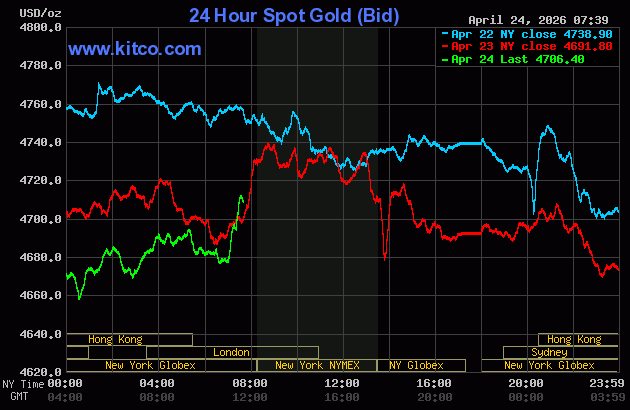
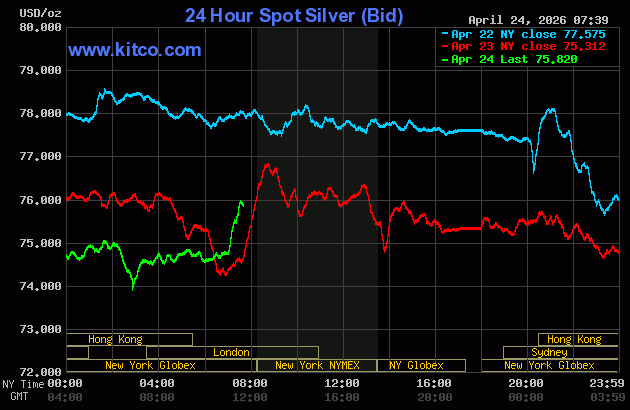
Gold price traded almost flat on Friday as bullion investors weighed fresh Middle East tensions, firmer crude oil, and shifting risk sentiment across global markets. June gold futures were last up $1.60 at $4,725.00 per troy ounce, while May silver futures rose $0.316 to $75.85, showing that precious metals paused after recent volatility rather than making a decisive breakout.
For Indian investors, the current gold price setup matters because global bullion moves, crude oil spikes, and U.S. dollar swings often feed directly into domestic gold rates in INR. If oil stays elevated and geopolitical stress remains unresolved, imported inflation and currency pressure could keep the Indian gold market firm even when international gold trades sideways.
Why is gold price steady today?
Gold price is steady because traders are pausing to assess whether the latest geopolitical risks in the Middle East will escalate further or move toward negotiations. The market is balancing safe-haven demand for bullion against a modest improvement in broader risk appetite.
In early U.S. trading on Friday, June gold was up $1.60 at $4,725.00, effectively near unchanged on the day. May silver gained $0.316 to $75.85, indicating mild strength in precious metals but not a full risk-off rush.
This price action suggests traders are not abandoning gold, but they are also not yet willing to chase XAUUSD sharply higher without clearer signals from Washington, Tehran, and energy markets. That leaves bullion range-bound near elevated levels.
What geopolitical developments are driving gold and silver markets?
The main driver is the widening pressure on Iran and the risk that disruption in the Persian Gulf could keep energy markets tight. Gold is holding firm because investors still see geopolitical uncertainty as supportive for safe-haven assets.
What is the United States doing toward Iran?
The United States has intensified pressure on Iran through a naval blockade as Washington tries to force Tehran into talks. According to the source report, the U.S. has so far failed to bring Iran to the peace table.
President Donald Trump ordered the U.S. Navy to shoot any boat laying mines in the Strait of Hormuz after the military intercepted two oil supertankers that allegedly tried to evade restrictions on traffic to and from Iran’s ports. Trump said in a Truth Social post, as reported by Bloomberg: “I have all the time in the World, but Iran doesn’t — The clock is ticking!”
The White House strategy aims to cut off Iran’s oil exports, squeeze the economy, and force concessions that could help end the war. Trump allies believe the blockade could force Iran to begin shutting down crude production within about two weeks, while JPMorgan Chase & Co. analysts said it may take closer to one month.
What is happening in the wider Middle East?
The broader region remains unstable, which is keeping safe-haven buying in gold alive. The report highlighted several key developments:
- The U.S. is working to get Iran to the peace talks table, with no success so far.
- The U.S. said it will sink any boat laying mines in the Strait of Hormuz.
- The International Energy Agency said the Iran war will keep the gas market tight for two more years.
- Goldman Sachs said Persian Gulf oil supply is 57% below pre-war levels.
- Israel and Lebanon are set to extend a ceasefire for three weeks.
How are oil prices and inflation expectations affecting gold price?
Higher oil prices are helping support gold because they raise inflation risks and deepen concerns about global growth. When energy costs surge, investors often buy bullion to hedge both inflation and geopolitical instability.
The key outside markets showed Nymex WTI crude oil around $97.50 a barrel. That elevated crude level is important because the Middle East conflict is already feeding into production costs worldwide.
Why are Chinese export prices important for gold?
Chinese exporters raising prices is a warning sign that the energy shock may spread into global inflation, which is typically supportive for gold price over time. According to a Bloomberg report cited in the source article, Chinese exporters are increasing prices because the Iran war has driven up oil-linked input costs.
Bloomberg said more than a dozen categories of household goods recorded sharp year-on-year price increases in March. Products dependent on rubber, plastic, and oil-derived chemicals saw notable spikes.
The report added that Bloomberg Economics estimates above-3% inflation in 2026 is “back in play” across major economies. If that inflation outlook strengthens, gold could attract more strategic buying from investors looking to protect purchasing power.
For India, this matters in two ways. First, higher global inflation can strengthen long-term demand for gold as a store of value. Second, higher oil prices can worsen India’s import bill and pressure the rupee, which can lift domestic gold prices even if international bullion is stable.
How are U.S.-China relations and carry trades influencing bullion sentiment?
Improving U.S.-China signals and reviving currency carry trades are limiting an aggressive move higher in gold. In short, safer market conditions can reduce immediate demand for safe-haven assets like bullion.
What was the U.S.-China signal?
A softer geopolitical signal came from improving U.S.-China relations. Beijing is sending two pandas to the United States before President Trump’s planned meeting with Xi Jinping in mid-May.
According to Zoo Atlanta, a male panda named Ping Ping and a female panda named Fu Shuang are part of an agreement with the China Wildlife Conservation Association. The new agreement replaces the original deal that expired in 2024.
While symbolic, traders often read such developments as signs of stabilizing ties, which can improve global risk appetite and reduce the urgency of safe-haven buying in gold.
What does “carry trades revving up” mean for gold?
Carry trades reviving means investors are moving back into riskier strategies, which can cap short-term upside in gold. Bloomberg reported that DoubleLine Capital and Van Eck Associates Corp. are among investors seeing renewed appeal in this strategy.
A carry trade involves borrowing in low-interest-rate currencies and investing where rates are higher. The report said the trade was already benefiting from oil-driven strength in commodity-linked currencies such as Brazil’s real and Colombia’s peso.
Now, as the Middle East ceasefire helps steady markets, volatility in currencies, bonds, and stocks has fallen sharply. That calmer backdrop gives investors more confidence that exchange rates will not swing violently against them, unlike in 2024, when the trade unwound and disrupted broader markets.
For gold, that matters because falling volatility and stronger risk appetite can temporarily pull money away from safe-haven assets.
What are the key market indicators traders are watching now?
Gold traders are watching crude oil, the U.S. dollar, and U.S. Treasury yields because these three markets often shape near-term bullion direction. On Friday, the signals were mixed rather than strongly bearish or bullish for gold.
The U.S. dollar index was slightly weaker, which usually helps gold because bullion becomes cheaper for holders of other currencies. At the same time, the yield on the benchmark 10-year U.S. Treasury note was 4.33%, a level that can limit upside in non-yielding assets like gold.
This combination helps explain why XAUUSD stayed near steady instead of making a large directional move. A softer dollar supported prices, while elevated Treasury yields and improved risk appetite prevented a stronger rally.
What are the technical levels for gold price and silver now?
Gold price remains in a neutral-to-slightly-bullish technical setup, but traders need a break above resistance or below support for a clearer trend. According to the source article, Wyckoff's Market Rating for June gold futures is 5.5.
Gold technical levels
For June gold futures, the next upside objective for bulls is a close above solid resistance at $5,000.00. The next downside objective for bears is pushing futures below solid technical support at $4,500.00.
The immediate levels to watch are:
- First resistance: $4,771.30
- Second resistance: $4,800.00
- First support: $4,672.20
- Second support: $4,626.00
Silver technical levels
For May silver futures, bulls are targeting a close above solid technical resistance at the April high of $83.245. Bears want a close below solid support at $70.00. Wyckoff's Market Rating for silver is also 5.5.
The immediate silver levels are:
- First resistance: $76.00
- Second resistance: $78.405
- First support: $73.00
- Second support: $70.00
How does the gold futures market work, and why does it matter now?
Gold trades through both the spot market and the futures market, and that distinction matters when liquidity shifts. The source article notes that the spot market prices gold for immediate purchase and delivery, while the futures market sets prices for delivery at a future date.
Because of year-end positioning market liquidity, the December gold futures contract is currently the most actively traded on the CME, according to the source note. That can affect how traders interpret price moves, volume, and technical levels across contracts.
For Indian investors, understanding the difference helps when comparing international prices with MCX gold and physical bullion rates in the local market. Futures often lead short-term sentiment, while spot prices better reflect immediate international bullion value.
For now, the biggest watchpoint is whether crude oil stays near $97.50, whether the U.S. blockade meaningfully reduces Iranian supply within two weeks or closer to one month, and whether gold can challenge $4,771.30 and then $4,800.00. If Middle East tensions deepen and the rupee weakens alongside higher oil, Indian gold buyers could see domestic prices stay elevated even without a sharp jump in global XAUUSD.