# Gold Price Spikes to $4,585 After Strong US Home Sales Data
Gold price climbed sharply on Tuesday morning, with spot bullion touching $4,585.20 per troy ounce after fresh U.S. housing data showed stronger-than-expected new home sales in February and March. For Indian investors, the move highlights how global macro data, U.S. interest-rate expectations and the U.S. dollar can quickly influence XAUUSD and, in turn, domestic gold rates in rupee terms.
Why did gold price rise after the US new home sales report?
Gold price rose because bullion held near session highs even after stronger U.S. housing data, suggesting investors continued to support safe-haven demand and broader precious metals buying. The reaction showed that traders focused not only on the headline gains in home sales, but also on the deeper economic context, including earlier weakness and the impact of past Federal Reserve rate hikes.
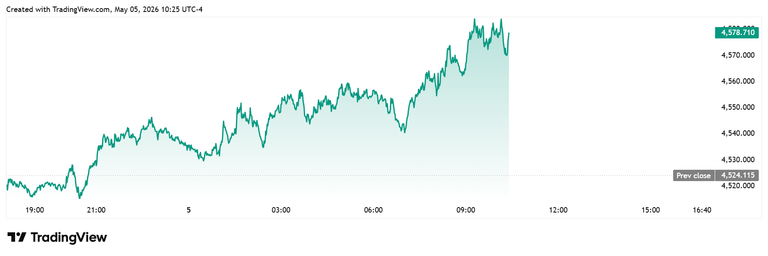
Spot gold jumped to a session high of $4,585.20 per ounce just after the 10 a.m. ET data release. It last traded at $4,579.03, up 1.21% on the day.
The U.S. Census Bureau and the U.S. Department of Housing and Urban Development released the figures together as the Federal government continued catching up on delayed data after the U.S. government shutdown. That unusual timing meant markets received both February and March numbers at once, giving traders a broader view of the U.S. housing market.
What did the latest US new home sales data show?
The data showed that U.S. new home sales beat expectations in both February and March. That was a positive signal for housing activity, even though January was revised sharply lower.
In February, new home sales rose 8.9%, well above the expected 3.9% increase. However, that followed a revised -19.9% drop in January.
On a seasonally adjusted annualized basis, February new home sales came in at 685,000 units, beating the market forecast of 610,000 units. January sales were revised to 583,000 units.
In March, new home sales rose 7.4%, again ahead of expectations for a 4.9% increase. March sales totaled 682,000 units, above the expected 650,000 units.
Why are investors watching the US housing market so closely?
Investors are watching the U.S. housing market closely because it remains a major contributor to overall economic activity. Housing data can shape expectations for growth, inflation, bond yields and future Federal Reserve policy, all of which affect gold price trends.
Economists continue to track housing closely because the sector has struggled in recent years. The Federal Reserve raised interest rates aggressively at the fastest pace in 40 years, and that tightening cycle hit housing demand hard.
Higher mortgage rates reduced affordability, while a lack of supply kept home prices elevated. That combination priced many potential buyers out of the market and limited the housing sector’s recovery.
How does Federal Reserve policy affect gold and bullion prices?
Federal Reserve policy affects gold because higher interest rates usually raise the opportunity cost of holding non-yielding bullion. At the same time, signs of economic strain or policy uncertainty can still support safe-haven demand for gold.
The latest housing figures matter because they arrive against a backdrop of aggressive Fed tightening. If U.S. economic data stays firm, markets may reassess how quickly the Federal Reserve can ease policy, which can influence Treasury yields, the U.S. dollar and XAUUSD.
For bullion traders, that creates a two-way push. Strong economic data can pressure gold through higher yield expectations, but concerns about growth after prolonged tight policy can also keep demand for precious metals elevated.
What does this gold price move mean for Indian investors?
For Indian investors, the rally in spot gold to $4,585.20 per ounce signals that global bullion prices remain highly sensitive to U.S. macroeconomic data. Any sustained move in XAUUSD can filter into Indian gold rates, especially when the rupee weakens against the U.S. dollar.
A stronger international gold price generally raises local prices of gold in India when converted into INR. That matters for jewellery buyers, physical bullion investors and traders in gold ETFs and MCX gold futures.
Indian investors should also watch whether strong U.S. data lifts the dollar or U.S. yields further. If the dollar strengthens, it can add pressure on the rupee, which may keep domestic gold prices elevated even if international bullion pulls back.
The next key watchpoint is whether upcoming U.S. data confirms that the housing rebound in February and March is sustainable after the sharp -19.9% revised drop in January. That will help determine whether gold price momentum above $4,579 and the spike to $4,585.20 per ounce can hold in the near term.