# Gold Price Slips Below $4,800 After Strong US Home Sales Data
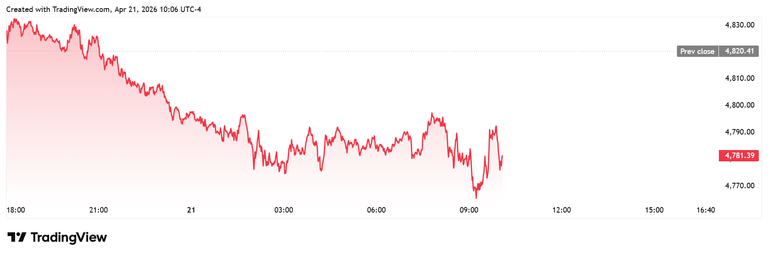
Gold prices eased on Tuesday after stronger-than-expected U.S. housing data pointed to resilience in the world’s largest economy. Spot gold traded at $4,781.31 per troy ounce, down 0.81% on the day, after briefly trying to reclaim the $4,800 level following the release of the U.S. pending home sales report.
For Indian investors, the move matters because firm U.S. economic data can support the U.S. dollar and interest-rate expectations, two factors that often influence global bullion prices and, in turn, domestic gold rates in rupees.
Why did gold price slip after the U.S. housing data?
Gold price slipped because the latest U.S. pending home sales data came in stronger than expected, reducing some immediate safe-haven urgency and reinforcing the view that parts of the U.S. economy remain stable. Stronger economic data can weigh on non-yielding assets such as gold when traders reassess growth and rate expectations.
The National Association of Realtors (NAR) said on Tuesday that the U.S. pending home sales index rose 1.5% in March. Economists had expected only a 0.1% increase, making the print a clear upside surprise.
The prior month was also revised higher. February pending home sales were revised up to 2.5% from 1.8%, adding to the view that housing demand may be firmer than previously thought.
After the data, spot gold moved off its session low and attempted to reclaim $4,800 per ounce. Even so, bullion remained under pressure and was last seen at $4,781.31 per ounce, down 0.81% on the day.
What did the pending home sales report show?
The report showed a solid monthly increase in contract signings, but the annual comparison remained weak. That mix suggests the U.S. housing market may be stabilizing in the short term, even though conditions are still uneven across regions.
On a month-over-month basis, pending home sales rose in the Northeast and South, but declined in the Midwest and West. That regional split shows demand has not recovered evenly across the country.
On a year-over-year basis, pending home sales fell 1.1%, missing expectations for a 0.7% increase. That came after February’s unrevised 0.8% decline.
Regional annual trends also remained mixed. Year-over-year sales increased in the South, while they declined in the Northeast, Midwest, and West.
Economists track pending home sales closely because the data acts as a leading indicator of existing home sales. Contracts are usually signed a few months before homes are actually sold, so the report offers an early read on housing-market momentum.
What did NAR Chief Economist Lawrence Yun say about the housing market?
Dr. Lawrence Yun said the March increase points to pent-up demand, even with mortgage rates still elevated. His comments suggest buyers remain interested, but affordability and supply continue to shape how quickly demand turns into completed sales.
According to NAR Chief Economist Dr. Lawrence Yun, “Contract signings rose in March despite higher mortgage rates, pointing to pent-up housing demand.” He added, “A greater supply of inventory will help translate that demand into more home sales.”
Yun also highlighted the pressure on first-time buyers. He said, “Demand sensitivity to mortgage rates is greatest among first-time buyers, particularly younger buyers.”
He argued that the supply response should focus on affordability. In his words, “As a result, boosting supply and new-home construction should focus on smaller, more affordable homes.”
Yun also pointed to a regional opportunity in the southern United States. He said, “A good number of markets in the South experienced price cuts over the past year but recorded the strongest job growth.” He added, “That combination should lead to stronger housing market activity in the South this year.”
How does stronger U.S. housing data affect gold prices?
Stronger U.S. housing data can pressure gold prices because it supports the idea that economic activity is holding up despite high borrowing costs. When that happens, traders may scale back aggressive expectations for easier monetary policy, which can be negative for XAUUSD in the short term.
Gold does not offer a yield, so bullion often faces headwinds when U.S. economic data surprises to the upside. A stronger macro backdrop can lift bond yields or the U.S. dollar, reducing the appeal of precious metals as a defensive allocation.
This does not automatically change gold’s broader trend, but it can trigger intraday weakness. That appeared to happen after Tuesday’s release, when spot gold stayed below $4,800 even after bouncing from session lows.
For market participants watching XAUUSD, the $4,800 per ounce level remains an important short-term psychological marker. Gold’s ability or inability to retake that level may influence near-term momentum.
What does this mean for Indian gold investors?
For Indian gold investors, stronger U.S. data can create short-term volatility in international bullion prices, but the local impact also depends on the rupee-dollar exchange rate. If the U.S. dollar strengthens and the Indian rupee weakens, domestic gold prices may remain supported even when international gold softens.
That means Indian buyers should track two variables at the same time: spot gold in U.S. dollars and USD/INR. A decline in global gold price does not always translate into an equal fall in Indian retail gold rates.
The housing data also matters indirectly because it feeds into expectations around the Federal Reserve and U.S. interest rates. Any shift in those expectations can affect global bullion flows, exchange rates, and investor demand for safe-haven assets.
Indian investors in physical gold, gold ETFs, and sovereign gold bond alternatives should watch whether gold can regain $4,800 per troy ounce and whether upcoming U.S. economic releases confirm that the housing market is stabilizing. If U.S. data continues to surprise on the upside, gold could face near-term resistance, while rupee moves may determine how much of that pressure reaches the Indian market.
The next key watchpoint is whether stronger housing activity becomes a broader economic signal or remains limited to select regions such as the South. That distinction could shape the next move in gold price, bullion sentiment, and domestic Indian gold trends.