# Gold Price Slips as Oil Rebound Clouds Fed Rate-Cut Hopes
Spot gold fell in early U.S. trading on Monday as rebounding crude oil prices and fresh U.S.-Iran uncertainty complicated the interest-rate outlook. For Indian investors, the move matters because higher oil prices can lift inflation expectations, support the U.S. dollar, and influence both global bullion prices and domestic gold rates in INR.
Why did gold price fall today?
Gold price fell because rising crude oil prices revived inflation concerns and reduced expectations for near-term rate cuts. That combination pressured bullion even as geopolitical risk in the Middle East continued to offer some safe-haven support.
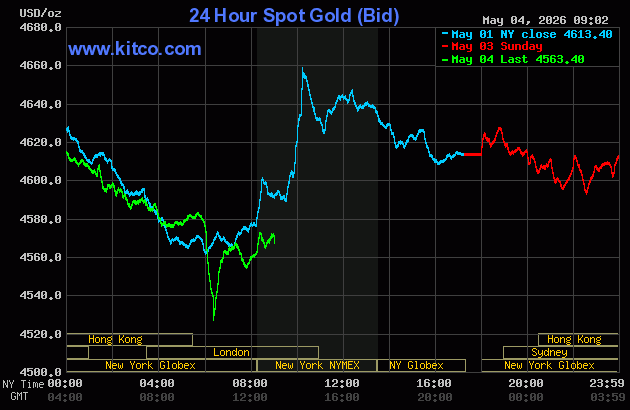
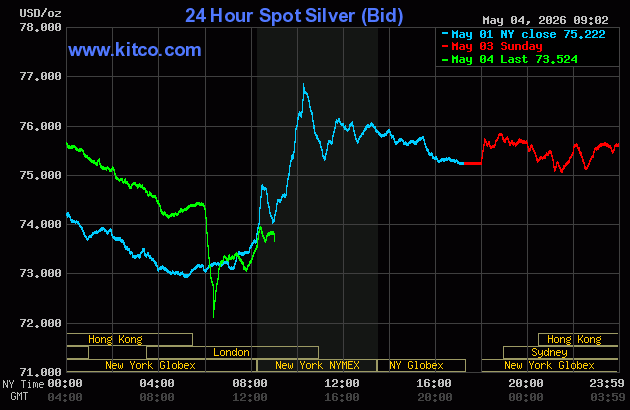
At the time of writing, spot gold traded near $4,570.26 per ounce, down 0.95% on the session. Spot silver traded at $73.953 per ounce, down around 1.86%.
Trading conditions were also thinner than usual overnight. Major markets in China, Japan, and the U.K. were closed for public holidays, which likely reduced liquidity and amplified price swings in XAUUSD and silver.
How is the U.S.-Iran conflict affecting gold and oil prices?
The U.S.-Iran conflict is supporting safe-haven demand for gold, but it is also pushing oil prices higher, which is creating an inflation risk that weighs on bullion. This mixed backdrop is why gold has not been able to fully capitalize on geopolitical tension.
The main weekend and overnight development was the ongoing U.S.-Iran conflict and its effect on energy markets. Oil prices bounced after the United States launched a military-supported maritime operation in the Strait of Hormuz to assist stranded vessels.
At the same time, Iran rejected the U.S. plan but continued reviewing an American response to a peace proposal. That kept uncertainty elevated across energy and precious metals markets.
For gold, the impact cuts both ways:
- Positive for gold: geopolitical stress typically boosts safe-haven buying.
- Negative for gold: higher oil prices can fuel inflation and delay rate cuts.
What are oil, the U.S. dollar, and Treasury yields signaling for bullion?
Oil, the U.S. dollar, and U.S. Treasury yields are signaling a firmer inflation-risk backdrop, which is bearish for gold in the short term. When energy prices rise and the dollar strengthens, non-yielding assets like bullion often face pressure.
The key outside markets showed:
- Nymex WTI crude oil higher near $102.57 a barrel
- Brent crude near $110.40 a barrel
- U.S. dollar index firmer
- 10-year U.S. Treasury yield near the 4.4% area
For Indian investors, a firmer U.S. dollar can also affect imported gold costs. Even if international gold prices soften, INR weakness versus the dollar can limit downside in domestic bullion prices.
What global manufacturing data are markets reacting to?
Markets are digesting mixed manufacturing data from Asia and Europe, which reinforces the view that global growth remains uneven. That matters because central banks are now balancing patchy growth against the risk of energy-driven inflation.
In Asia, the data was relatively constructive:
- South Korea April manufacturing PMI rose to 53.6
- India final April manufacturing PMI rose to 54.7 from 53.9
In Europe, the picture was more mixed:
- Spain manufacturing PMI softened
- Italy manufacturing PMI softened
- France final manufacturing PMI rose to 52.8 from 50.0
- Germany final manufacturing PMI fell to 51.4 from 52.2
- Eurozone final manufacturing PMI came in at 51.6, below the prior 52.2
What are central banks likely watching now?
Central banks are watching whether higher oil prices translate into broader inflation pressure at a time when growth signals remain mixed. That policy tension is becoming a key driver for gold price expectations.
Traders are monitoring scheduled European Central Bank speeches and surveys later on Monday. Markets are also watching comments from Bank of Canada officials for clues on how policymakers are assessing energy-driven inflation risks against uneven global growth.
For bullion traders, the central question is whether policymakers begin to sound less confident about near-term rate cuts. If that happens, it could keep pressure on gold and silver despite ongoing geopolitical risk.
What are the key technical levels for gold price today?
Gold bulls need to reclaim the $4,645.91 to $4,670 resistance zone to regain near-term control. Bears need a break below $4,576.74 to strengthen downside momentum.
Gold upside levels
The next upside price objective for gold bulls is to push spot gold back above the $4,645.91 to $4,670 resistance zone. If bulls achieve a sustained move above that area, the next targets are:
- $4,733
- $4,800
- $4,645.91
- $4,670

Gold downside levels
The next near-term downside price objective for gold bears is a break below $4,576.74. If sellers force a deeper decline, the next downside targets are:
- $4,566
- $4,500
- $4,576.74
- $4,566
What are the key technical levels for silver price today?
Silver bulls need to reclaim the $73.00 to $73.40 zone to improve the near-term chart structure. Bears need a break below $72.65 to open the door to deeper losses.
Silver upside levels
The next upside price objective for silver bulls is to drive prices back above the $73.00 to $73.40 area. A move above that zone would target:
- $74.20
- $75.10
- $73.40
- $74.20
Silver downside levels
The next downside price objective for silver bears is a break below $72.65. If that level gives way, deeper downside targets are:
- $71.85
- $70.90
- $72.65
- $71.85