# Gold Price Slips Ahead of Iran Strait of Hormuz Deadline
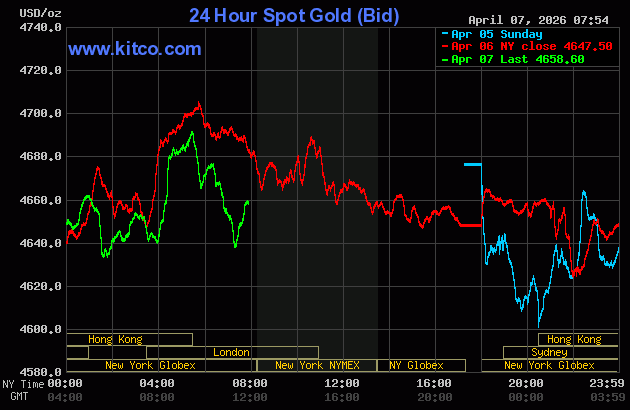
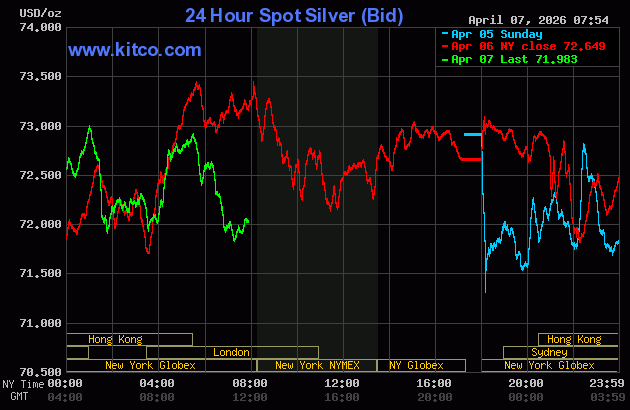
Gold price moved lower in early U.S. trading as traders turned cautious before a U.S.-imposed deadline for Iran to reopen the Strait of Hormuz. June gold futures were last down $11.20 at $4,673.00 per troy ounce, while May silver futures fell $0.792 to $72.07.
For Indian investors, the move matters because any rise in geopolitical risk, crude oil prices, or the U.S. dollar can quickly feed into domestic bullion prices in rupees. A stronger dollar and higher oil also have implications for India’s import bill, inflation outlook, and near-term sentiment in the gold market.
Why did gold price edge lower today?
Gold price eased because traders booked profits and reduced risk exposure ahead of a major geopolitical deadline involving Iran and the Strait of Hormuz. Even with war tensions still elevated, the market showed mild price pressure instead of a full safe-haven surge.
June gold futures were last down $11.20 at $4,673.00. May silver futures were down $0.792 at $72.07 in early U.S. trading.
The immediate trigger was the U.S. deadline set for Tuesday at 8 p.m. ET, with Washington demanding that Iran reopen the Strait of Hormuz. Traders held back as the deadline approached, especially with peace prospects appearing weak.
What are the latest developments in the Middle East war?
The conflict remained highly volatile on Tuesday, keeping precious metals, crude oil, and currency markets on edge. Several developments pointed to rising uncertainty rather than a near-term de-escalation.
The latest reported developments were:
- President Donald Trump set a deadline deal, including reopening the Strait of Hormuz, by Tuesday at 8 p.m. ET.
- Iran continued attacks before the U.S. deadline, dimming peace chances.
- Iran rejected U.S. proposed ceasefire terms.
- Iran’s demands included a permanent end to fighting and the lifting of sanctions.
- Israel warned Iranians to avoid the country’s railway network until 9 p.m. local time Tuesday.
- Saudi Arabia intercepted ballistic missiles fired overnight.
How is China’s gold buying supporting bullion?
China’s gold buying is supporting bullion because it shows that central bank demand remains intact even while prices face pressure from war-driven macro forces. According to Bloomberg, this remains a key pillar of support for precious metals.
Bullion held by the People’s Bank of China rose by 160,000 troy ounces in March, or about 5 tons, according to World Gold Council data cited in the report. The People’s Bank of China has now added to its gold holdings for 17 straight months.
That buying matters because the People’s Bank of China is one of the world’s largest official-sector buyers of gold. Persistent central bank accumulation can help stabilize investor confidence when futures prices weaken.
How much did gold fall in March?
Gold prices sank 12% in March, marking the worst monthly performance since 2008. Bloomberg said the Middle East conflict boosted the U.S. dollar and also increased expectations that the Federal Reserve would be unable to cut interest rates if inflation accelerated.
Those two forces matter directly for XAUUSD. A stronger U.S. dollar makes gold more expensive for non-dollar buyers, while higher-for-longer Federal Reserve expectations lift real yields and can weigh on non-yielding assets like gold.
What are other central banks doing?
Not all central banks are buying gold, which makes China’s purchases more notable. Bloomberg reported that Turkey’s central bank sold and swapped about 60 tons in March to defend the lira.
In the first two months of the year, central banks bought a net 25 tons, according to an estimate from the World Gold Council last week. The National Bank of Poland bought 20 tons in February, accounting for much of that buying.
For Indian investors, sustained central bank buying remains a medium-term constructive signal for bullion, even if near-term volatility stays high.
What is driving crude oil and the U.S. dollar higher?
Crude oil and the U.S. dollar stayed firm because the Iran conflict has tightened energy risk and reinforced safe-dollar demand. Those outside-market moves often shape the direction of gold price in the short term.
The key outside markets showed Nymex WTI crude oil higher and trading around $114.00 a barrel. The U.S. dollar index was slightly up early in the session, while the yield on the benchmark 10-year U.S. Treasury note stood at 4.34%.
Higher Treasury yields raise the opportunity cost of holding gold. A firmer U.S. dollar can also pressure spot gold and gold futures, even when geopolitical risks remain elevated.
Why are U.S. shale drillers expected to increase output?
U.S. shale drillers are expected to raise output because the recent surge in crude prices has made production far more attractive. Bloomberg reported that the 68% surge in crude prices since the U.S. and Israel began attacks on Iran roughly five weeks ago is enough incentive to push output higher.
Observers cited by Bloomberg included Citigroup Inc., Enverus Inc., and government analysts at the Energy Information Administration. According to the Federal Reserve Bank of Dallas, shale explorers need oil prices between $62 and $70 a barrel to turn a profit on new wells.
Mike Sommers, chief executive officer of the American Petroleum Institute, told Bloomberg Television: “Elevated prices are certainly going to increase production in the United States. You are going to see that over the course of the next few months.”
If oil stays near $114.00 a barrel, Indian investors should also watch the inflation and rupee impact. Higher crude prices can weaken the Indian rupee, which may cushion or even amplify domestic gold price moves in INR terms even if international XAUUSD softens.
How do spot and futures prices affect gold trading?
Gold trades through both the spot market and the futures market, and that distinction matters when investors track price moves. Spot gold reflects on-the-spot purchase and immediate delivery, while futures prices reflect delivery at a later date.
The note in the source article said that the gold market operates through two primary pricing mechanisms. The first is the spot market, and the second is the futures market.
It also noted that, due to year-end positioning market liquidity, the December gold futures contract is currently the most actively traded on the CME. Even so, the article’s quoted daily move focused on June gold futures at $4,673.00.
For Indian investors comparing MCX gold with international benchmarks, this distinction is important. Domestic bullion often tracks global futures and spot markets alongside INR movement, import duties, and local premiums.
What are the key technical levels for gold price now?
Gold price remains in a technically balanced position because neither bulls nor bears have a clear near-term advantage. Wyckoff's Market Rating for June gold futures is 5.0, which signals a neutral chart posture.
The bulls’ next upside price objective is a close above solid resistance at $5,000.00. The bears’ next near-term downside price objective is pushing futures prices below solid technical support at $4,300.00.

What resistance levels should traders watch in gold?
The first resistance level in June gold futures is $4,750.00. The next resistance level is last week’s high of $4,825.90.
A move above those levels would likely improve short-term bullish momentum in XAUUSD and bullion-linked assets. For Indian traders, such a breakout could translate into stronger MCX gold prices, especially if the rupee remains under pressure.
What support levels should traders watch in gold?
The first support level is this week’s low of $4,626.20. The next support level is $4,580.40.
If gold falls through those supports, traders would likely focus more closely on the larger bearish target at $4,300.00. That would signal deeper near-term weakness in the international gold price.
What are the technical levels for silver price?
Silver price also weakened early in the session, with May silver futures under pressure and a neutral technical structure. Wyckoff's Market Rating for May silver futures is also 5.0.
The next upside price objective for silver bulls is a close above solid technical resistance at $80.00. The next downside price objective for bears is a close below solid support at the March low of $61.21.
What resistance and support levels matter in silver?
The first resistance level in May silver futures is $75.00. The next resistance level is last week’s high of $76.265.
The next support level is seen at $70.00. After that, traders are watching last week’s low of $67.70.
Silver often trades with both precious metals and industrial demand dynamics, so volatility can remain sharper than in gold. Indian investors in silver bullion or MCX silver should keep an eye on both geopolitical headlines and broader commodity sentiment.
For now, the biggest watchpoint is Tuesday’s 8 p.m. ET Iran deadline and any follow-through in the Strait of Hormuz, crude oil, the U.S. dollar index, and the 10-year Treasury yield at 4.34%. If war risks escalate further, safe-haven demand could return quickly, but if the dollar and yields keep rising, gold price may remain under mild pressure despite strong central bank buying.