# Gold Price Outlook Brightens After Iran Cefire, but Risks Linger
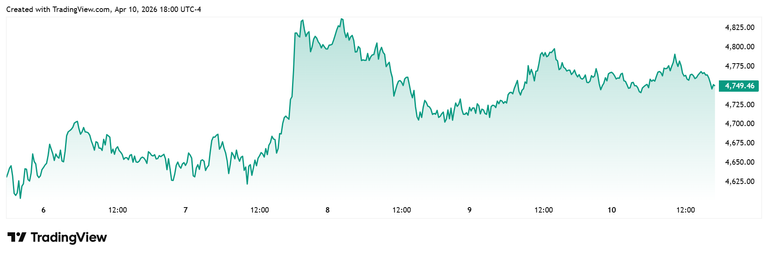
Gold sentiment improved after the two-week Iran ceasefire deal, but traders still see an uneasy market where headlines can swing bullion prices sharply. Spot gold moved from a weekly low near $4,600 per ounce to a rally high of $4,835, then settled into a $4,700-$4,800 consolidation range as investors weighed whether the truce would hold.
What happened to gold prices after the Iran ceasefire deal?
Gold prices jumped sharply after the ceasefire announcement, then lost momentum and moved into a narrower consolidation band. The move showed that traders still want safe-haven exposure, but they are reluctant to make large directional bets until the geopolitical picture becomes clearer.
Spot gold started the week at $4,630.61 per ounce. Early Sunday evening, shortly after 8:00 p.m. EDT, gold dipped to test $4,600 per ounce, marking the weekly low.
From there, gold climbed steadily overnight and rose to just above $4,700 by 5:15 p.m. Eastern. That rally faded during the North American session, and by Monday evening spot gold had slipped back to around $4,626 per ounce.
Markets then focused on President Donald Trump's Tuesday evening deadline for the United States and Iran to reach a deal. When the two-week ceasefire deal was announced on Tuesday afternoon, gold surged from $4,662 at 2:45 p.m. to $4,835 by 7:45 p.m. Eastern.
After testing resistance at $4,835 again shortly after 2:30 a.m. Wednesday morning, spot gold turned lower through the European and North American sessions. It fell back near $4,700 about an hour before the equity market close.
For the rest of the week, gold traded in a roughly $100 range between $4,700 and $4,800. While the $4,800 ceiling held through Friday afternoon's trade, the lower end of the range gradually moved higher, encouraging bullish traders heading into the next week.
For Indian investors, this kind of XAUUSD consolidation matters because any sustained move above $4,800 per troy ounce could quickly feed into higher domestic bullion rates, especially if the Indian rupee weakens against the U.S. dollar. Even when global gold prices pause, INR volatility can keep local prices elevated.
Why did Wall Street and Main Street gold sentiment improve?
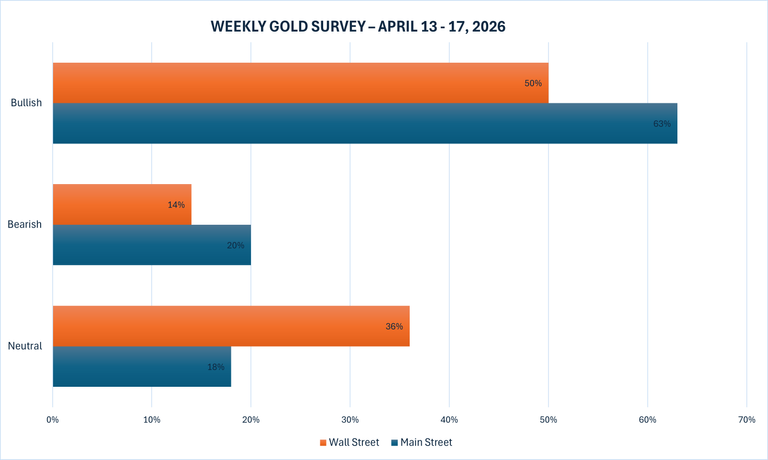
Sentiment improved because the ceasefire reduced immediate panic while gold still held most of its recent gains. According to the latest Kitco News Weekly Gold Survey, both Wall Street and Main Street participants became more willing to reenter the gold market after the ceasefire and gold's three-week gain streak.
That shift in sentiment suggests investors still see underlying support for bullion. In other words, the market no longer appears to be pricing only war risk; it is also pricing inflation concerns, central-bank buying, liquidity risks, and longer-term safe-haven demand.
What Adrian Day says about the gold outlook
Adrian Day, president of Adrian Day Asset Management, remained bullish.
“Up,” said Adrian Day. “Gold is valiantly pushing higher. It will be uneven, but I believe we have seen the post-Iran bombing low, and now that we know that Turkey sold and swapped nearly 120 tons, it is clear to see why gold fell as much as it did.”
Day argued that gold now sits in a favorable setup regardless of whether the truce holds.
“Gold is now in a win-win situation: If the ceasefire holds and an agreement is reached, then the monetary factors return to the fore,” Day said, “while if the conflict resumes, it will deepen and gold’s role as a safe-haven will return.”
His view is relevant for Indian investors because it points to two separate bullish drivers for gold price: geopolitical stress and monetary instability. Either can support domestic gold demand, particularly during periods of inflation anxiety and rupee weakness.
Why are some analysts still cautious on gold in the short term?
Some analysts remain cautious because gold may have entered a broad sideways phase after an extraordinary rally. They do not necessarily reject the long-term bull case, but they see near-term technical resistance and headline-driven volatility.
What Darin Newsom says about technical downside risk
Darin Newsom, senior market analyst at Barchart.com, took a bearish short-term view.
“Down,” said Darin Newsom. “Short-term, the June futures contract looks to be nearing a top, meaning momentum could start to build to the downside. Short-term. I want to emphasize this. But this is from a technical point of view, and technical analysis is about as useful as the US Congress (and judicial branch) these days, meaning it isn’t.”
Even so, Newsom said the broader fundamental support for gold remains intact.
“Fundamentals, which are almost as useless, tell us central banks around the world continue to buy due to the instability intentionally created by - well - you know,” Newsom added. “It’s the same story that’s been in place for a decade. And it won’t be changing any time soon.”
That distinction matters. A short-term pullback in XAUUSD does not necessarily mean the broader bull market in precious metals has ended.
What Rich Checkan says about the path to $5,000
Rich Checkan, president and COO of Asset Strategies International, also stayed constructive on gold.
“Up,” said Rich Checkan. “I still believe the sell-off in gold was overdone. We should continue building now toward $5,000 and above. However, a crack in the fragile truce for the conflict between Iran and the United States/Israel could push gold prices down. Of course, another drain on liquidity in the markets could cause a short-term selloff in gold as well. I am looking for peace and higher gold prices.”
Checkan's call highlights a key risk for Indian investors: even a bullish gold market can suffer short-term liquidation if liquidity tightens globally. In India, that can create sharp intraday volatility in MCX gold and retail bullion rates.
Is gold now stuck in a trading range?
Yes, according to Colin Cieszynski, gold appears to have moved from a strong uptrend into a broad sideways range. That does not mean the rally is over, but it does mean traders face a much noisier environment.
Colin Cieszynski, chief market strategist at SIA Wealth Management, told Kitco News that he does not want exposure in either direction right now.
“Gold to me looks like it's settled into a trading range, and that's to be expected after the massive rally it had,” he said. “It ran from $3,200, $3,300 to $5,300 pretty much nonstop over a six-month period – that was an enormous gain – so you had to expect that at some point, gold was going to have a correction and consolidate.”
Cieszynski said he sees gold trading within a broader $4,400 to $5,200 range.
“We've bounced off the bottom of that and now we're in the middle,” he said. “Because there's still the ongoing war-related uncertainty – day to day, we could still get significant fluctuations in what happens with the war – but at least for the moment, it looks like we've gone from an uptrend into a sideways trend.”
Why is near-term direction so hard to predict?
Near-term direction is hard to predict because the gold price is reacting more to geopolitical messaging than to stable macro trends. In this kind of market, headlines can overpower technical signals and even economic data.
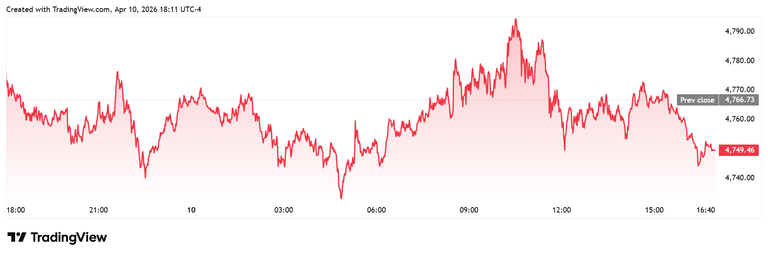
Cieszynski said the current range is wide enough to allow moves of several hundred dollars in either direction, yet still not offer a reliable trend.
“It depends on how the war goes,” he said. “We've seen that this week alone, where you had the day where they announced a ceasefire and boom, gold goes crazy. But prior to that, [Trump] was threatening to burn Iran to the ground, and gold was going down.”
He added:
“We can see that it doesn't even matter right now what people do; it comes down to what they say. And when you're in that kind of an environment, it's really hard to predict.”
For Indian buyers, this means local gold prices may stay volatile even without a clear global trend. If XAUUSD remains range-bound while USD/INR swings, domestic prices can still make sharp moves.
How do inflation and central-bank expectations affect gold now?
Inflation still supports gold, but some analysts think the current high gold price already reflects much of that risk. Gold rallied so strongly that part of the inflation and uncertainty story may already be priced in.
Cieszynski said recent inflation data, including CPI and consumer expectations, may not provide as much fresh upside as investors expect because gold had already surged from around $3,250 to $5,250.
“For starters, we can see that the humongous run that gold already had may have already priced some of that in, higher inflation – not necessarily higher interest rates, but higher inflation expectations and higher uncertainty is one of the reasons why gold went from $3,250 to $5,250 in the first place, so some of this may have already been already being accounted for in the fact that gold was trading up near $5,000 to begin with.”
Still, he warned that inflation remains a macro problem because it limits central banks' room to support slowing economies.
“But overall inflation creeps up and it makes it harder for the central banks to cut interest rates at a time when the economy might be slowing you into stagflation, and it's a problem,” he added. “The last time they had this problem, gold did something like what it’s already done.”
For Indian investors, this is important. If global inflation stays sticky and major central banks, including the Federal Reserve, struggle to cut rates into slowing growth, gold can retain its strategic appeal as a safe-haven asset. At the same time, Indian buyers should watch the Reserve Bank of India, imported inflation, and rupee trends because those factors shape local bullion prices alongside international spot moves.
The key watchpoint now is whether spot gold can break decisively above $4,800 per ounce or slip back toward $4,700 and then the broader $4,400-$5,200 range identified by Cieszynski. For Indian investors, the next move in gold price will likely depend not only on the Iran ceasefire holding, but also on inflation signals, central-bank expectations, and the direction of the rupee against the dollar.