
# Gold Price Slides Below $4,600 After Philly Fed Surprise
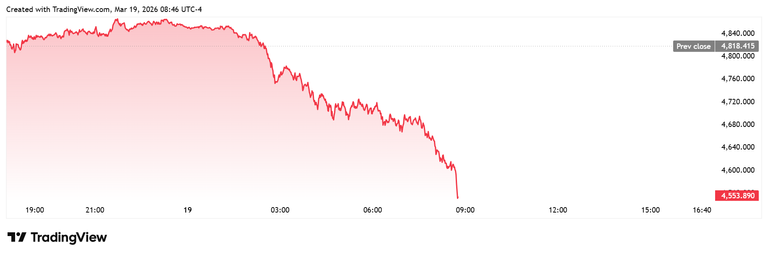
Gold prices fell sharply on Thursday morning after stronger-than-expected U.S. manufacturing data reduced immediate safe-haven demand for bullion. Spot gold dropped below the key $4,600 support level after the Philadelphia Federal Reserve's March Manufacturing Business Outlook Survey came in at 18.1, well above both February's 16.3 reading and the 10.0 consensus forecast.
For Indian investors, the move matters because stronger U.S. economic data can lift the U.S. dollar and Treasury yield expectations, which often pressures international gold price benchmarks such as XAUUSD. That, in turn, can influence domestic bullion rates in rupees, although INR moves can cushion or amplify the global trend.
Why did gold prices fall after the Philly Fed survey?
Gold prices fell because the Philadelphia Federal Reserve's manufacturing survey showed stronger business activity than markets expected. Better U.S. economic data can reduce the urgency for safe-haven buying and make traders reassess the outlook for interest rates, both of which can weigh on gold.
The regional Federal Reserve bank said its March manufacturing business outlook index rose to 18.1 from 16.3 in February. Economists had expected a much softer reading of 10.0, so the data delivered a clear upside surprise.
The report said responses to the March Manufacturing Business Outlook Survey pointed to overall expansion in regional manufacturing activity. It added that current activity, new orders and shipments all stayed positive, while firms continued to report higher prices.
The survey also said its broad forward-looking indicators continued to signal growth over the next six months. That combination of current expansion and future optimism helped trigger the sell-off in gold.
How far did spot gold fall on Thursday morning?
Spot gold dropped below $4,600 immediately after the data release and then sank to its session low within 15 minutes. The speed of the decline showed how sensitive bullion traders were to stronger U.S. macroeconomic signals.
Gold slipped under the $4,600 support level just after the 8:30 am EST release. Fifteen minutes later, spot gold was trading at session lows.
Spot gold last traded at $4,554.98 per troy ounce, down 5.57% on the session. For traders in XAUUSD, that marked a sharp intraday move lower and confirmed a bearish reaction to the report.
For Indian bullion buyers, a fall in international gold prices can lower imported gold costs if the rupee stays stable against the U.S. dollar. However, if the dollar strengthens at the same time, domestic gold price relief in INR may be more limited.
What did the Philadelphia Fed survey show about manufacturing activity?
The Philadelphia Fed survey showed that manufacturing activity in the region remained in expansion mode in March. Several current-condition indicators either stayed positive or improved, reinforcing the view that business momentum held up.
The current new orders index fell by 3 points to 8.6. Even with that decline, the reading remained positive.
The current shipments index jumped 22 points to 22.2, its highest level since January 2025. More than 40% of firms reported increases in shipments, up from 22% last month.
At the same time, 18% of firms reported decreases in shipments, down from 22% in February. Another 42% reported no change, down from 50% last month.
The inventories index edged up 2 points to 1.4. That suggested stock levels also improved modestly.
What did the survey say about jobs and working hours?
Employment conditions were mostly steady, but the numbers improved slightly in March. That supported the broader message that manufacturing activity remained resilient.
The employment index rose 2 points to 0.8. More than 74% of firms reported no change in employment levels, while almost 13% reported increases and 12% reported decreases.
The average workweek index climbed 14 points and returned to positive territory at 2.8. That suggests firms expanded hours worked even if hiring remained broadly stable.
What does the report say about inflation and price pressures?
The report showed that price pressures increased again in March, which is important for gold because persistent inflation can shape Federal Reserve expectations. Gold can benefit from inflation fears over time, but in the short term stronger growth plus sticky prices can also keep rate expectations elevated and pressure bullion.
The prices paid index rose 6 points to 44.7 in March, nearly reversing its decline from the previous month. Nearly 46% of firms reported higher input prices, while 1% reported lower prices and 53% reported no change.
The current prices received index also rose, gaining 5 points to 21.2. More than 21% of firms reported increases in the prices of their own goods, nearly none reported decreases, and 75% reported no change.
For Indian investors, this matters because persistent U.S. inflation pressures can delay hopes for easier monetary policy. If U.S. rates stay higher for longer, gold price rallies can become more volatile even when long-term demand for precious metals remains intact.
What are firms expecting over the next six months?
Businesses still expect growth over the next six months, although some forward indicators were mixed. The overall message from the survey remained constructive for U.S. manufacturing and negative for gold in the immediate aftermath.
The diffusion index for future general activity fell 3 points to 40.0. Even so, more than 56% of firms expected activity to increase over the next six months, compared with 16% expecting a decrease, while 23% expected no change.
The future new orders index declined 5 points to 49.6. In contrast, the future shipments index rose 6 points to 53.6.
The future employment index surged 26 points to 40.4, showing firms continued to expect stronger hiring ahead. The report said companies still anticipated employment gains over the coming six months.
What did companies signal on future prices and spending?
Firms still expect elevated price pressures and higher capital spending. Those forward-looking details reinforce the market view that the U.S. economy is not cooling quickly.
The future prices paid index eased slightly from 54.1 to 53.7. The future prices received index dropped 12 points to 38.4, but both remained above their long-run averages.
The index for future capital expenditures rose 11 points to 25.8. That increase suggested businesses still planned to invest despite ongoing cost pressures.
What does this mean for gold investors in India now?
The main takeaway for Indian investors is that stronger U.S. growth data can trigger fast pullbacks in global gold prices, especially when gold is testing technical support such as $4,600 per ounce. In the near term, traders will watch whether XAUUSD stabilizes above the $4,550 area or extends losses if more U.S. data supports a higher-for-longer rate outlook.
Indian investors should also track the rupee alongside international bullion prices. If global gold remains weak but USD/INR rises, local gold prices may not fall as much as international charts suggest, making currency moves just as important as the next U.S. macro release.