Spot gold fell because stronger-than-expected U.S. economic data, higher Treasury yields, a firmer U.S. dollar and another spike in oil prices reduced near-term support for bullion on Monday. For Indian investors, the move matters because global XAUUSD weakness can weigh on domestic gold rates, although any rupee depreciation against the U.S. dollar can partly cushion the fall in INR terms.
Why did gold price fall on Monday?
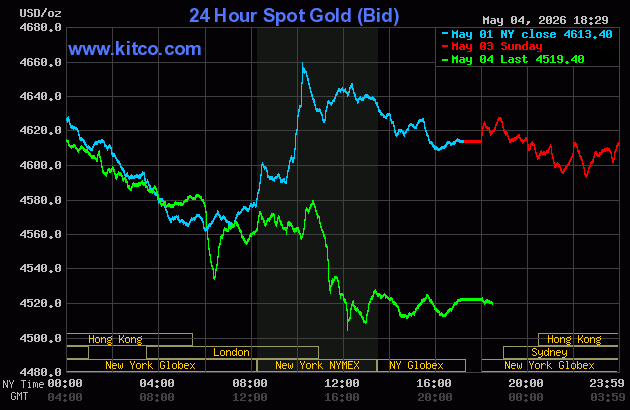
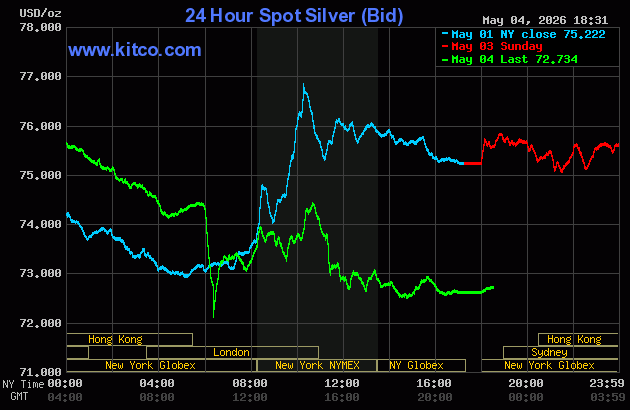
Gold price fell sharply on Monday as markets reacted to firmer U.S. data and tighter financial conditions across yields, the dollar and energy. Despite elevated geopolitical risk, traders sold bullion and silver as macro headwinds outweighed safe-haven demand.At the time of writing, spot gold traded near $4,513.70 per troy ounce, down 2.16% on the session. Spot silver traded at $72.570, down 3.53%.
Kitco’s spot page showed gold’s intraday range at $4,502.40 to $4,630.70. Silver traded in a range of $72.10 to $76.12.
For Indian bullion buyers, a decline in international gold price often translates into softer wholesale and retail prices. However, the final impact in India also depends on the USD/INR exchange rate, import costs and local premiums.
What U.S. economic data pressured gold and silver?
Stronger U.S. manufacturing and factory-order data pressured gold because they reduced the immediate case for Federal Reserve rate-cut repricing. Higher-for-longer interest-rate expectations typically hurt non-yielding assets such as gold.The U.S. Census Bureau said on Monday that March factory orders rose 1.5% to $630.4 billion, after a 0.3% increase in February. The result also beat the 0.5% consensus.
Other details in the report were also firm. Shipments rose 1.4% to $633.9 billion, while inventories rose 0.6% to $956.3 billion.
The manufacturing backdrop had already turned less supportive for bullion after Friday’s ISM release. ISM said April U.S. manufacturing activity expanded for a fourth consecutive month, with the manufacturing PMI at 52.7%.
For gold investors, this data mix matters because stronger growth signals can keep the Federal Reserve cautious on easing. That tends to support real yields and the U.S. dollar, both of which often pressure precious metals.
How did Treasury yields and the U.S. dollar affect bullion?
Treasury yields and the U.S. dollar did most of the damage to gold on Monday. When yields rise and the dollar strengthens, gold becomes less attractive relative to interest-bearing assets and more expensive for non-dollar buyers.The 10-year U.S. Treasury yield traded near 4.44%, up about 6.5 basis points on the day. Its intraday range was 4.377% to 4.467%.
The U.S. dollar index stood at 98.472, up 0.32%. That firmer dollar added another layer of pressure on XAUUSD and silver.
For Indian investors, this relationship is crucial. A stronger dollar can push imported bullion costs higher in rupee terms even when international spot prices fall, especially if the INR weakens at the same time.
Why did oil prices and Middle East tensions fail to support gold?
Oil and geopolitical risk stayed elevated, but they did not lift gold because the inflation impact of higher crude pushed yields up faster than safe-haven demand rose. In this case, the market focused more on inflation and rates than on conflict-driven bullion buying.In the outside markets, Nymex WTI crude oil traded around $104.88 a barrel, while Brent crude was near $113.56 a barrel. Brent rose 5.8% to $114.44 as Middle East fighting flared.
The market again focused on risk around the Strait of Hormuz, which fed inflation concerns and pushed bond yields higher. That dynamic undercut gold even though geopolitical stress usually supports precious metals.
For India, higher oil prices carry an added significance because India is a major energy importer. Costlier crude can worsen inflation pressure and affect the rupee, both of which can shape domestic gold demand and pricing.
What are traders watching next from the Federal Reserve and U.S. data?
Traders are now watching labor-market data and Federal Reserve communication to see whether higher oil prices are only delaying the next easing cycle or cancelling it. That distinction is critical for the near-term gold price outlook.The minutes of the April 28-29 FOMC meeting are due on May 20 at 2 p.m. ET. Markets are also watching the Federal Reserve’s Senior Loan Officer Opinion Survey, scheduled for May 4 at 2 p.m. ET.
Upcoming U.S. labor-market prints will also matter because they could confirm whether the economy remains strong enough to keep yields elevated. If that happens, bullion may struggle to regain momentum in the short term.
Indian investors should track these events closely because Fed policy signals often flow quickly into global gold price, dollar moves and local bullion rates.
What are the key technical levels for gold price now?
Gold remains under near-term pressure, with traders focused on whether spot can hold above immediate support or reclaim resistance. The next move in XAUUSD will likely depend on whether yields cool or extend higher.Gold resistance levels
Spot gold bulls’ next upside price objective is to push prices back above the $4,530 to $4,568 resistance zone. A sustained move above that area would target $4,615 and then $4,630.70.
First resistance is seen at $4,530 and then $4,568.
Gold support levels
Bears’ next near-term downside price objective is a break below $4,502.40. If that level gives way, deeper downside targets come in at $4,485 and then $4,450.First support is seen at $4,502.40 and then $4,485.
For Indian traders in MCX gold and physical bullion, these global spot levels can act as an important directional guide, especially when paired with USD/INR moves.
What are the key technical levels for silver price now?
Silver also weakened sharply, and the market is now watching whether bulls can reclaim the nearby resistance band above $73 or whether bears force a deeper break below session lows.Silver resistance levels
Spot silver bulls’ next upside price objective is to drive prices back above the $73.00 to $73.50 area. A move above that zone would target $75.00 and then $76.12.First resistance is seen at $72.82 and then $73.50.
Silver support levels
The next downside price objective for the bears is a break below $72.10. If silver slips below that level, deeper downside targets are $71.00 and then $70.00.Next support is seen at $72.10 and then $71.00.
The near-term watchpoint for Indian precious-metals investors is clear: if U.S. yields stay near 4.44% or push back toward the intraday high of 4.467%, gold and silver could remain under pressure unless geopolitical stress triggers a stronger safe-haven bid.