Gold price remained pinned near the key $5,000 per troy ounce level on Tuesday, but RJO Futures' Daniel Pavilonis says that support could break if the Iran conflict widens, oil prices keep rising, and U.S. Treasury yields move higher. For Indian investors, that means global bullion weakness could still emerge even when geopolitical risks usually support safe-haven demand.
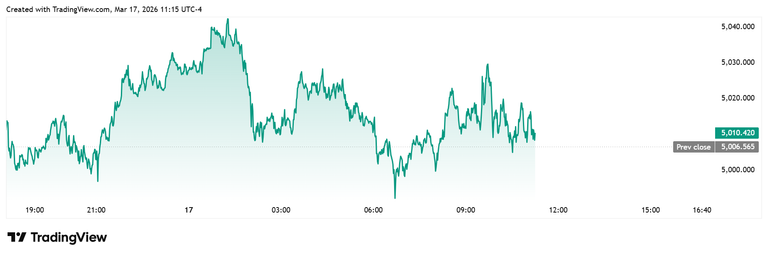
Spot gold was last at $5,010.42 per ounce, up just 0.08% on the session, showing how tightly XAUUSD is trading around the $5,000 support zone.
Why is gold price holding near $5,000 despite the Iran conflict?
Gold price is holding near $5,000 because traders are balancing safe-haven demand against pressure from rising Treasury yields and energy-driven inflation risks. That tug-of-war has kept bullion in a narrowing range instead of triggering a clean breakout.
Daniel Pavilonis, senior commodities broker at RJO Futures, told Kitco News that the market is still trying to understand how long the Iran conflict will last and how far it could spread. The war has now moved into its third week, and that uncertainty is keeping investors cautious across gold, silver, equities, and bonds.
Pavilonis said the market is especially focused on whether the conflict lasts longer than the U.S. administration's six-week estimate. If investors conclude that the war will become broader and more prolonged, he believes that could trigger a significant new leg lower for both equities and precious metals.
For Indian investors, that matters because local gold prices do not respond only to war headlines. They also react to the U.S. dollar, Treasury yields, crude oil, and the rupee, all of which can amplify or offset moves in global bullion.
What could drive gold prices down toward $4,200?
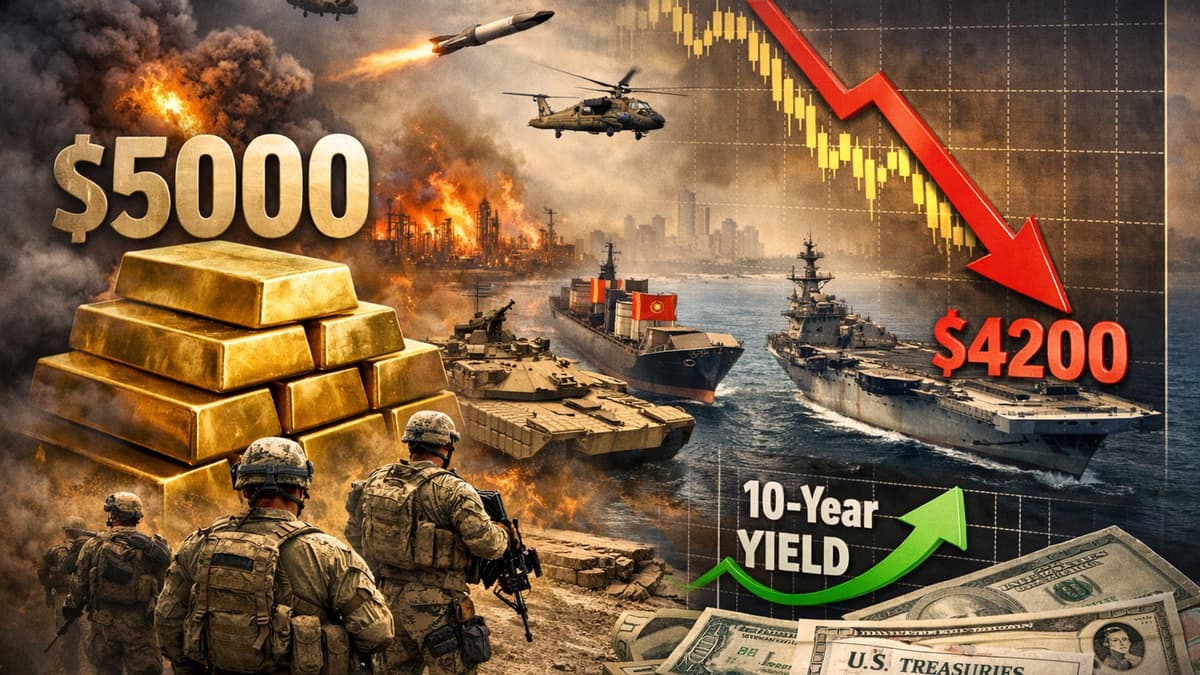
Pavilonis says gold could fall toward $4,200 per ounce if stocks weaken further, oil pushes higher, and Treasury yields keep rising. In his view, gold and silver are not trading purely as safe-haven assets right now; they are following the same macro path as risk assets.
He told Kitco News, "Everything in the metals is tied to energies and focused on the yield curve, especially the 10-year yield. As long as that continues to go up, it's going to put pressure on gold and silver." That means higher yields can outweigh geopolitical buying in bullion.
Pavilonis added that stocks and precious metals could continue to fall together. He said, "Stocks and gold follow the same path, especially silver, and stocks look like they're getting really weak, and they want to make a leg down, similar to what we saw last April."
If that pattern repeats, he expects oil to make new highs or at least move back up to previous highs. Under that scenario, higher energy costs would keep inflation and yields elevated, creating a more hostile backdrop for gold price and silver price.
He summed up the risk clearly: "Things are going to get ugly before they get better. Can we see a scenario where gold goes back down towards $4,200? I think it's possible."
How do oil prices and Treasury yields affect gold and silver now?
Oil and Treasury yields are the main macro transmission channels for gold right now, according to Pavilonis. When oil rises because energy shipments to Europe and Asia are at risk, yields can rise too, and that combination pressures bullion.
Pavilonis said precious metals are moving with equities, while equities are moving inversely to Treasury yields. In practical terms, that means a rising yield environment is hurting both stocks and gold.
He explained the chain this way: if oil and energies rise because movement of energy to Europe and Asia is under threat, rates move higher and metals sell off with them. If rates fall, then gold, silver, and stocks could all move higher together.
But he also warned that any relief could be temporary. As soon as oil starts moving higher again, he said, "you could see everything starts to sell off again."
For Indian readers, this is important because higher crude prices can weaken the rupee and raise imported inflation. A weaker INR can cushion domestic gold prices even if international gold in dollar terms falls, but it can also make physical gold more expensive for Indian buyers.
What is Daniel Pavilonis saying about the Iran conflict and market risk?
Pavilonis says the next few days are critical because they may reveal the true shape and scope of the conflict. He believes market direction will depend on whether the situation escalates militarily or stabilizes through continued oil flows.
He said there is concern that the United States may send more forces to the region, including the possibility of "bringing the Marines to the Middle East" and potentially putting "boots on the ground." That kind of escalation would likely keep markets on edge.
At the same time, he pointed to shipping through the Strait as a possible calming factor. He said there appear to be Indian tankers moving through the straits, with one already having passed, and possibly more to come, along with potential Chinese ships.
If those ships keep moving, Pavilonis said that would mean most of the oil that had already been going through the Straits is still flowing. In that case, he thinks the market could calm down.
That point carries a direct India angle. If Indian tankers continue operating through the route, it could reduce fears of a severe energy supply shock for Asia. That would matter for India's oil import bill, rupee stability, inflation expectations, and ultimately domestic gold price trends.
Why does Pavilonis think Gulf states and U.S. assets matter for gold?
Pavilonis argues that Iran may be trying to pressure neighboring oil states not only through direct attacks on energy infrastructure but also by forcing them to raise liquidity. In his view, that could lead Gulf states to sell U.S. Treasuries, U.S. stocks, and other dollar assets.
He told Kitco News, "I think that's one of Iran's tactics." He then asked why Iran would target Dubai, adding that over 95% of the people living there "are not from Dubai."
His reasoning is that if people leave, Dubai's economy comes under severe pressure, and authorities may have to liquidate foreign assets to shore up security and finances. He said oil-producing countries often place their revenue in U.S. Treasuries, stocks, and gold, and when they need liquidity quickly, they can sell bonds and equities first.
That view matters for gold because forced liquidation can hit precious metals even during periods of geopolitical stress. In a liquidity event, investors often sell what they can, not only what they want to sell.
For Indian investors, this is a reminder that safe-haven demand does not always mean gold rises immediately. During sharp cross-asset stress, bullion can temporarily fall alongside equities before longer-term safe-haven buying returns.
What is the broader geopolitical message for precious metals investors?
Pavilonis says the conflict is exposing deeper strains in U.S. relations with Gulf states, especially around security guarantees. He believes that if the United States cannot provide effective protection, regional states may rethink the value of holding U.S. assets.
He framed the issue bluntly, saying, "It's all about security." He questioned why the United States backs regional kingdoms while presenting itself as a champion of democracy, and he argued that Gulf states may reconsider their asset allocations if they are being attacked despite long-standing ties with Washington.
Pavilonis also highlighted the cost mismatch in modern warfare. He said Iran is "knocking things out with $20,000 drones" while the United States is trying to intercept those threats with $1 million missiles.
That asymmetry, in his view, increases investor anxiety about the durability and cost of security arrangements in the region. If markets begin pricing in a prolonged disruption, precious metals could remain volatile rather than behaving like a straightforward hedge.
What should Indian gold investors watch next?
Indian gold investors should watch four variables next: the duration of the Iran conflict, oil flows through the Strait, the direction of the U.S. 10-year yield, and whether spot gold can hold the $5,000 level. Those signals will likely determine whether bullion stabilizes or starts moving toward Pavilonis' $4,200 downside scenario.
In the near term, a continued rise in oil could keep pressure on Treasury yields and weigh on XAUUSD. But if shipping normalizes, rates ease, and equity markets stabilize, gold and silver could recover alongside other risk assets.
For the Indian market, the global move will still filter through the rupee and import costs. Even so, Tuesday's price action shows the market is at an important inflection point: spot gold was last trading at $5,010.42 per ounce, up just 0.08%, with bulls still defending the $5,000 support area while traders wait for the next geopolitical and macro signal.