# Gold Price Rises as Silver Surges on U.S.-Iran Deal Hopes
Spot gold and spot silver moved higher in early U.S. trading on Thursday as crude oil prices dropped, the U.S. dollar softened, and U.S. Treasury yields eased. For Indian investors, the move matters because global bullion prices, USD/INR trends, and oil prices all feed into domestic gold rates.
Why did gold price rise and silver jump on Thursday?
Gold price rose because traders responded to falling crude oil, a weaker U.S. dollar, and lower Treasury yields as markets priced in progress toward a U.S.-Iran deal. Silver outperformed gold sharply, showing stronger momentum across precious metals.
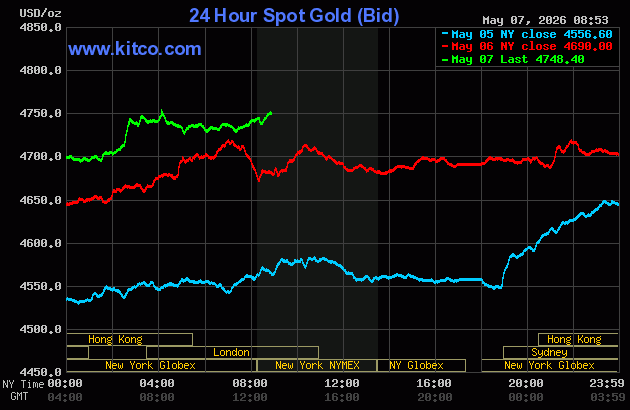
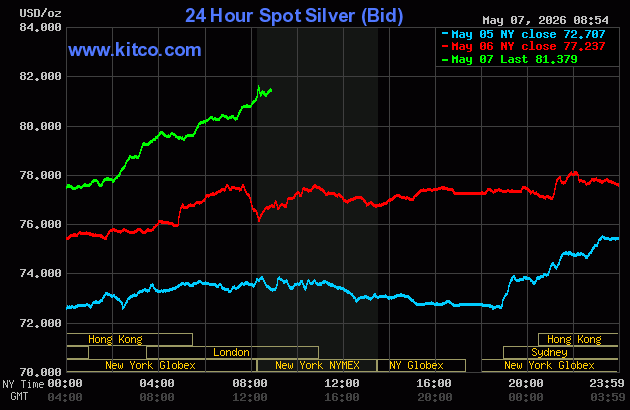
At the time of writing, spot gold traded near $4,744.80 per ounce, up 1.17% on the session. Spot silver traded at $81.150 per ounce, up 5.06%.
The main overnight macro driver was the reversal in crude oil. Markets focused on the possibility that the United States and Iran could reach an agreement that would allow tankers to move crude through the Persian Gulf again and effectively reopen the Strait of Hormuz.
For bullion, that mattered in several ways. Lower oil prices can reduce immediate inflation pressure, while a softer U.S. dollar and lower bond yields tend to improve the appeal of non-yielding assets such as gold and silver.
How did oil, the U.S. dollar and Treasury yields affect XAUUSD?
XAUUSD gained support from a broad easing in outside markets. Crude oil fell sharply, the U.S. dollar index weakened, and the benchmark 10-year U.S. Treasury yield held near the 4.3% area.
Nymex WTI crude oil fell $3.23 to $91.85 a barrel. Brent crude lost $3.30 to $97.97 a barrel. The U.S. dollar index, or DXY, traded near 97.88, down 0.15%.
These moves usually help bullion because gold becomes more attractive when the dollar weakens and real or nominal yields stop rising. A softer dollar can also limit the cost pressure on Indian buyers when converted into rupees, although the final impact on local prices still depends on USD/INR and import duties.
For Indian investors, lower crude is also important beyond bullion. India is a major oil importer, so a sustained fall in oil can improve macro sentiment, influence inflation expectations, and indirectly shape demand for safe-haven assets such as gold.
What U.S. economic data moved precious metals today?
The U.S. data flow was mixed, but it was not hostile to gold or silver. Labor-market and productivity figures suggested resilience in some areas while showing softer demand in others.
Initial jobless claims rose to 200,000 for the week ending May 2, up from 190,000 the prior week. That was still below the 205,000 forecast listed before the release.
First-quarter nonfarm business productivity increased 0.8%. Unit labor costs rose 2.3% at a seasonally adjusted annual rate. Manufacturing productivity rose 3.6%, while manufacturing unit labor costs increased 2.4%.
The labor market remained central ahead of Friday’s nonfarm payrolls report. ADP said private employers added 109,000 jobs in April, the fastest pace since January 2025.
That ADP figure came in below the 118,000 consensus forecast but above March’s 61,000 increase. Annual pay growth was 4.4%.
For gold traders, this mix matters because it keeps Federal Reserve expectations in play. Strong enough employment can limit aggressive rate-cut hopes, but softer patches in demand can still support bullion by capping yields and weakening the dollar.
What were global stock markets and Fed watchers tracking?
Global equities were mostly firmer, while U.S. traders also watched for comments from Federal Reserve officials. The combination signaled a market balancing risk appetite with rate sensitivity.
In Asia, Japan’s Nikkei 225 jumped nearly 6% to 63,086.00 as Tokyo reopened after Golden Week. Hong Kong’s Hang Seng rose 1.7%, South Korea’s Kospi gained 1.4% to another record, and Taiwan’s Taiex advanced 1.9%.
In Europe, markets were mixed at midday. Germany’s DAX was up 0.2%, France’s CAC 40 rose 0.3%, and Britain’s FTSE 100 slipped 0.3%.
Before the U.S. open, S&P 500 futures were up 0.1%, Dow futures rose 0.2%, and Nasdaq futures were essentially unchanged.
U.S. traders were also watching scheduled remarks from Federal Reserve officials later in the day, including Beth Hammack and John Williams. This week’s data reinforced a mixed picture of resilient labor conditions but softer pockets of demand, making Fed communication especially relevant for bullion and broader financial markets.
What are the key gold price levels to watch now?
Spot gold is extending its rebound after this week’s volatility, and the next technical levels are clearly defined. Bulls need a breakout above the immediate resistance zone to open the way for another leg higher.
According to the technical levels cited in the report, gold bulls’ next upside price objective is to push prices above the $4,754.40 to $4,775 resistance zone. A move above that band would open the door to $4,820 to $4,850.
On the downside, bears’ next near-term objective is a break below $4,684.60. If that level fails, deeper downside targets come in at $4,650 and then $4,615.
The first resistance level is seen at $4,754.40, followed by $4,775. The first support level is seen at $4,684.60, followed by $4,650.

For Indian investors, these global XAUUSD levels can influence MCX gold and local jeweller pricing, especially if the rupee remains volatile against the U.S. dollar.
What are the key silver price levels to watch now?
Spot silver showed stronger momentum than gold, and the chart levels now point to a test of higher resistance. If silver breaks through the next ceiling, traders may start targeting the mid-$84 area.
Silver bulls’ next upside price objective is to drive prices above the $81.81 to $82.50 resistance zone. A move above that area would target $84.00.
For bears, the next downside price objective is a break below $73.14. If silver falls through that level, deeper downside targets sit at $72.00 and then $70.90.
The first resistance is seen at $81.81 and then at $82.50. The next support is seen at $73.14 and then at $72.00.
Silver’s stronger percentage gain than gold may also attract Indian investors looking at high-beta precious metals exposure, but volatility in silver remains significantly higher than in gold.
What does this mean for Indian gold investors?
The immediate takeaway for Indian investors is that gold price support currently comes from a weaker U.S. dollar, lower yields, and easing oil prices tied to U.S.-Iran deal hopes. But Friday’s U.S. nonfarm payrolls report and any shift in Federal Reserve messaging could quickly change that setup.
If global gold holds above $4,684.60 and breaks $4,754.40-$4,775, traders will watch for a move toward $4,820-$4,850. Indian investors should also track the rupee, because even when international bullion rises, INR moves can amplify or offset domestic gold price gains.