# Gold Price Rebounds Above $4,630 After U.S. Home Sales Shock
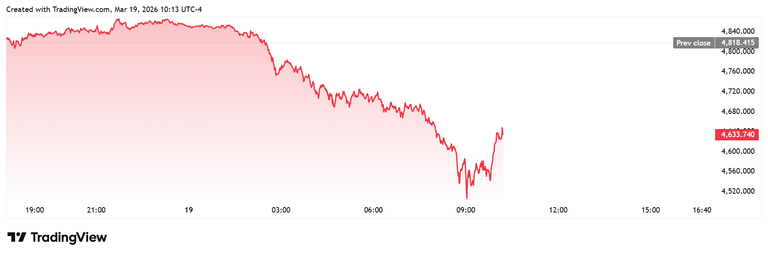
Gold prices bounced from session lows on Thursday morning after weak U.S. housing data raised fresh concerns about economic momentum in the world's largest economy. Spot gold last traded at $4,634.20 per troy ounce, even though it remained down 3.84% on the day.
For Indian investors, the move matters because softer U.S. economic data can support safe-haven demand for bullion and influence the XAUUSD trend, which later feeds into domestic gold rates after adjusting for the rupee, import duties, and local premiums.
Why did gold price rebound above $4,630 today?
Gold price rebounded because U.S. new home sales data came in far weaker than expected, prompting traders to reassess the economic outlook and return to safe-haven assets. The sharp downside surprise helped bullion recover from its intraday lows immediately after the data release at 10 am EDT.
Spot gold rose off earlier session lows and was last seen at $4,634.20 per ounce. Even with that recovery, gold was still down 3.84% on the day, showing that the broader session remained volatile.
The immediate trigger was a major miss in U.S. housing data for January 2026. According to the U.S. Census Bureau and the U.S. Department of Housing and Urban Development, new home sales fell 17.6% in January.
The source headline referenced a 17.9% drop, but the body data released by the agencies showed a 17.6% decline. That was still dramatically worse than the market expectation for just a 0.9% decrease.
What did the U.S. new home sales data show?
The U.S. housing report showed a deep and broad-based slowdown in new home sales in January 2026. The data missed both monthly and annual forecasts by a wide margin.
New home sales fell to a seasonally adjusted annualized rate of 587,000 in January. Economists had expected sales of 720,000 units, so the actual figure came in far below consensus.
December's data also weakened after revisions. New home sales for December were revised down to 712,000 from the previously reported 745,000 units.
On a year-on-year basis, new home sales were down 11.3% from the January 2025 rate of 662,000. That annual decline reinforced the view that higher interest rates continue to pressure the housing sector.
What happened to U.S. home prices and inventory?
Home prices remained elevated even as sales slowed sharply. In January, the median sales price for new homes was $400,500, while the average sales price was $499,500.
Housing supply also remained high relative to demand. At the end of January, inventory stood at 476,000 houses for sale, equal to a 9.7-month supply at the current sales pace.
That combination of falling sales and a sizeable inventory overhang suggests the housing market remains under pressure. For macro traders, that matters because housing is closely tied to consumer spending, credit conditions, and broader economic activity.
How does weak U.S. housing data affect gold and precious metals?
Weak U.S. housing data can support gold because it signals slower economic activity and may strengthen demand for safe-haven assets. When investors see cracks in growth-sensitive sectors like housing, they often reassess interest-rate expectations and rotate into bullion.
Economists watch the U.S. housing market closely because it is a major contributor to economic activity. A sudden drop in housing demand can spill over into construction, lending, household wealth, and consumer confidence.
The housing sector has struggled after the Federal Reserve raised interest rates aggressively at the fastest pace in 40 years. Higher borrowing costs have made mortgages more expensive, which has weighed on affordability and home sales.
For gold, that backdrop matters in two ways. First, weaker growth can lift safe-haven demand for precious metals such as gold. Second, if investors believe softer economic data could eventually influence the Federal Reserve's policy path, that can affect the U.S. dollar, Treasury yields, and the near-term direction of XAUUSD.
What does this mean for Indian gold investors?
For Indian investors, weaker U.S. housing data can indirectly support domestic gold prices if it keeps global bullion prices resilient. Any sustained strength in spot gold can feed into Indian gold rates, although the final move in rupee terms also depends on the USD/INR exchange rate.
If the rupee weakens while international gold holds above $4,630 per troy ounce, local gold prices in India can stay firm or rise faster. If the rupee strengthens, it can partly cushion the effect of higher global bullion prices.
Indian buyers should also note that sharp one-day moves like 3.84% in international spot gold can increase volatility in MCX gold and physical bullion markets. That makes short-term pricing more sensitive to U.S. macro data releases, especially those tied to growth and interest rates.
Why should Indian investors track U.S. housing numbers?
Indian investors should track U.S. housing data because it can shift expectations for the Federal Reserve and broader risk sentiment. Those shifts often ripple through the dollar, bond yields, and gold price discovery in global markets.
Since India is one of the world's largest gold-consuming nations, global price swings eventually affect jewellery demand, investment buying, and hedging decisions. For traders and long-term savers alike, U.S. macro data can be an early signal for short-term volatility in bullion.
What should markets watch next for gold price direction?
Markets should now watch whether more weak U.S. economic data confirms a broader slowdown and keeps safe-haven demand intact. If that happens, gold could find support despite the day's overall decline.
The key near-term watchpoint is whether incoming U.S. data continues to show pressure in interest-rate-sensitive sectors. Traders will also monitor how the Federal Reserve responds to signs that its aggressive tightening cycle is weighing on growth.
For now, the most important signal is clear: after a sharp housing-market miss, gold climbed back above $4,630 per ounce. Indian investors should keep an eye on the next U.S. macro releases, the dollar, and rupee moves to judge whether this rebound in bullion can extend.